Categories

Category: Health Policy

The Independent Purchase Decision Support Test

By ADRIAN GROPPER

It’s a busy time in Washington, DC. June 3 marks the Datapalooza and begins a week of cheering and reflection on the success of federal initiatives designed to improve health while reducing cost. This year, the big claim is “information following patients” – a combination of federal Stage 2 Meaningful Use regulations, federal Health Information Exchange guidelines and federal open pricing data policies. We’re surely beyond 1,000 pages of federal initiatives around health data and the policy fog seems to be getting thicker every day. The Independent Purchase Decision Support Test is my beacon for whether we’re headed in the right direction.

Here’s a quote from the Meaningful Use Implementation Guidelines to Assure Security and Interoperability just released by ONC:

“In effect, HISPs are creating “islands of automation using a common standard.” This will hamper information following patients where they seek care―including across organizational and vendor boundaries―to support care coordination and Meaningful Use Stage 2 requirements.”

How will “information following patients” improve health while reducing cost?

It all depends on where the patient goes to get what. Not surprisingly, federal Accountable Care Organizations and related accountable quality contracts with private payers are exactly about where the patient goes too. The difference between these health reform innovations and the old managed care approach is supposed to be the patient’s ability to choose where to go for a healthcare service. Will Stage 2 and the new federal health information exchange implementation guidelines actually lead to effective patient engagement or is it time to “reboot” the HITECH incentives as some have suggested?

The Independent Purchase Decision Support Test cuts through the techno-jargon and paternalistic framing and goes straight to the heart of the policies that influence the physician-patient decisions to drive health care quality and cost. This the essence of patient engagement and the place where the money in healthcare is actually spent.
Continue reading…

Letting the Data Speak: On Refusing Medicaid Expansion

By FRANK DE LIBERO

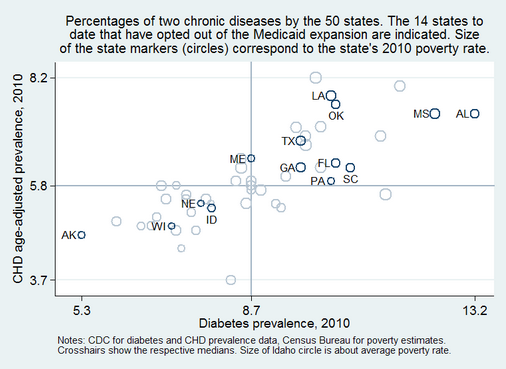
Robert Pear wrote in the Times that the refusal by “states to expand Medicaid will leave millions of poor people ineligible for government-subsidized health insurance…[1]” Indeed, the refusals will do that, as well as worsen what instead should be remedied. In the following I present a graph of two chronic diseases over the 50 states. Those states which have opted out of the Medicaid expansion are identified. Additionally each state’s poverty rate is indicated. The take-away is that populations in greater need are being further disadvantaged. A conjecture is presented as to why.

Please understand that refusal to expand Medicaid is not about state expenditures. Over the ten years, 2013-2022, every state would gain far more than it would spend for expansion [2]. Were all states to opt-in, the total ROI for the states combined would be almost 10,000% ($8 billion state expenditures in return for $800 billion federal).

Empirically health is associated with income, so if you’re poor you’ll likely have worse health. Also it’s well known that chronic conditions are often comorbid, that if you have a chronic disease, you probably have more than one. Additionally, chronic disease is a major contributor to total health care costs. Continue reading…

Rate Shock and Awe in California

By ROBERT LASZEWSKI

I have to say I was surprised with the press reports last week that there wasn’t “rate shock” in California when the California exchange offered preliminary information about their new plans and rates.

At least one prominent health actuarial group had predicted a 30% baseline increase in costs for California’s new health insurance exchange plans under the Affordable Care Act (ObamaCare”).

As the director of the California exchange put it, “These rates are way below the worst-case gloom-and-doom scenarios we have heard.”

But a few days later there is lots more information coming out and it would appear we have a case of apples to oranges to grapefruit. And, we have a pretty good case of rate shock.

First, the exchange officials pointed out that we have to be careful to compare apples to apples when looking at 2013 rates and comparing them to the 2014 exchange rates because the 2014 exchange plans have far more generous benefits.

Yes we do, particularly when the California exchange forces us to give up our apple and buy a more expensive orange.

One of the reasons health insurance in the exchange will cost a lot more in most states is because the new health law outlaws many of the existing plans now being offered and requires only those much richer plans to be sold.

Are people going to get more coverage for their money? Yes. Do they want more coverage if the premium costs for those plans is a lot higher? Likely yes if taxpayers are paying for most of it. If not, clearly they didn’t want to pay for it before. Come January, lots of California consumers in the small group and individual market are going to get a letter from their existing insurer telling them their current plan is no longer available and the cost of the new required plans will be a lot more.

Simply, the new law is taking plan design choices away instead of letting the consumer decide what is good for them. Does that matter in California?

Continue reading…

7. Task a single entity with defining standards for measuring and reporting quality and cost data.

By Berenson, Pronovost & Krumholz

There is a plethora of health care quality data being pushed out to the public, yet no rules to assure the accuracy of what is being presented publicly. The health care industry lacks standards for how valid a quality measure should be before it is used in public reporting or pay-for-performance initiatives, although some standards have been proposed.

The NQF does a good job of reviewing and approving proposed measures presented to it, but lacks the authority to establish definitive quantitative standards that would apply broadly to purveyors of performance measures. However, as discussed earlier, many information brokers publically report provider performance without transparency and without meeting basic validity standards. Indeed, even CMS, which helps support NQF financially, has adopted measures for the Physician Quality Reporting System that have not undergone NQF review and approval. Congress now is considering “SGR repeal,” or sustainable growth rate legislation, that would have CMS work directly with specialty societies to develop measures and measurement standards, presumably without requiring NQF review and approval [30].

Without industry standards, payers, policy makers, and providers often become embroiled in a tug-of-war; with payers and policy-makers asserting that existing measures are good enough, and providers arguing they are not. Most often, neither side has data on how good the contested measures actually are. Most importantly, the public lacks valid information about quality, especially outcomes, and costs.

Indeed, most quality measurement efforts struggle to find measures that are scientifically sound yet feasible to implement with the limited resources available. Unfortunately, too often feasibility trumps sound science. In the absence of valid measures, bias in estimating the quality of care provided will likely increase in proportion to the risks and rewards associated with performance. The result is that the focus of health care organizations may change from improving care to “looking good” to attract business. Further, conscientious efforts to reduce measurement burden have significantly compromised the validity of many quality measures, making some nearly meaningless, or even misleading. Unfortunately, measurement bias often remains invisible because of limited reporting of data collection methods that produce the published results. In short, the measurement of quality in health care is neither standardized nor consistently accurate and reliable.

Continue reading…

6. Invest in the basic science of measurement development and applications.

By Berenson, Pronovost & Krumholz

The unfortunate reality is that there is no body of expertise with responsibility for addressing the science of performance measurement. The National Quality Forum (NQF) comes closest, and while it addresses some scientific issues when deciding whether to endorse a proposed measure, NQF is not mandated to explore broader issues to advance the science of measure development, nor does it have the financial support or structure to do so.

An infrastructure is needed to gain national consensus on: what to measure, how to define the measures, how to collect the data and survey for events, what is the accuracy of EHRs as a source of performance, the cost-effectiveness of various measures, how to reduce the costs of data collection, how to define thresholds for measures regarding their accuracy, and how to prioritize the measures collected (informed by the relative value of the information collected and the costs of data collection).

Despite this broad research agenda, there is little research funding to advance the basic science of performance measurement. Given the anticipated broad use of measures throughout the health system, funding can be a public/private partnership modeled after the Patient-Centered Outcomes Research Institute or a federally-funded initiative, perhaps centered at AHRQ. Given budgetary constraints, finding the funding to support the science of measurement will be a challenge. Yet, the costs of misapplication of measures and incorrect judgments about performance are substantial.

Continue reading…

2. Use quality measures strategically, adopting other quality improvement approaches where measures fall short.

By Berenson, Pronovost & Krumholz

While working to develop a broad set of outcome measures that can be the basis for attaining the goals of public accountability and information for consumer choice, Medicare should ensure that the use of performance measures supports quality improvement efforts to address important deficiencies in how care is provided, not only to Medicare beneficiaries but to all Americans.

CMS’ current focus on reducing preventable rehospitalizations within 30 days of discharge represents a timely, strategic use of performance measurement to address an evident problem where there are demonstrated approaches to achieve successful improvement [6]. Physicians and hospital clinical staff, if not necessarily hospital financial officers, generally have responded quite positively to the challenge of reducing preventable readmissions.

CMS has complemented the statutory mandate to provide financial incentives to hospitals to reduce readmission rates by developing new service codes in the Medicare physician fee schedule that provide payment to community physicians to support their enhanced role in assuring better patient transitions out of the hospital in order to reduce the likelihood of readmission [7]. CMS recently announced that after hovering between 18.5 percent and 19.5 percent for the past five years, the 30-day all-cause readmission rate for Medicare beneficiaries dropped to 17.8 percent in the final quarter of 2012 [8], simplying some early success with efforts to use performance measures as part of a broad quality improvement approach to improve a discrete and important quality and cost problem.

However, this Timely Analysis of Immediate Health Policy Issues 3“CMS’ current value-based purchasing efforts, requiring reporting on a raft of measures of varying usefulness and validity, should be replaced with the kind of strategic approach used in the national effort to reduce bloodstream infections.”approach is not without controversy.

Improvements have been modest, and some suggest that readmission rates are often outside the hospital’s control, so CMS’ new policy unfairly penalizes hospitals that treat patients who are the sickest [9]. And while readmission in surgical patients is largely related to preventable complications, readmissions in medical patients can be related to socioeconomic status. Also, some have questioned the accuracy of CMS’ seemingly straightforward readmission rate measure, finding that some hospitals reduce both admissions and readmissions—a desirable result—yet do not impact the readmission rate calculation [10]. And one of this paper’s authors (R. Berenson) has suggested a very different payment model that would reward hospital improvement rather than absolute performance, thereby addressing the reality that hospitals’ abilities to influence readmission rates do vary by factors outstside of their control [11].

Continue reading…

The Oregon Experiment Revisited

By ASHISH JHA

It has been a couple of weeks since the landmark Oregon Experiment paper came out, and the buzz around it has subsided.  So what now?  First, with passage of time, I think it is worth reflecting on what worked in Oregon.  Second, we should take a step back, and recognize that what Oregon really exposed is that health insurance is a small part of a much bigger story about health in general.  This bigger story is one we can’t continue to ignore.

So let’s talk quickly about what worked in Oregon.  Health insurance, when properly framed as insurance (i.e. protection against high, unpredictable costs) works because it protects people from financial catastrophe.  The notion that Americans go bankrupt because they get cancer is awful and inexcusable, and it should not happen. We are a better, more generous country than that.  We should ensure that everyone has access to insurance that protects against financial catastrophe.  Whether we want the government (i.e. Medicaid, Medicare) or private companies to administer that insurance is a debate worth having.  Insurance works for cars and homes, and the Oregon experiment makes it clear that insurance works in healthcare.  No surprise.

The far more interesting lesson from Oregon is that we should not oversell the value of health insurance to improving people’s health.  While health insurance improves access to healthcare services (modestly), its impact on health is surprisingly and disappointingly small.  There are two reasons why this is the case.  The first is that not having insurance doesn’t actually mean not having any access to healthcare.  We care for the uninsured and provide people life-saving treatments when they need it, irrespective of their ability to pay.  Sure – we then stick them with crazy bills and bankrupt them – but we generally do enough to help them stay alive.  Yes, there’s plenty of evidence that the uninsured forego needed healthcare services and the consequences of being uninsured are not just financial.  They have health consequences as well.  But, claims like 50,000 Americans die each year because of a lack of health insurance? The data from Oregon should make us a little more skeptical about claims like that.

So what really matters?  Right now, we are pouring $2.8 trillion into healthcare services while failing to deliver the basics.  To borrow a well-known phrase, our healthcare system is perfectly designed to produce the outcomes we get – and here’s what we get: mediocre care and lousy outcomes at high prices.  Great.

Continue reading…

Into the Extrapolation Machine

By LES FUNTLEYDER

The Kaiser Family Foundation (KFF) recently released a study that showed that 42% of Americans are unaware that Obamacare (the Affordable Care Act) remains the “law of the land.” News like this seems to us, to act as a Rorschach test on how observers feel about the law. Considering 50% of Americans can’t identify New York on a map we tend not to read too much into these polls. However, according to the logic of extrapolation, since we know that the ACA remains law, we are in the elite 58% (it’s about time we made it into the elite of something).

In almost parallel to the KFF news, the New England Journal of Medicine published a follow-up study of the “Oregon experiment.” For those who haven’t been following closely, the study found that previously uninsured people who were enrolled in Medicaid did not see an improvement in clinical measures when compared to those who remained uninsured. The study did seem to show a reduction in the amount of financial distress for the insured however.

Another contentious study, another Rorschach test (example, example). The problem we see with the polarity of views is that both sides seem to be cranking up the extrapolation machine and use single studies/data points to draw broad conclusions to gin up opinions about ACA’s success or lack thereof. In light of the fact that for most practical matters ACA doesn’t really get going until 2014, use of the extrapolation noise generator approach smacks of a lack of analytical rigor in our view. We will know soon enough how the program is doing… exchanges start enrolling on 10/1.

As investors, we should state upfront that we tend to give more weight to financial returns than what the philosopher-kings might call the political context. So what caught our eye in the Oregon study was that Medicaid recipients had higher healthcare utilization rates (and associated costs) than the uninsured. The connection between gaining insured status and healthcare utilization should not come as a surprise since there is a very extensive literature elucidating this connection.

Continue reading…

The Bounce Back Effect

By Anubhav Kaul, MD and Sindhu Kubenderan

Critically ill Medicare patients, who are battling for stable health at the end of life, are victims of repeated hospitalizations, especially after being discharged to a skilled nursing facility (SNF).  The cycle of hospitalizations is an indicator of poor care coordination and discharge planning – causing the patient to get sicker after every “bounce back” to the hospital.  Total spending for SNF care was approximately $31 billion in 2011; with an estimated one in four patients being re-hospitalized within thirty days of discharge to a SNF.[1]

Each readmission leads to further test and treatments, higher health care costs, and most importantly, patient suffering.  It is hard to imagine that patients would prefer to spend their last few months of life shuttling from one healthcare setting to another and receiving aggressive interventions that have little benefit to their quality and longevity of life.  The heroic potential of medical care should not compromise the patient’s opportunity to die with dignity.   A hospital is not a place to die.

Medicare beneficiaries are eligible to receive post-acute care at SNFs, after a three day hospital admission stay.  SNFs provide skilled services such as post-medical or post-surgical rehabilitation, wound care, intravenous medication and necessities that support basic activities of daily living.  Medicare Part A covers the cost of SNF services for a maximum of 100 days, with a co-payment of $148/day assessed to the patient after the 20th day.  If a patient stops receiving skilled care for more than 30 days, then a new three day hospital stay is required to qualify for the allotted SNF care days that remain on the original 100 day benefit.  However, if the patient stops receiving care for at least 60 days in a row, then the patient is eligible for a new 100 day benefit period after the required three day hospital admission.[1]  It is evident that the eligibility for the Medicare SNF benefit is dependent on hospitalizations – many of which may be a formality and a source of unnecessary costs.

Continue reading…

A Duty to Share Patient Information

By VINCE KURAITIS & LESLIE KELLY HALL

The sharing of patient information in the US is out of whack — we lean far too much toward hoarding information vs. sharing it. While care providers have an explicit duty to protect patient confidentiality and privacy, two things are missing:

  • the explicit recognition of a corollary duty to share patient information with other providers when doing so is the patient’s interests, and
  • a recognition that there is potential tension between the duty to protect patient confidentiality/privacy and the duty to share — with minimal guidance on how to resolve the tension.

In this essay we’ll discuss:

1. A recent recognition in the UK

2. The need for an explicit duty to share patient information in the US

Continue reading…

