Categories

Category: Health Policy

The IRS Scandal: Implications for HIPAA and the Affordable Care Act

By DR. WES

As my head reels at the implications of the IRS scandal mushrooming in Washington, the IRS’s recently disclosed ability to access e-mails without warrant, the intricacy of the NSA PRISM wiretap techniques that includes their ability to acquire tech firms’ digital data, and even the Justice Department’s ability to secretly acquire telephone toll records from the Associated Press, I wonder (as a doctor) what all this means for the privacy protections afforded by the Health Insurance Portability and Accountability Act of 1996 (HIPAA) in our new era of mandated electronic medical records.  Are such privacy protections credible at all?

It doesn’t seem so.

Now it seems everyone’s health data is just as vulnerable to federal review as their Google search data.  This is not a small issue.  We have already seen that discovering “leaks” of personal health information has produced some very handsome rewards for the feds, so it is not beyond reason to think that HIPAA might also be a funding tool for our government health care administration disguised as a beneficent effort to protect the health care data of our populace.

But even more concerning is the role the IRS scandal has for America’s health care system.  After all, the Affordable Care Act is ultimately funded by the IRS by administering some 47 tax provisions.  These include the right to levy a penalty against businesses and individuals who don’t provide or acquire insurance and determining how to distribute annual subsidies to 18 million people who make less than $45,000 a year and thus qualify for subsidies in buying health coverage. In addition, the agency will collect taxes on medical devices and a surtax on people making more than $200,000 a year, as well as conducting compliance audits of tax-exempt hospitals.

Continue reading…

Data Points: CDC Numbers Show Fewer Americans Have Trouble Paying Medical Bills

By TOM FRIEDEN

CDC’s report, Problems Paying Medical Bills: Early Release of Estimates From the National Health Interview Survey, January 2011-June 2012, provides some encouraging news. The data show fewer Americans have trouble paying their medical bills.

Among adults between the ages of 18-64, the percentage of those in families that have problems paying medical bills decreased from 20.9 percent in the first half of 2011, to 19.7 percent in the first half of 2012. The news was also encouraging for teens and children 17 and younger living in families with problems paying medical bills. The percentage of these decreased from 23.7 percent to 21.8 percent for the same period.

While the report provides good news, far too many Americans still find it burdensome to access medical services.

This is why the Affordable Care Act was passed. The law helps Americans with their medical bills in several ways. It requires many insurers to cover certain preventive services at no out of pocket cost to patients. Because of the law, 71 million Americans are receiving expanded coverage of preventive services without co-pays or deductibles — including vaccines, blood pressure and cholesterol tests, mammograms, colonoscopies and screenings for osteoporosis.

The Affordable Care Act has also played a role in helping Americans access the health insurance they need. Since 2010, the law has allowed more than 3.1 million young people to stay on their parents’ health insurance policies until age 26.

Continue reading…

Will the Affordable Care Act’s Health Insurance Exchanges Be Ready On Time? The Obama Administration’s Top Secret Enterprise

By ROBERT LASZEWSKI

Last week, I received my weekly email update from the Maryland health insurance exchange:

Maryland Health Connection completed its Final Detailed Design Review (FDDR) live system demo on Thursday, May 30. The FDDR is a federal stage-gate required of all state-based exchanges. Maryland Health Connection successfully demonstrated end-to-end enrollment of a split family scenario including user log in, eligibility determination, real-time data verification through the Federal Data Services Hub, enrollment into plans, payment and file generation to be sent to an insurance carrier. This major information technology milestone received high marks by federal partners. We will continue with development of Maryland Health Connection over the next several weeks and begin user acceptance testing in July.

This report tells us a few things.

First, the Maryland health insurance exchange is on track to launch on time and ready to serve all comers. I continue to be impressed by how well this state-run health insurance exchange is working toward implementing the Affordable Care Act (“ObamaCare”) on October 1, 2013.

Second, apparently the Federal Data Hub is up and running. While that is what the Obama administration has been telling us, it has been hard to find anyone who has actually seen it or used it.

Third, Maryland has its system ready to exchange eligibility and premium information with the health insurance plans––perhaps the biggest challenge the new exchanges, state or federal, face.

Across the country, I am not so worried that consumers will have a website to go to on October 1 in order to shop for the new health plans as I am concerned with how things will go on January 1, 2014 when patients show up in a doctors office. If we don’t have a clean exchange of eligibility and payment information there are going to be lots of people who will have their doctor or hospital telling them they don’t know anything about their coverage.

Continue reading…

What is the Future State Vision for Health Care Delivery System Transformation?

By JIM HANSEN

“You’ve got to be very careful if you don’t know where you are going because you might not get there.”

– Yogi Berra

“Would you tell me, please, which way I ought to go from here?” said Alice.
“That depends a good deal on where you want to get to,” said the Cat.
“I don’t much care where —” said Alice.
“Then it doesn’t matter which way you go,” said the Cat.
“— so long as I get SOMEWHERE,” Alice added as an explanation.
“Oh, you’re sure to do that,” said the Cat, “if you only walk long enough.”

– Alice’s Adventures in Wonderland

The country is in the midst of an unprecedented transformation of the health care system and may even be at a ‘tipping point’, yet many of us find it astounding that we have no official (or unofficial for that matter) collective vision of where we are headed, thus how the heck do we know if we are on the right path to get there? Given the very high stakes and costs that extend far beyond financial ones, why is it acceptable to not have a future state in mind so that the current state can be quantified and a gap analysis roadmap can be created to address it? Sure, we have the Triple Aim as the overall goal but what are the ‘guardrails’ that help build the road to it?

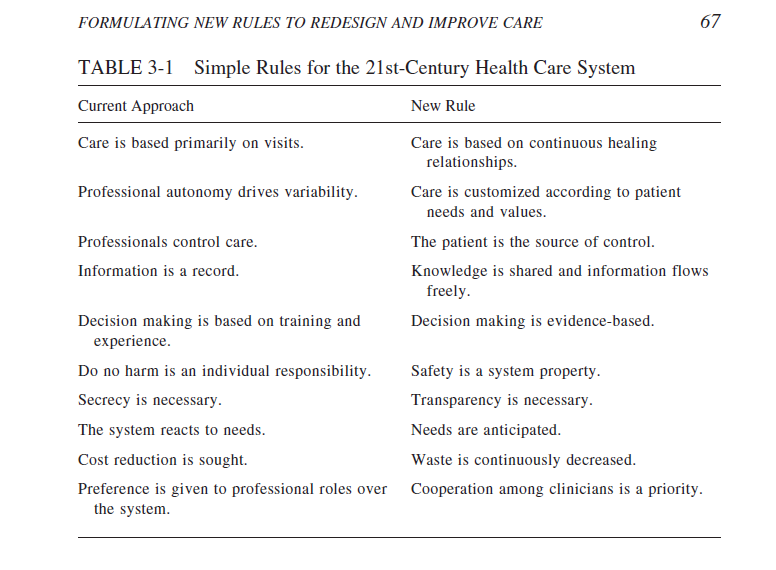
The truly great news is that we actually have those ‘guardrails’, and in fact have had them for over a dozen years. It is just that most people have not been aware of this hidden time-tested gem, created by incredibly thoughtful health system transformation forefathers and foremothers back in 2001. This visionary team has overwhelmingly been praised for creating the powerful and gutsy call to action in their Crossing the Quality Chasm Institute of Medicine (IOM) report. What many have missed is that in addition to all the highly visible work, the group created a set of 10 key new rules to inform a future state for the health care system (see figure 1).

Figure 1 Source: Institute of Medicine, “Crossing the Quality Chasm,” p. 67, 2001.

Twelve years later, the chart in Figure 1 strikes many of us in two powerful ways: 1) How the ‘New Rule’ column has stood the test of time for the vast majority of its intended direction and spirit, and 2) how sad and disappointing that many of the 2001 ‘Current Approach’ column items are still entrenched even today.

Continue reading…

When Retiree Benefits and Obamacare Collide

By DAVID M. WALKER

Oct. 1, 2013 is a focus of increasing anxiety in this country. That’s the date when enrollments begin for the federally run health insurance exchanges, created under the Affordable Care Act (ACA). No one really knows what to expect, but it could be far worse than advertised —and for a reason that has more to do with the federal deficit than health care.

What’s anticipated is unsettling enough. President Obama speaks of inevitable “glitches and bumps” in the implementation. Senate Finance Committee Chairman Max Baucus (D-Mont.) sees the possibility of “a huge train wreck” if the public isn’t adequately educated and prepared. Supporters of the ACA, especially Democrats in the Congress, are nervous about taking the blame if the exchanges don’t unfold as intended.

All these worries are legitimate. The American people, already burdened by a numbingly complex, inefficient and inequitable tax system, now wonder if an increasingly government-run health care system will follow suit. Many are concerned that some employers will dump their current health care plans and pay the relatively modest fine. There’s also worry that young people will opt out of the exchanges (preferring to pay the small penalty), leaving the exchanges with a disproportionately older and sicker pool. Then there’s the very real uncertainty surrounding the ACA’s ultimate cost — illustrated by the impact of Medicare alone, which the Office of the Chief Actuary of Medicare estimates could cost cost $10 trillion more than claimed.

Amid all these concerns and speculations, almost no attention is being paid to the opportunity that the ACA’s insurance exchanges could represent for state and local governments’ retiree health care programs. It’s time to think about it because the consequences could be far-reaching.

States in a deep hole

We already know that many state and local governments are in a financial hole that keeps getting deeper. A newly released report by the U.S. Government Accountability Office (GAO) makes clear that, absent significant reforms, the fiscal picture for most state and local governments will steadily worsen through 2060. A main cause, in addition to Medicaid, is the cost of health care for state and local government retirees. These largely unfunded obligations are similar to the pressures on the federal government to fulfill its unrealistic Medicare promises.

Continue reading…

Knocking the Palooza Out of the Data

By JONATHAN BUSH

Just back from the Health Datapalooza confab that took place last week – an event now in its 4th year hosted by the federal government. I had a few lingering thoughts to share. First, on the event name: I’m guessing it came out of my old business partner and current national CTO Todd Park’s experience in Washington, where trying to get any single distinct thought through “the interests” could knock the “palooza” out of a grown stallion.

You’d think the federal government would be the last ones to host a Datapalooza, but the fact is NO ONE ELSE has stepped up!

So they did.

And complain as I might about the G-men and G-women being industry conference conveners (makes me want to bathe with a wire brush) they pulled it off pretty darn well. The Department of Health & Human Services (HHS) attracted hundreds of serious entrepreneurs… and hundreds more wannabes (who real entrepreneurs desperately need in order to feel cool).

And boy were there some great bloopers…

Kaiser came blistering onto the scene with an open API—to the location and hours of operation of its facilities! Kinda sounds like Yelp to me…I’d be surprised if developers will come a runnin’ to that one. Kaiser’s CIO (a very cool guy whom they or anyone in health care would be lucky to get) broke this news in a two-minute keynote speech. Imagine President Obama announcing, in a State of the Union address, that the green vegetables in the White House cafeteria were now much crunchier!

HHS Secretary Kathleen Sebelius applied similarly excessive fanfare announcing the release of cost data for 30 ambulatory procedures. The whole idea that Toddy (Park) was trying to get going with this Palooza was not to release REPORTS on things but to release the SOURCE data so that anyone with proper security and privacy clearance could INVENT a million reports that no one had ever conceived before!

So here are my thoughts on all of this, some of which I shared at the conference in my way-longer-than-two-minute keynote:

1. Release the data!! Secretary Sebelius announcing the release of cost data for 30 ambulatory procedures during her keynote felt like the Secretary of Energy serving up a can of 10W30 to oil companies to drill into.

Her words were great. To wit: “The fact that this [unlocking the data] is growing by leaps and bounds is a good indication that we can leapfrog over years and decades of inaction into an exciting new future.” YES! GO GIRRRL!  OK, so…where’s the data?

Continue reading…

Physicians Face Unexpected Obamacare Loophole

By MATTHEW WAYT

Doctors who contract with state health insurance exchanges next year might find themselves on the hook for treatment costs resulting from what many are calling a loophole in the Affordable Care Act.

Some say the provision might prompt doctors to avoid the exchanges altogether, while other experts say few health care providers are aware of the issue and likely won’t know about the loophole until it’s too late.

Provision Permits Care Without Coverage

Under the ACA, if families who obtain subsidized health plan coverage through the exchanges fail to pay their premiums, they have a three-month grace period before the policy is cancelled. However, insurers are responsible only for paying claims during the first month of that grace period.

During the other two months, families are asked to pay their doctor’s bill or their insurance premium if they seek health care services. However, if they do not pay either bill, physicians are left to cover the cost of the treatment.

Such families would face a tax penalty for missing payments, but they would not receive a fine, a premium rate increase or a repayment order. They also would not be barred from purchasing another subsidized plan during the next enrollment period.

A ‘Laudable’ Design With Flaws

“I believe this part of the law was designed for logical and laudable reasons,” Lisa Folberg — vice president of medical and regulatory policy at the California Medical Association — said.

She explained that the three-month grace period was meant to ensure continuity of care for low-income families who might be between jobs and cannot afford to pay their premiums for a few weeks.

Continue reading…

Why Is Obamacare So Unpopular?

By JASON SHAFRIN

Views on the Affordable Care Act (a.k.a. Obamacare, a.k.a. Health Reform) are mixed. Despite the fact that many people support individual provisions, overall, the measure is unpopular. Why would that be the case?

A revealing Health Affairs interview with Cythnia Morgan, may reveal the answer. Morgan is a fifty-eight-year-old former hotel manager, has been out of work and uninsured for the past three years. Her income is low, but not low enough to quality for Medicaid. She is exactly the type of person the health insurance exchange is supposed to help. So why wouldn’t like someone like her support the Exchanges?

After being told of how the ACA’s health insurance exchanges would work, she stated:

“Oh, God, that would be great—if there’s going to be a plan that’s affordable. But come on now, it’s really hard to believe.”

A Democrat would read this and claim that Mrs. Morgan is ignorant of the provisions and yes, in fact, this is exactly what the ACA will do. Republicans will say that Mrs. Morgan is 100 percent correct. Although the provisions do promise affordable care, she is correct to be skeptical that government can deliver on this promise when private industry could not.

Continue reading…

Datapalooza Report on Data Economics and a Call for Reciprocity

By ADRIAN GROPPER

Uwe Reinhardt said it perfectly in a Tuesday plenary but I can only paraphrase his point: “health information is a public good that brings more wealth the more people use it.” Or, as Doc Searls puts it: personal data is worth more the more it is used. Datapalooza is certainly the largest meeting of the year focused on health data, and our Health and Human Services data liberation army was in full regalia. My assessment is: so far, so good but, as always, each data liberation maneuver also reveals the next fortified position just ahead. This post will highlight reciprocity as a new challenge to the data economy.

The economic value of health data is immense. Without our data it’s simply impossible to independently measure quality, get independent second opinions or control family health expenses. The US is wasting $750 Billion per year on health care which boils down to $3,000 per year that each man, woman and child is flushing down the drain.

Data liberation is a battle in the cloud and on the ground. In the cloud, we have waves of data releases from massive federal data arsenals. These are the essential roadmap or graph to guide our health policy decisions. I will say no more about this because I expect Fred Trotter (who is doing an amazing job of leading in this space) will cover the anonymous and statistical aspects of the data economy. Data in the cloud provides the basis for clinical decision support.
Continue reading…

Health Care Like It’s 1972?

By BRUCE CHERNOF

Growing older with health care and support needs is a “people” issue; not a partisan one.

As the entitlement debate rages on and the health care system evolves, the bottom line remains that there needs to be more affordable and accessible options for all people who need long-term care. This is the kind of care that we are all likely to need at some point in our lives as we age; it will range in scope from everyday assistance such as getting groceries, to more comprehensive help in the form of assisted living or nursing home care. Those few who are fortunate enough not to face these kinds of needs personally are likely to need to care for a loved one at some point in their lives, such as a parent, grandparent, or spouse. As a country, we seem blind to these realities, even as the short window that we have to make a meaningful difference for the emerging older population is closing rapidly.

The fact is that roughly 70 percent of Americans over the age of 65 will need some form of long-term care, on average for three years. Yet most people, when asked, think they will never need this kind of care.

To make matters even worse, many individuals mistakenly believe that Medicare will pay for long-term services and supports even (it does not). The result is a public that is woefully underprepared and ill-equipped to prepare for what are probably inevitable health needs.

This gap in knowledge and awareness has contributed to our current “non-system” of financing long-term care, in which people are left to fend for themselves to pay for services or spend down to near poverty levels to qualify for Medicaid; for only then is public help available. This is neither a sustainable nor a dignified policy. We need to develop a better model that will ensure that all Americans can age with dignity, choice, and independence. But what would that look like?

As a physician, I believe we have perfected the health care delivery model for 1972 that focuses on acute care, and is not necessarily designed to meet the needs of individuals living for an extended period of time with multiple chronic conditions. What we need today and into the future is an updated toolbox for financing long-term care that serves the needs of a 2013 population. In 1965, the average life expectancy was 69 years old. If an older person experienced a major health event—a heart attack or stroke, for example—they might have recovered, but they probably did not live much longer beyond that event. Today, with advances in medicine and technology and the increased number of intensive care units and critical care units, people are living longer than ever before, but with functional impairments and multiple chronic conditions. The delivery model we have today is not designed to meet these growing care needs, and the financial strains on individuals and families are significant.

Continue reading…