Categories

Category: Health Policy

Value-Based Reform

By JACK COCHRAN & CHARLES KENNEY

Cochran THCBThe U.S. Department of Health and Human Services’ recent announcement to move the Medicare program toward value-based payments is among the most promising recent developments in health care.

While changing the way we pay for care will not be easy, we believe that shifting away from fee-for-service to value-based payments could be a catalyst to a better, more affordable health care system in our country.

Three Benefits of Paying for Quality
There are numerous potential benefits to paying for quality rather than quantity, including the three we want to focus on today.

  1. We believe this payment shift has the potential to accelerate progress toward achieving the Triple Aim – defined as better individual care, better population care, and lower cost.
  2. We believe the payment shift by Medicare will accelerate the transition to value-based payments among commercial insurers – a major benefit to employers in terms of improved health for employees and greater affordability.
  3. We believe value-based payments have the potential to help slow – and possibly reverse – the epidemic of physician burnout in the United States, particularly among primary care doctors.Continue reading…
King v Burwell: Three Scenarios

By ROGER COLLIER

SCOTUS ROBERTS

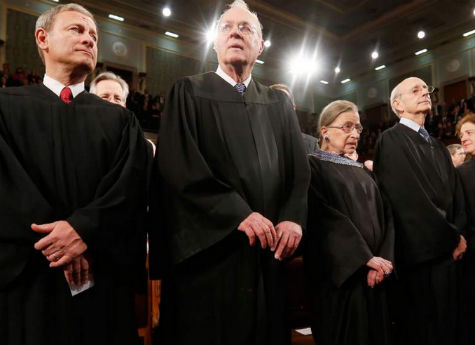
By now, every reader of THCB must be aware the Supreme Court is hearing arguments this week in a case that could undermine much of Obamacare. Simplifying somewhat, the plaintiffs in King versus Burwell argue that the phrase “exchange established by the state” in the Affordable Care Act’s section 1311 dealing with tax subsidies precludes making such subsidies available to those who enroll through the federal exchange(s).  The government argues (a) that other sections of the law make it apparent that all exchange enrollees are potentially eligible for subsidies, and (b) that language in section 1321 providing that HHS shall “establish and operate such exchange within the state,” where a state is unable or unwilling to create their own exchange, essentially establishes a state exchange.

As many media articles have commented, the implications of a SCOTUS ruling for the plaintiffs are huge. Some five to eight million enrollees in the 34 federal exchange states would lose their subsidies, making insurance unaffordable for many of them, and premiums in these states would skyrocket—all while leaving the existing tax fines for being uninsured in place.

Continue reading…

Shared Responsibility in the Affordable Care Act

By DRANOVE and GARTHWAITE

Craig GarthwaiteRecently we wrote that it was well past time to end the employer mandate in the Affordable Care Act.  In light of some commentary, we thought it best to revisit this issue in more detail.  It seems that most of the support for the employer mandate comes from a misguided understanding of why employers are currently the primary source of private health insurance.  It is explicitly not because of a sense of “responsibility” to the employee, at least not any more responsibility than they feel when they pay employee wages for their work.

Here is a basic summary of how labor markets work, based on decades of very widely accepted academic research and practical experience. Employees receive compensation from their employers in return for their work product.  In other words, employers aren’t running charities for their workers, but neither are workers volunteering their time at firms.  Each expects something from the other. Some employee compensation comes in the form of cash wages and some in the form of fringe benefits such as health insurance, pensions, free coffee, parking, etc.Continue reading…

A Master Class In Health Policy with Kavita Patel

By MATTHEW HOLT

flying cadeuciiThe HxRefactored Conference kicks off April 1st in Boston and we are excited to have Kavita Patel giving a Master Class in U.S. Health Policy.” Kavita is a Managing Director at The Brookings Institution in Washington, DC and has a long history working in health reform for both Ted Kennedy and at the Obama White House.  I interviewed Kavita to talk health care reform impact, insight, technology and and timing.

Matthew Holt: What are the most important changes that you are currently seeing due to Health Care Reform as well as in the health care system as a whole?

Kavita Patel:I would say the most important change is everybody is now intensely focused on transforming every aspect of health care, not only the consumer experience or people who are not already inside the health care system, but also for patients and then for their family members–whether it’s an insurance company that had massive numbers of enrollees, as a result of the Affordable Care Act and the last wave of 11 million people who signed up, or if it’s the one person’s primary care physician who is now looking at whether or not he or she should be part of the patient centered medical home, because he or she is kind of thinking through what the future of medicine will look like, as well as patients and consumers.Continue reading…

Weight Loss Fines Are Discriminatory and Counterproductive

Vik KhannaAl Lewis

By LEWIS, KHANNA and ROBISON

One year ago in these pages, Harvard Medical School’s Stephen Soumerai wrote a scathing essay arguing that employer fines on overweight employees were ineffective.  We’re here to tell you that Professor Soumerai is a cockeyed optimist.  A new review in the American Journal of Managed Care shows that these fines transcend ineffectiveness.  They are counterproductive.

To begin with, forced corporate weight loss programs don’t work.  Of roughly 1000 wellness vendors promising weight loss, only one, the iDiet, has received validation.  Literally no other corporate weight loss program can check three simple boxes that are standard in medical research:

  1. The study was controlled the way grownups would define “controlled,” not using unmotivated non-participants as a control for motivated participants, which Health Fitness Corporation  inadvertently invalidated
  2. the program was sustained for 18 months, rather than eight weeks, which seems to be the new standard for get-thin-quick programs; and
  3. The results showed both high persistence and significant weight loss.

Even that study had significant limitations: One could argue that the sample was small and even 18 months was not a long enough period to determine if weight maintenance was likely to be permanent.

Continue reading…

What Do Women Know About Obamacare That Men Don’t?

By SUSAN DENTZER

Susan DentzerFor the second year running, more women than men have signed up for coverage in health insurance marketplaces during open enrollment under the Affordable Care Act. According to the Department of Health and Human Services, enrollment ran 56 percent female, 44 percent male, during last year’s open enrollment season; preliminary data from this year shows enrollment at 55 percent female, 45 percent male – a 10 percentage point difference.

What gives? An HHS spokeswoman says the department can’t explain most of the differential. Females make up about 51 percent of the U.S. population, but there is no real evidence that, prior to ACA implementation, they were disproportionately more likely to be uninsured than men – and in fact, some evidence indicates that they were less likely to be uninsured than males .

What is clear that many women were highly motivated to obtain coverage under the health reform law – most likely because they want it, and need it.

It’s widely accepted that women tend to be highly concerned about health and health care; they use more of it than men, in part due to reproductive services, and make 80 percent of health care decisions for their families . The early evidence also suggests that women who obtained coverage during open enrollment season last year actively used it.  Continue reading…

Reality-Based Policy and the Digital Doctor: An Interview with Mark Smith

By ROBERT WACHTER

Mark Smith

Mark Smith, MD, MBA, was the founding CEO of the California HealthCare Foundation; he served in that role for 17 years before stepping down last year. I’ve known Mark since we were residents together at UCSF in the mid-1980s, and both of us were influenced by training at the epicenter of the AIDS epidemic. Mark continues to see AIDS patients at San Francisco General Hospital one day each week. He was the lead author of Best Care at Lower Cost, a major Institute of Medicine report, published in 2012. Mark is one of those rare people who can take complex and politically charged concepts and distill them into sensible nuggets – while managing to be hilarious and profound at the same time.

In the continuing series of interviews I conducted for my upcoming book, The Digital Doctor: Hope, Hype, and Harm at the Dawn of Medicine’s Computer Age, here are excerpts of my interview with Mark Smith, conducted on July 24, 2014.

Bob Wachter: Put yourself back about 10 or 15 years ago when you were thinking about the promise of healthcare IT. As you’ve watched the last 15 years play out, what’s been surprising to you?

Mark Smith: As with most of life, it’s a lot harder in fact than in theory. My first hint of this came with the implementation of computerized order entry at Cedars-Sinai in 2002. [In a story I tell in the book, Cedars’ physicians all but threatened to go on strike after they turned on the clunky system. Within a month, they pulled the plug on the system, a hiccup that cost the organization $34 million in 2002 dollars.] That was my first window into the gap between what sounds lovely in a policy paper, and what it means in practice to implement this stuff.Continue reading…

Healthcare’s Reform Pareto Trap

By SAURABH JHA

Screen Shot 2015-02-16 at 10.25.45 AM

It is reassuring that in a country which produced HL Mencken, Homer Simpson and Mark Twain, reports of death of satire have been grossly exaggerated.

Recently, the faculty at Harvard were up in arms because their new health plan involves copayments and deductibles. With ninety cents to the dollar covered, the plan is generous by national standards, and would be rated “platinum” in Obamacare’s exchanges. It’s not as if the professors were placed on Medicaid to show solidarity with the poor.

Increased out-of-pocket contribution is the trend post health care reform. That same reform which many Harvard professors supported and some designed. This is why their revolt, an Orwellian political satire, has spread schadenfreude amongst conservatives who are enjoying Gore Vidal’s favorite words in the English Language: “I told you so.”Continue reading…

Please Choose One

By PHILIP ALLEN GREEN

flying cadeuciiPlease choose one:

The three words blink in front of me on the computer screen.

Please choose one:
Patient is-

☐Male     ☐Female 

I click FEMALE.

I watch as the auto-template feature fills in the paragraph for me based on my choices.

Patient #879302045

Patient is: 38-year-old female status post motor vehicle accident. Please acknowledge you have reviewed her allergies, medications, and past medical history.

I click YES.

Have you counseled her about smoking cessation?

I click NO.

A little animated icon of a doctor pops up on the screen. His mouth begins to move as if speaking. A speech bubble from a comic strip appears next to it.

“Tip of the day: smoking cessation is important for both the patient’s health and part of a complete billing record.”

Continue reading…