Categories

Category: Health Policy

Something Not So Terrific

MARGALIT GUR-ARIE

By MARGALIT GUR-ARIE

The brand new President Barack Obama, whether wittingly or not, invested his entire political capital in reforming health care in America. He gambled and he lost, not because he had nefarious intentions, but because he left the gory details to a corrupt Congress and a shady cadre of lying and conniving technocrats, ending up with something vastly different from what he campaigned on. From everything I’m reading now, Mr. Trump is about to walk in Mr. Obama’s footsteps, and if he does, the results will be unsurprisingly identical.

On the campaign trail, Mr. Trump repeatedly stated that Bernie Sanders forfeited his place in history when he “made a deal with the devil” and embraced the corrupt Democratic Party establishment that fought his candidacy in most abject fashion. Guess what? Mr. Trump seems to be making the same deal with the red version of the same devil. Mr. Trump’s cabinet choices indicate that he is now embracing the ultra-conservative factions of the Republican Party, the same people who actively or passive-aggressively opposed his candidacy. Nowhere is this peculiar and completely unnecessary capitulation more evident than in the beleaguered health care sector.Continue reading…

The Price Is Basically Right

Niran S. Al-Agba

By NIRAN AL-AGBA

screen-shot-2016-12-01-at-12-19-09-pm

Recently, President-Elect Trump selected Rep. Tom Price, MD to lead the Department of Health and Human Services.  Suffice it to say, this signals Mr. Trumps’ resolve and commitment to definitively repealing and replacing.  Dr. Price has already sunk his teeth into health care reform, having proposed alternative healthcare solutions in every Congressional session since 2009.  As a physician myself, I am delighted at the prospect of having another doctor at the helm of HHS. The last physician to lead HHS was Louis Sullivan, MD as part of the administration of George H.W. Bush.  Having a physician, who can understand the needs of physicians and patients, representing both in health policy decision making at the federal level gives everyone the best chance for meaningful and successful health care reform. 

Dr. Price is a third generation physician and a retired orthopedic surgeon with experience in clinical practice and academia before being elected to the U.S. House of Representatives.  At his core, he has been a fierce critic of Obamacare.  Dr. Prices’ most frequent objection to the ACA is the fact it hinders the ability of patients and physicians to be in control of medical decision making and puts the government squarely between doctors and patients.  Amen! He understands the subtle distinction that while expanding coverage may provide insurance, it is in no way akin to delivering patients unfettered access to health care. Continue reading…

Science in the Age of Trump

By DAVID SHAYWITZ

screen-shot-2016-11-30-at-6-12-34-pm

As Donald Trump seeks to build his administration, he will likely struggle with creating a science infrastructure, given his estrangement from the nation’s scientific community.

The distance between Trump and scientists seems to reflect mutual disdain. Trump famously trusts his gut over more data-driven methods. Trump’s success, against most expectations, can be read as a triumph of instinct over science, or at least to reveal the perils of data-driven overconfidence. Trump’s apparent intention to appoint a climate-change skeptic to lead the environmental protection agency suggests to many a disregard for the vast weight of scientific data here, while his comments about vaccinations during one of the Republican debates were charitably described by Steven Salzberg as “wildly inaccurate” and “thoroughly discredited.”

For their part, most scientists take a very dim view of Trump: Science prides itself on being inclusive, international, objective and collaborative–not generally the first adjectives used to describe Trump. (Whether science in practice lives up to these ideals is another question.) Add to this Trump-specific distaste the left-leaning bias of universities (well documented by centrist academics like Jon Haidt, among others–see here and references therein), and the result is a community that seems solidly united against the President-elect. (That said, I’d note that I’ve met more than a few political independents within academia who chafe at current norms.)

Continue reading…

One Regulation Could Eliminate a Dozen Others

ADRIAN GROPPER

By ADRIAN GROPPER

President-Elect Trump recently announced: “for every one new regulation, two old regulations must be eliminated.” Regulatory capture, the topic of a recent THCB post by Nortin Hadler, has enabled many regulations based on HITECH that restrict competition by allowing information blocking. Many other regulations around quality measures, documentation, decision support, contract transparency, and kickback safe harbors are now needed to counteract EHR vendor consolidation through regulatory capture.

One regulation designed to establish a patient-controlled interface (a patient-controlled API) to health records will enable competition for all aspects of the institutional EHR by decentralizing access to the patient information. The impact on health reform, ACA reform, and medical research would be immense.

Continue reading…

Why Trump Won? A Brief Tutorial for Harvard Medical Students

By ANISH KOKA, MD

Mike Milligan, a Harvard medical student, recently wrote in THCB about the shock felt throughout his medical school upon the election of Donald Trump.  Seeking to understand how it may be that ‘equality, service and compassion’ were defeated, Mike settles on the narrative that appears to have taken hold of the elites on the left – Trump did not really win, Hilary lost.  While he does not say so in explicit terms, clearly we are to understand that the recent election was lost, and that in order to assure a better outcome the next election, physicians should urge their patients, and particularly their ‘poorer and less educated patients’ to register to vote.   Hopefully, these voters can then ensure that access to ‘affordable, high-quality medical care’ through constructs like Obamacare and MACRA are nevermore placed in jeopardy.

What complete hogwash.

Let me start with the factually incorrect parts.

Mike writes that ‘Mr. Trump received fewer votes in victory than the previous two republican nominees garnered in defeat.’  As of today Donald Trump has received 62.2 million votes out of a total of 126.6 million votes cast.  Mitt Romney received 60.9 million votes out of a total of 126.8 million votes, and John Mccain received 59.9 million votes out of a total of 129.4 million votes cast.  So despite the fact that his opponent raised and spent close to 1 billion dollars on ads promising the literal apocalypse if Trump was elected, no republican candidate in history garnered more popular votes than Donald Trump.  While it is true that nearly half of all Americans did not cast a ballot in this election, 3 million more votes were cast in 2016 than were cast in 2012.  The percentage of eligible voters casting their vote in 2012 was 55%.  The percentage of voters casting their vote in 2016?  Also 55%.  I realize the desire to deligitimize Trump by arguing this was a low turnout election that delivers no mandate is a very strong one among the millions on the losing side.  Unfortunately, wishes and reality sometimes find themselves in conflict.Continue reading…

The Uncertainty Bomb

By PAUL KECKLEY

screen-shot-2016-11-27-at-7-53-28-am

I like certainty and routine. I like my daily Tall Dark Roast with no room for cream at 5 am at Starbucks. I like the same restaurants, the same suits and ties and the same TV shows. Holidays throw me off and I get bored quickly when I have down time.

For six years, the healthcare industry in the U.S. has been adjusting to its new normal based on the regulatory framework of the Affordable Care Act (ACA). It became routine to discuss the volume to value, accountable care organizations, bundled payments, Medicaid expansion and Healthcare.gov. We were certain they’d be around for years to come.

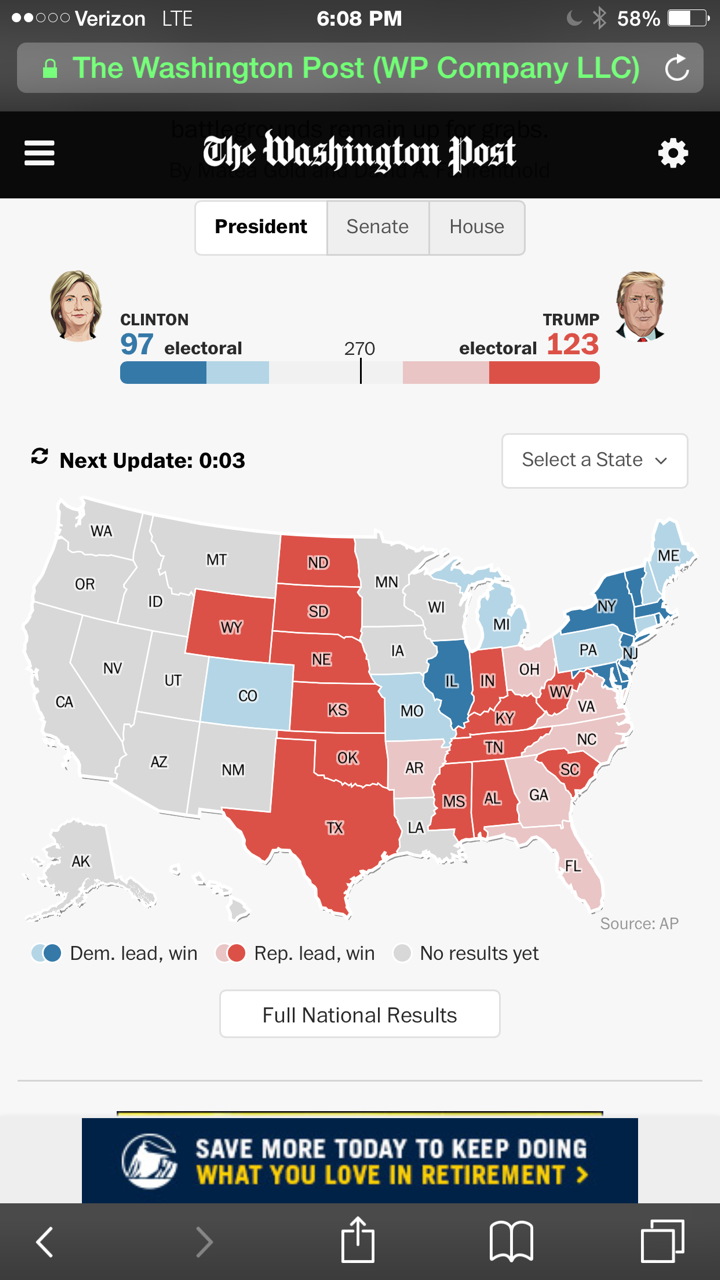
Then came the election. When 61 million voters elected Donald Trump to the White House and kept GOP majorities in both houses of Congress, it signaled our routines in healthcare would be disrupted. The campaign promised to repeal and replace the ACA: its repeal appears certain but it’s replacement injects uncertainty into our routines around a number of meaty issues:Continue reading…

How Doctors Can Help Win the Next Election

By MIKE MILLIGAN

img_1917

On the morning of November 9th, the day after the 2016 U.S. Presidential Election, a visceral sense of shock was felt throughout the campus of Harvard Medical School. Donald Trump’s victory appeared to be an abrupt rebuke of so many of our commonly held values—equality, service, compassion. As medical students and physicians in Boston, we understood that we were isolated—both geographically and ideologically—from the myriad forces that swept Mr. Trump into office. However, there was something unsettling about our collective disbelief. How was it that so many of us had failed to recognize the depth of pain and divisiveness that existed within our country? There arose, in all of us, a need to understand.

In the aftermath of the election, political analysts have ascribed Trump’s victory to several themes—condemnation of the intellectual elite, widespread economic disaffection, and the rise of a potent strain of populism.  However, closer inspection reveals another contributor to this startling election result. Though the final votes are still being tallied, it is clear that Mr. Trump will have received fewer votes in victory than the previous two republican nominees garnered in defeat. Instead of representing a powerful mandate, Mr. Trump’s victory hinged on vast portions of the electorate choosing to stay home. Nearly half of all Americans did not cast a ballot in this election1. As captured poignantly by Jon Favreau, former speechwriter to President Obama, “democracy is fragile and belongs to those who show up.” Continue reading…

American Healthcare Rackets: Monopolies, Oligopolies, Cartels and Kindred Plunderbunds

NORTIN HADLER

By NORTIN HADLER

The Healthcare Dollar, the Healthcare Industry and the Healthcare System are shibboleths. All are parlance. All render terms such as Healthcare Profession, Service Profession, and Healthcare Professionals quaint. All drive linguistic determinism: if it’s labeled so, it must be so. Furthermore, all have become jingoistic. This is our dollar, our industry, our system and don’t dare tread on us.

These are shibboleths that engender considerable cognitive dissonance. If healthcare is no longer a service profession but an industry that transfers wealth in a systematic fashion, shouldn’t it comply with the legal constraints that tightly govern other industries including others that serve essential needs of the population?Continue reading…

Will Trumpcare Repeal & Replace Obamacare?

By DEVON HERRICK

DEVON HERRICK

BY DEVON HERRICK

Donald Trump made repealing Obamacare one of the cornerstones of his campaign. Now that he has won, his administration will face the daunting task of unraveling nearly seven years of Obamacare. Republican policymakers cannot agree how to proceed. Some Republicans believe Trump should repeal Obamacare piecemeal; others worry that would be a disaster.

Whether you oppose or support the Affordable Care Act (ACA), it has structural flaws that will have to be addressed. Addressing those flaws will be less painful if repeal of the costly insurance provisions is accompanied by a replacement plan. Congress can repeal some Obamacare provisions using budget reconciliation, which requires only a simple majority. Only those provisions involving taxes and the budget can be repealed this way. The individual and employer mandates and all the ACA taxes can be repealed using budget reconciliation. However, the regulations that prevent insurers from designing affordable health plans cannot. Repealing the insurance mandates require a filibuster-proof majority. A slight Republican majority in Congress means the Trump Administration likely has the power to gut the ACA. However, Trump cannot replace Obamacare without maybe a dozen Senate Democrats willing to go along.Continue reading…

Congress Shouldn’t Pass FDA Reform Bills Without Addressing Patient Safety and Drug Prices

By DIANA ZUCKERMAN

A major proposed law that alters the way the Food and Drug Administration (FDA) approves drugs and medical devices has been wending its way through Congress since 2014.  Momentum is building on Capitol Hill to pass the legislation in the current “lame-duck” session of Congress. 

That shouldn’t happen. 

The House passed its version of the legislation—the 21st Century Cures Act (hereafter the Cures bill) —in July 2015.  The Senate health committee created and passed 19 related bills, under the banner “Innovation for Healthier Americans,” this past spring.

Sen. Lamar Alexander (R-Tenn) pushed, without success, to get the legislation to the Senate floor this past summer.  Now, he and proponents—which include the pharmaceutical and medical device industries and dozens of research and patient groups who get support from those industries—seek to pass the legislation in the lame-duck session.

Continue reading…