Categories

Category: Uncategorized

This Year Give The Gift of the Health Care System

Screen Shot 2015-12-26 at 5.36.34 AMThe United States health care system is a big, expensive mess, and the people working in the system today often don’t even know how to start learning about the system, and it’s problems.  My own frustration with the health care system – and lack of teaching about it during medical school – lead me to write The Health Care Handbook: A Clear and Concise Guide to the US Health Care System with my colleague Elisabeth Askin.  The goal was to create an understandable primer on the health care system for providers so that we can all work together to improve the system and help our patients.

We have partnered with THCB to provide excerpts from the 2nd edition of the Handbook, which will provide background and insight on important health care issues that we face today.  We would love your questions, comments and feedback.  Today’s excerpt provides a brief overview of the state of the US health care system today.

Cost 

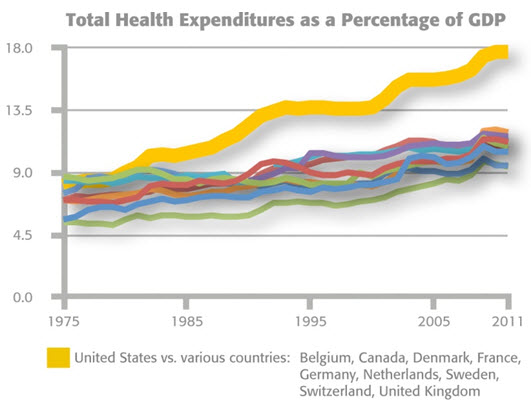
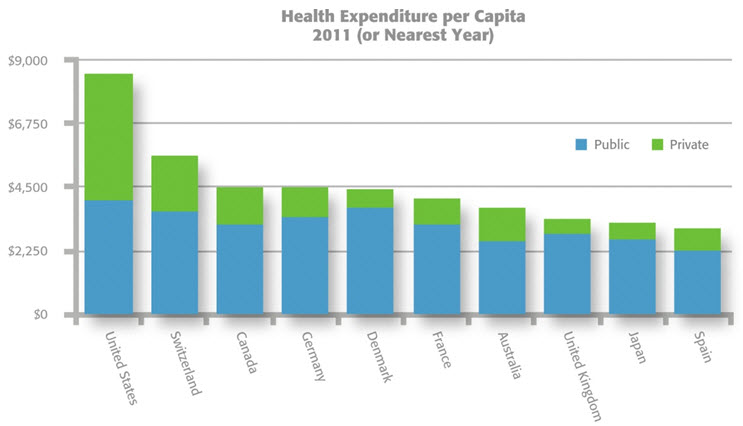
The U.S. currently spends more than 17% of its national gross domestic product (GDP) on health care, far more than any other country in the world. Health care spending now averages almost $9,000 per American,1and health care is the fastest growing industry in the country.2Private (nongovernmental)health care spending accounts for a large portion of the difference between spending in the U.S. and in other industrialized countries.
Img1

Img2Organisation for Economic Co-operation and Development, “Health Statistics2013,” June 2013. Note: Values in U.S. $ Purchasing Power Parity. Data for Japan and Australia refers to 2008.

Access

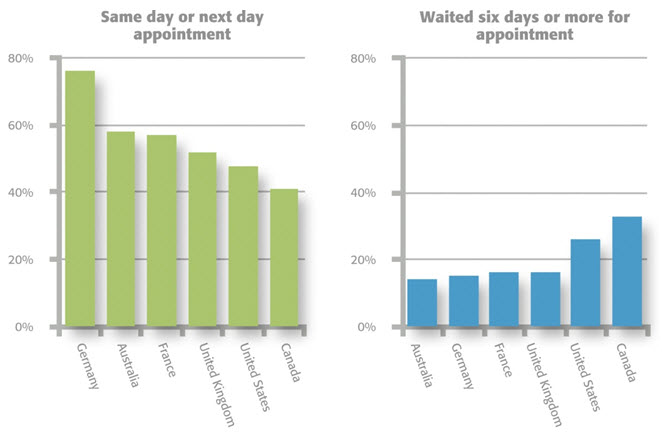
The U.S. has fewer physicians,hospital beds, physician visits,and hospitalizations per capita than most other industrialized countries.3 Eighty-five percent of Americans report having a regular source of ongoing care, but more than a quarter encounter difficulty accessing the healthcare system.4 There are large disparities in access by type of health insurance coverage.

Img3Continue reading…

Was Martin Shkreli Arrested For Hiking Drug Prices?

Martin Shkreli

I don’t subscribe to conspiracy theories. I never believed a second shot was fired. Nor do I believe that Bill Clinton was stalked on the grassy knoll. So I won’t speculate that Martin Shkreli’s arrest for alleged securities fraud that happened years ago is related to his raising Daraprim’s price by 5500 %.

Just because something isn’t suspicious doesn’t mean that it isn’t odd.

Shkreli is a perfect poster child for rapacious pharmacocapitalism – so perfect that it’s odd. He openly admits “I have a sworn duty to my shareholders to maximize profit.” Shkreli’s admission is odd not for its implausibility, but brazen honesty.

Who, in the business of making money, says they’re in the business for profit?

Elizabeth Holmes wants to change the world, including Africa, by biotechnology, and she has recruited Henry Kissinger, known for his contributions to emerging economies and biotechnology, to help. Even Goldman Sachs believe their work leads to greater good. Their CEO once said banking is “doing God’s work.” I developed a Richter’s hernia reading that.

Continue reading…

The Little Agency That Could

Leah-BinderIn the children’s book The Little Engine That Could, a little blue engine hauls an improbably large trainload of toys and candy over a mountain while chanting, “I think I can, I think I can, I think I can.” The Labor Department named this classic among the 100 books that shaped work in America.

There’s a federal health agency in Washington that might be called the “Little Agency That Could”: the Agency for Healthcare Research and Quality (acronym “AHRQ”, pronounced “Arc”) – and it’s shaping the work of healthcare in America.

AHRQ’s priority is making the work done in healthcare benefit the patient. They assemble all the treatments, medicines, expertise, technology and medical advances, and figure out the best strategies for delivering them safely and effectively. This is very complex, and lapses and errors in delivery can and do cause unnecessary patient death and suffering on a grand scale. Avoidable errors in hospitals kill upwards of 500 people a day, making it equivalent to the third leading cause of death in the United States.

What works for the patient often defies conventional wisdom, which AHRQ has observed time and again. For instance:

Continue reading…

Job–Health 2.0 seeks Conference Director

Quick note from Matthew Holt, TCHB publisher

Our sister organization Health 2.0 is looking for a conference director. That is, someone to essentially be the GM of our conference business, reporting to me & Indu subaiya. We looking for someone who knows the world of new SMAC technologies in health care (go ahead, Google it!) & who can run an events business. If that’s you or someone you know, please take a look at this job description and apply there.

This Visit May Be Recorded

flying cadeuciiIn their 1993 book, Reinventing Government, David Osborne and Ted Gaebler entitled a section “what gets measured gets done.” Unfortunately, when it comes to improving health care quality, safety, and costs, we often fail to observe the real work of care, and miss the chance to get it done better. To make a real difference, we need to begin measuring care when and where it happens – behind the curtain.

Why We Must Directly Observe Patient Care

For the last 10 years, our work in research and quality improvement has used concealed audiorecorders to capture what actually happens during patient-physician encounters, and to provide feedback to physicians about their performance. Much of our focus has been on demonstrating the importance of appreciating the patient’s life context and showing how encounters in which physicians elicit patient context and incorporate it into care planning have better health care outcomes and lower costs from inappropriate care. We’ve found such contextual factors are relevant to health care in two-thirds of encounters, that physicians ask about them less than a third of the time, and when they are discovered, they are incorporated into the plan less than 60% of the time. Contextual errors—inappropriate care due to failure to contextualize—are pervasive.

Records Don’t Record

Only direct observation of care reveals these errors. The medical record, currently the source of most data in performance improvement, does not and cannot identify mistakes that the physician doesn’t already recognize. The medical record, at best, shows that the physician rendered the care they believe the patient needed, which can be the “right” care for the wrong patient.

Continue reading…

All I Want For Christmas: Seven Things I Wish My EMR Could Do

Dear Santa,

I’ve been a very good doctor all year. I have checked all my boxes and aced all my Meaningful Use requirements. This year, I’m not asking you for anything fancy. I just thought you might be able to instill some kindness and good will into the people who designed the user interface of my EMR. Maybe, with your help, they would come to see how a few minor tweaks could make the practice of medicine safer and more efficient, and my day a lot more enjoyable than it already is:

1) I wish I could see a routine laboratory panel, like a CBC or a CMP, in one view without scrolling inside a miniature window. That would save time and help me not miss abnormal results.

2) I wish the patient’s next appointment date was displayed next to any incoming report I have to review. That would help me decide if I need to contact the patient about the results or if I’m seeing them soon enough that I can talk about the report then.

3) I wish I could split my computer screen so I could see an X-ray or consultation report or a hospital discharge summary at the same time as I type or dictate the narrative of my office note. That would help me quote them correctly.

Continue reading…

A Little Context in the Workplace Wellness Debate

Ms. Dentzer has once again offered a constructive course correction with her commentary on the most recent public installment of the workplace wellness “debate” at the Population Health Continuum’s November 2015 conference. Few have done so with as much clarity and impartiality over the years, and for this she merits this note of thanks. In this instance, for those of us who have followed and at times participated in this debate but did not attend the conference, it is most appreciated.

From her summation of how return-on-investment dominated the exchange, it appears that little new transpired in terms of the debate itself. If one went to the session apprised of the previously stated positions of Lewis and colleagues and of Goetzel and colleagues and of the communications each has published in response to the other, one would likely have left with the sense that no forward movement – either in their exchange or for the debate more generally – had occurred. However, while it is presumably preferable to have not missed out on a catalytic moment, employer investment in wellness remains a domain marked by much capacity to improve the health and productivity/performance in the workplace and communities and, by extension, the value and sustainability of health care reform. Yet, it is also sorely in need of the galvanizing coherence and direction that such a moment would foster.

Continue reading…

It’s Still the Prices, Stupid!

Steve FindlayOh, for heaven’s sake! Just when we thought we knew one important path to retraining healthcare costs—by mimicking what communities with lower Medicare costs do — along comes a study that blows that idea out of the water.

The landmark new research, unveiled this week in The New York Times, found that communities with lower Medicare hospital spending don’t necessarily have lower hospital spending for privately insured people.

That matters because for the last 10 years or so we have assumed that where Medicare costs were high (or low), privately insured costs would be high (or low), — in short, that there was a correlation. It just made sense.

President Obama trumpeted this relationship in the run-up to passage of the Affordable Care Act, sometimes citing Atul Gawande’s now-famous June 2009 New Yorker article on McAllen, Texas. Obama advised health leaders nationwide to study communities with lower Medicare costs and learn from their cost-cutting ways.

Continue reading…

Electronic Health Record Data Shows Reports of Hoverboard Risks Zipping Higher

Screen Shot 2015-12-18 at 10.12.42 AMWhen I was 10, Marty McFly rode a hoverboard through a 2015 Hill Valley’s Courthouse Square, and I knew what I wanted from Santa that year. Needless to say, I was disappointed that Christmas morning in ’89.

Fast forward to  the real 2015, and a tattooed woman in her early 20’s has maneuvered her way off the DC Red Line and onto the escalator in front of me riding some kind of self-powered two-wheeled object that looks like a disembodied Segway. It has a blue neon underglow that gives it the appearance of floating. My calves ache in sympathy as she shuffles to maintain her balance on our long ascent to the street, and I hold my breath as she navigates to solid ground, surprisingly without incident. As she pivots, I ask her the name of this strange new transportation device.

“It’s a hoverboard,” she tells me.

And I know exactly what I want for Christmas this year.

I’m sure I’m not alone in this sentiment. As a pediatrician, I’m also sure I’m not alone in my concern for the safety of kids using these products, just as I was for the young woman riding hers up the Metro Center escalator.

Continue reading…

The Magical World of ACA Funding

Congressional leaders just agreed to a budget that would keep the government open through September 2016. I was happy to hear the government was not going to shut down. I was much less happy to hear about the fate of provisions supposed to fund the Affordable Care Act (ACA). The ACA – costing $1.2 trillion over 10 years – was supposed to ‘mostly’ pay for itself.  Revenue was to be generated (in large part) by a series of taxes on a variety of different sources. These taxes did not fare so well in the current budget.

‘Cadillac’ Tax

The ACA took aim squarely at high cost employer-sponsored plans.  Economists believe that since employer health insurance is tax deductible, high cost plans proliferate as a mechanism to provide a tax free benefit to employees. These expensive plans are expensive because they cover most of the cost of medical care, insulating the patient from the actual cost of medical care. The ACA imposed an annual 40% tax on plans with annual premiums exceeding $10,200 for individuals and $27,500 for families to be paid by the insurers. The results were to be two fold: One, create a disincentive for employers to offer ‘cadillac’ plans, and two, generate revenue to pay for the ACA. A broad coalition composed of democrats and republicans lobbied to defeat this tax.

Continue reading…

assetto corsa mods