Categories

Author Archives

matthew holt

Particle Health, Complete Patient Records & ‘The Business’ of the Information Blocking Rule

By JESSICA DAMASSA

Particle Health’s CEO Troy Bannister stops by to not only talk about the API platform company’s $25M Series B, but to also explain exactly what’s going on in that patient data ‘exchange-standardize-and-aggregate’ space that, these days, looks poised to pop as the 21st Century Cures Act Information Blocking Rule stands ready to make hospitals share data like never before.

Troy calls Particle a “network of networks” and what that means is that their API pulls patient records from organizations and businesses that are already aggregating them (so aggregating the aggregators) to get all the lab data and medical data a clinician would want to in order to have a more complete picture of their patient. For clients like One Medical or Omada Health, who deliver value-based care and take on risk, having such a robust historic data set on patients – along with a more complete picture of their comorbidities – helps improve decision making and outcomes.

So, how is Particle Health working now – and what will change – as the Information Blocking Rule gets implemented? Troy’s written about this for Forbes, and explains what has him fired up here too. Turns out their model has room to accommodate a big pivot: giving patients access to their own ‘network of networks’ record. Find out what sets Particle off in this new B2B2C direction and how they will be using that Series B funding to build out deeper analytical tools to help everyone make better sense of what the data in all those records can show us.

Link to Troy’s Forbes piece on Anti Information Blocking Rules

Link to Jess’s chat with Micky Tripathi, the National Coordinator for Health Information Technology at HHS, on Anti Information Blocking & TEFCA:
Next-Gen PBM Capital Rx Becomes a Tech Co: Inside New PBA Biz, $106M Series C & Big Plans

by JESSICA DAMASSA

What’s the bigger news coming out of Capital Rx: that the next-gen PBM just closed a $106 million dollar Series C? Or, that the health tech startup’s business model has expanded significantly over the past 18 months, from PBM-only to PBM-plus-PBA, meaning that instead of just servicing the pharmacy benefits management needs of employer groups directly, that now they’re also adding to their business by selling THEIR TECH to other carriers and health systems so they can use it to administrate their benefits plans??

Capital Rx’s CEO AJ Loiacono takes those questions in stride, lets us in on which “side” of the business fueled their 200% year-over-year growth in 2021, and gives us the details on that tech that his business developed and why its standout compared to the inefficient infrastructure that currently exists to administrate and process pharmacy claims.

The big deal here is that AJ and team are tackling one of the biggest friction points in the cost of pharmacy benefits: the cost to administer a plan. They reduce that cost, and the “net cost” of every drug is reduced. AJ says its in this way that Capital Rx operates at one-seventh the cost of his competitors, the “Big Three PBMs” (CVS’s Caremark, Express Scripts, and UnitedHealth’s OptumRx) and saves its customers an average 27% on their prescription drug spend.

Now that Capital Rx has their slick enterprise software, will the business continue to operate a dual PBM-plus-PBA model, or will they double-down on the PBA side? AJ lets us know what’s next and (spoiler alert) it sounds like things might go in a surprising direction. If Capital Rx’s software is so effective at doing all the things it takes to manage pharmacy claims — underwriting sequences, implementation management and onboarding, communication, patient portals, network management, reimbursement networks, eligibility checks, etc. – what stops Capital Rx from processing other kinds of healthcare claims? Is a step into the medical claims processing side of the healthcare world on the roadmap? Tune in and find out!

Jenny Schneider on Homeward’s $50M Series B, 30K-Patient Partnership with Priority Health

By JESSICA DaMASSA, WTF HEALTH

Just FIVE MONTHS after launch, rural health startup Homeward is proving its potential for growth with MORE funding – today announcing its $50 million Series B (that’s $70 million total for the folks keeping score at home) – AND a huge 30,000-patient partnership with Priority Health. Co-founder & CEO Dr. Jennifer Schneider is here to breakdown both bits of news and give us some context about what they indicate about the rural healthcare market.

There are a couple surprising facts in this one that add up to why investors like ARCH Venture Partners and Human Capital (co-leads), General Catalyst (which led the Series A), and Lee Shapiro and Glen Tullman (old buddies and former Livongo colleagues who went in on this with personal funds outside of their fund 7wireVentures) were excited to jump into a quick Series B.

Surprising Fact 1: 90% of all rural Medicare beneficiaries are covered by just 7 payers, which makes the Priority Health deal a bigger deal than even that massive 30K patient population might indicate.

Surprising Fact 2: Homeward’s market of rural Americans is actually TWICE as large as the diabetes market that spurred the investment and growth of Livongo.

For all the math, the details on how the business actually works five months in, and how Homeward is actually going to market as a ‘healthcare infrastructure’ provider rather than just a next-gen medical group, you’re going to have to give this one a watch!

The Impact of COVID-19 on Shared Priorities for International Cooperation in Active and Healthy Aging

By ELIZABETH BROWN, CATALYST @ HEALTH 2.0


IN THIS MINI-SERIES, WE WILL BE TAKING A LOOK BACK AT THE IDIH WEEK 2022 USA REGIONAL WORKSHOP, TITLED THE IMPACT OF COVID-19 ON THE SHARED PRIORITIES FOR INTERNATIONAL COOPERATION IN ACTIVE AND HEALTHY AGING, WITH A DIFFERENT BLOG POST DEVOTED TO EACH OF THE THREE COMMON PRIORITIES THAT WERE REFINED THROUGHOUT THE IDIH PROJECT: INTEROPERABILITY BY DESIGN, DATA GOVERNANCE, AND DIGITAL INCLUSION.

INTRODUCTION: THE REGIONAL WORKSHOP PANELISTS AND BACKGROUND OF THE PANEL

For the past three years, Catalyst has been involved in the IDIH Project, which has recently concluded (you can read more about the overall project findings here). IDIH (International Digital Health Cooperation for Preventive, Integrated, Independent and Inclusive Living) – funded under the European Union Horizon 2020 Research and Innovation Program – was aimed at fostering cooperation in the field of Digital Health for Active and Healthy Aging (AHA) between the European Union and five Strategic Partner Countries (Canada, China, Japan, South Korea, and USA), especially focusing on four key areas that embrace common priorities of all countries/regions involved: Preventive Care, Integrated Care, Inclusive Living, and Independent and Connected Living. 

Following an expert-driven approach, experienced and renowned experts, executives, and advocacy groups from the six regions (Europe, China, Canada, Japan, South Korea and USA) were brought together by IDIH in a Digital Health Transformation Forum working to define more specific priorities in Digital Health and Ageing, and identifying opportunities for mutual benefit and priorities for international cooperation.  

During IDIH Week 2022, Catalyst ran a Regional Workshop aiming to explore the impacts of COVID-19 on AHA.

Continue reading…

US Cardiac electrophysiologists meet reimbursement reality and don’t like it.

By ANISH KOKA

It’s been a while but Anish Koka, a one time regular writer on THCB and occasional THCB Gang member, is back publishing up a storm on his Substack channel. You may recall that his political and clinical views don’t always mesh with some of the wooly liberals we feature on THCB (cough, cough, me), but we are delighted to be back publishing some of his pieces–this one is on reimbursement.–Matthew Holt

The subspecialty of Cardiology known as electrophysiology has seen explosive growth over the last few decades in large part because of a massive expansion in the suite of procedures now offered to patients. It used to be that electrophysiologists would spend the majority of their careers implanting pacemakers and defibrillators, but the last 2 decades saw an explosion in electrophysiology procedures known as ablations. Ablations essentially involve burning cardiac tissue in a strategic manner to get rid of arrhythmias that may be afflicting a particular patient. The path humans took from first taking an electrical picture of the heart with a surface ECG to putting catheters into the heart to map and treat dangerous arrhythmias is one of the great achievements of the modern era.

Giants of the field like the recently deceased Mark Josephson essentially created a field by going where no humans had gone before. Dr. Josephson did much of his work in Philadelphia at the University of Pennsylvania publishing seminal papers that lead to a greater understanding and eventual treatment of previously incurable malignant arrhythmias. As is true of all trailblazing work in medicine , there were no reimbursement codes in the beginning , just desperate patients with no place to turn.

The procedures being embarked on were rare and the patients were very complex. The renumeration that was awarded from Medicare was reflective of this. But two things almost always happen once a highly reimbursed procedure code comes on line – technological advances makes the procedure easier, and the population that the procedure is intended for massively balloons.

Continue reading…

Dr. Topol’s comment on LongCOVID and the heart is misleading/lacking context

By ANISH KOKA

It’s been a while but Anish Koka, a one time regular writer on THCB and occasional THCB Gang member, is back publishing up a storm on his Substack channel. You may recall that his political and clinical views don’t always mesh with some of the wooly liberals we feature on THCB (cough, cough, me), but we are delighted to be back publishing some of his pieces–starting with a look at a tweet from one of America’s most prominent cardiologists.–Matthew Holt

Given Twitter’s commitment to the truth in Medicine, I thought I would try to give them a hand by analyzing a semi-viral tweet about COVID and the heart.

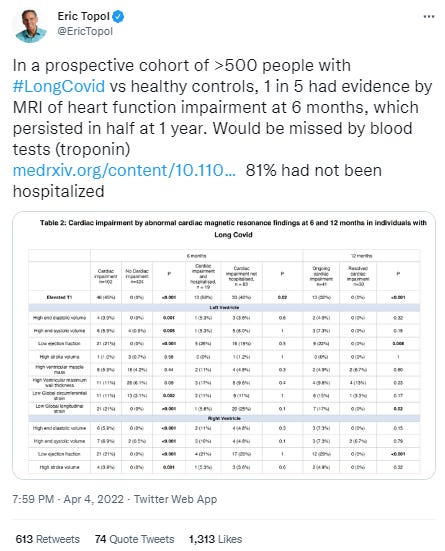
Earlier this year (April 2022), the most influential cardiologist in the world tweeted about a study on the long term cardiac effects of COVID (LongCOVID).

Medical trainees who trained in the early 2000s like I did know Dr. Topol as an absolute legend in the field of Cardiology. He was responsible for seminal work in Cardiology in the 1980’s on the use of clot busting drugs for patients having heart attacks, and became head of cardiology for the famed Cleveland Clinic at the age of 36! (I vaguely recall feeling like I was starting to understand Cardiology at the age of 36.) He’s since moved on to do many other things, and is a potent voice that may have been instrumental in the FDA delaying approval of the mrna vaccines until after the 2020 election.

Nonetheless, this paper that he is giving his significant stamp of approval to has significant issues. As far as I can tell individuals with LongCOVID were recruited by advertising in LongCOVID support groups. No independent assessment carried out as far as I can tell clinically. If you say you have it—> you’re in.

Continue reading…

How Happify Health Became Twill: Inside the New Biz Model & What’s Next

By JESSICA DaMASSA, WTF HEALTH

Mental health digital therapeutics startup Happify Health has spent the past 5 years quietly ‘self-actualizing’ into a brand-new, tech platform company that just launched this week: Twill. This is a big pivot – not just a brand change – and we’ve got co-founder & President Ofer Leidner and newly-hired Chief Operating Officer Megan Callahan (who formerly ran Lyft Health) here to tell us how it all went down AND what will happen to the old Happify app.

Wellness-app-no-more, Twill has emerged as a health tech infrastructure company. Its core product (called Sequences) is the open architecture, digital back-end that ties together a health plan, employer, or pharma co’s various digital point solutions – wellness apps, digital therapeutics, virtual coaching, peer support groups, telehealth platforms, etc. etc. – to create one neat-and-tidy, hyper-personalized, automagically-navigated patient care journey based on condition or patient population.

Big brands like Elevance Health (Anthem), Biogen, and Almirall have already bought-in, with products already in market for conditions as diverse as maternal health, multiple scleroses, and psoriasis. Not forgetting its mental health roots, Twill is bringing in its own vast resources from the ole Happify days to run digital mental health support under each of these disease-specific point solutions. Ofer and Megan say that Sequences can be developed for ANY condition or to target specific populations of patients and they plan to launch 2-3 new Sequences each year.

What else is ahead for Twill now that it’s revealed from its stealthy start? Happify Health had raised $73 million in March 2021 in a big round lead by Deerfield Management Company – what should we expect next? Tune in for all the details on the transformation, the new products, and how other digital health companies can expect to work with Twill in the future.

Quickbite Interviews: NeuroFlow

I was at the AHIP conference in Vegas late last month and caught up with a number of CEOs & execs for some quick bite interviews — around 5 mins getting (I hope) to the gist of what they & their companies are up to. I am dribbling them out–Matthew Holt

Next is Julia Kastner, CPO & Chris Molaro, CEO, Neuroflow, and it includes a great brief product demo from Julia

Matthew’s health care tidbits: Texas is the present future of abortion care

Each week I’ve been adding a brief tidbits section to the THCB Reader, our weekly newsletter that summarizes the best of THCB that week (Sign up here!). Then I had the brainwave to add them to the blog. They’re short and usually not too sweet! –Matthew Holt

In this edition’s tidbits, I have to return to the stunning impact of the Dobbs ruling. We know will happen because it is already happening in Texas where the 6 week law was already being enforced in contravention of Roe v Wade.

Taxpayer money is going to “pregnancy crisis centers” that flat out lie to vulnerable patients about the impact of abortions on their health. Doctors are questioning women who have miscarried–at a moment that is already terrible for them, and women who have miscarried are being denied basic D&Cs–which can kill them.

Don’t get me started on the absolute nonsense being talked–and passed into law –about ectopic pregnancies, of which there are over 130,000 each year in the US, being carried to term. How unlikely is it that an ectopic pregnancy makes it to term with no ill effects? Let me tell you a story. My dad was an OBGYN. He and his anesthetist saved the life of a woman and her baby who somehow had made it to term while being ectopic. During the surgery she needed 12 pints of blood (a normal woman has 7-8 pints in her body) and he considered it the greatest piece of surgery he did in his entire career. He thought that he and the patients were very lucky. So I demand that crazy legislation saying ectopic pregnancies have to be carried to term also mandates that my dad is around to do every single C-Section. Unlikely, as he’s dead, but no crazier than the legislation in Indiana.

Then there’s the impact on telehealth. Most abortions are done using drugs but more and more of the pandemic-era exemptions to prescribing drugs and seeing patients over telehealth across state lines are being withdrawn. Clearly the state-based licensing of doctors is itself ridiculous in an age of online commerce, but despite the DOJ statements the legality of prescribing abortifacients across state lines is very unclear and, as Deven McGraw explained in this harrowing piece on THCB Gang, HIPAA doesn’t protect patient privacy from local law enforcement. So what happens to someone in a state where abortion is banned if they have to go to hospital because of a complication from taking an abortifacient? Trump thinks they should go to jail.

What is clear is that bans on abortion don’t stop abortions. But they do endanger women. And if the pregnancy crisis center stops a woman from getting an abortion, do they help afterwards? Why yes, if you mean by “helping”, they have a celebratory dinner and light a fricking candle.

assetto corsa mods