Categories

Author Archives

matthew holt

DNA is Better at Math than You Are

By KIM BELLARD

I was tempted to write about the work being done at Wharton that suggests that AI may already be better at being entrepreneurial than most of us, and of course I’m always interested to see how nanoparticles are starting to change health care (e.g., breast cancer or cancer more generally), but when I saw what researchers at China’s Shanghai Jiao Tong University have done with DNA-based computers, well, I couldn’t pass that up. 

If PCs helped change the image of computers from the big mainframes, and mobile phones further redefined what a computer is, then DNA computers may cause us to one day – in the lifetime of some of you — look back at our chip-based devices as primitive as we now view ENIAC.

It’s been almost 30 years since Leonard Adleman first suggested the idea of DNA computing, and there’s been a lot of excitement in the field since, but, really, not the kind of progress that would make a general purpose DNA computer seem feasible. That may have changed.

At the risk of introducing way too many acronyms, the Chinese researchers claim they have developed a general purpose DNA integrated circuit (DIC), using “multilayer DNA-based programmable gate arrays (DPGAs).” The DPGAs are the building blocks of the DIC and can be mixed and matched to create the desired circuits. They claim that each DPGA “can be programmed with wiring instructions to implement over 100 billion distinct circuits.”

They keep track of what is going on using fluorescence markers, which probably makes watching a computation fun to watch. 

One experiment, involving 3 DPGAs and 500 DNA strands, made a circuit that could solve quadratic equations, and another could do square roots. Oh, and, by the way, another DPGA circuit could identify RNA molecules that are related to renal cancer. They believe their DPGAs offers the potential for “intelligent diagnostics of different kinds of diseases.”

DNA tracking DNA.

Continue reading…

Poor Kids. Pitiful Us

By KIM BELLARD

Well, congratulations, America.  The child poverty rate more than doubled from 2021 to 2022, jumping from 5.2% to 12.4%, according to new figures from the Census Bureau.  Once again, we prove we sure have a funny way of showing that we love our kids.

The poverty rate is actually the Supplemental Poverty Measure (SPM), which takes into account government programs aimed at low income families but which are not counted in the official poverty rate. The official poverty rate stayed the same, at 11.5% while the overall SPM increased 4.6% (to 12.4%), the first time the SPM has increased since 2010.  It’s bad enough that over 10% of our population lives in poverty, but that so many children live in poverty, and that their rate doubled from 2021 to 2022 — well, how does one think about that?

The increase was expected. In fact, the outlier number was the “low” 2021 rate.  Poverty dropped due to COVID relief programs; in particular, the child tax credit (CTC).  It had the remarkable (and intended) impact of lowering child poverty, but was allowed to expire at the end of 2021, which accounts for the large increase. We’re basically back to where we were pre-pandemic.

President Biden was quick to call out Congressional Republicans (although he might have chided Senator Joe Manchin just as well):

Today’s Census report shows the dire consequences of congressional Republicans’ refusal to extend the enhanced Child Tax Credit, even as they advance costly corporate tax cuts…The rise reported today in child poverty is no accident—it is the result of a deliberate policy choice congressional Republicans made to block help for families with children while advancing massive tax cuts for the wealthiest and largest corporations.

Many experts agree: child poverty, and poverty more generally, is a choice, a policy choice.

Continue reading…

The Times They Are A-Changing….Fast

By KIM BELLARD

If you have been following my Twitter – oops, I mean “X” – feed lately, you may have noticed that I’ve been emphasizing The Coming Wave, the new book from Mustafa Suleyman (with Michael Bhaskar). If you have not yet read it, or at least ordered it, I urge you to do so, because, frankly, our lives are not going to be the same, at all.  And we’re woefully unprepared.

One thing I especially appreciated is that, although he made his reputation in artificial intelligence, Mr. Suleyman doesn’t only focus on AI. He also discusses synthetic biology, quantum computing, robotics, and new energy technologies as ones that stand to radically change our lives.  What they have in common is that they have hugely asymmetric impacts, they display hyper-evolution, they are often omni-use, and they increasingly demonstrate autonomy. 

In other words, these technologies can do things we didn’t know they could do, have impacts we didn’t expect (and may not want), and may decide what to do on their own.  

To build an AI, for the near future one needs a significant amount of computing power, using specialized chips and a large amount of data, but with synthetic biology, the technology is getting to the point where someone can set up a lab in their garage and experiment away.  AI can spread rapidly, but it needs a connected device; engineered organisms can get anywhere there is air or water.

“A pandemic virus synthesized anywhere will spread everywhere,” MIT”s Kevin Esvelt told Axios.

I’ve been fascinated with synthetic biology for some time now, and yet I still think we’re not paying enough attention. “For me, the most exciting thing about synthetic biology is finding or seeing unique ways that living organisms can solve a problem,” David Riglar, Sir Henry Dale research fellow at Imperial College London, told The Scientist. “This offers us opportunities to do things that would otherwise be impossible with non-living alternatives.”

Jim Collins, Termeer professor of medical engineering and science at Massachusetts Institute of Technology (MIT), added: “By approaching biology as an engineering discipline, we are now beginning to create programmable medicines and diagnostic tools with the ability to sense and dynamically respond to information in our bodies.”

For example, researchers just reported on a smart pill — the size of a blueberry! — that can be used to automatically detect key biological molecules in the gut that suggest problems, and wirelessly transmit the information in real time. 

Continue reading…

Shiv Rao, CEO demos Abridge

Abridge has been trying to document the clinical encounter automatically since 2018. There’s been quit a lot of fuss about them in recent weeks. They announced becoming the first “Pal” on the Epic “Partners& Pals” program, and also that their AI based encounter capture technology was now being used at several hospitals. And they showed up in a NY Times article about tech being used for clinical documentation. But of course they’re not the only company trying to turn the messy speech in a clinician/patient encounter into a buttoned-up clinical note. Suki, Augmedix & Robin all come to mind, while the elephant is Nuance, which has itself been swallowed by the whale that is Microsoft.

But having used their consumer version a few years back and been a little disappointed, I wanted to see what all the fuss was about. CEO Shiv Rao was a real sport and took me through a clinical example with him as the doc and me as a (slightly) fictionalized patient. He also patiently explained where the company was coming from and what their road map was. But they are all in on AI–no off shore typists trying to correct in close to real time here.

And you’ll for sure want to see the demo. (If you want to skip the chat it’s about 8.00 to 16.50). And I think you’ll be very impressed indeed. I know I was. I can’t imagine a doctor not wanting this, and I suspect those armies of scribes will soon be able to go back to real work! — Matthew Holt

Beyond the Scale: How organizations should evaluate the success of obesity management solutions

By CAITLYN EDWARDS

Obesity treatment is often framed as a race to the bottom — how much weight can someone lose? Five percent? Ten percent? And with recent scientific advancements in anti-obesity medications such as GLP-1s, what about even 15-20%?

Obesity treatment, though, isn’t just about the number on the scale. It’s about moving the needle on biomarkers that really matter to overall health. Seven out of the top ten leading causes of death and disability in the United States today are chronic diseases that have links to overweight and obesity. The metabolic benefits of just 5% weight loss can be life-changing for many people with obesity-related comorbidities. This means that for organizations looking to treat their chronic conditions, obesity care shouldn’t be all about striving for the lowest possible weight.

Indeed, consensus and practice statements from groups including the American Heart Association, the American College of Cardiology, the American Diabetes Association, and The Obesity Society, support weight loss programs that achieve clinically significant weight loss outcomes, defined as greater than or equal to 5% of an individual’s baseline body weight. This number is derived from decades of research demonstrating that even modest weight loss has impacts on physiological health including type 2 diabetes, dyslipidemia, hypertension, and many kinds of cancer.

People who attain just 5% weight loss see the following health improvements:

  • Reductions in systolic and diastolic blood pressure
  • Risk reductions of developing type 2 diabetes by almost 60%
  • Reductions in HbA1c and fasting blood glucose levels
  • Greater insulin sensitivity
  • Decreased need for newly prescribed diabetes, hypertension, and lipid-lowering medications

Understanding that obesity outcomes include more than just the number on the scale, how can benefit managers and health plan leaders measure success? Here are some things organizations should look for when evaluating an obesity management solution:

N-size of outcomes

While a high weight loss average may sound impressive, it doesn’t tell the whole story. A better measure might be the number of people in a program able to achieve greater than 5% weight loss. The fact is that weight loss averages are easily skewed by outliers.  An exceptionally high average may not be representative of what is actually taking place at the individual level. What matters is that a large percentage of people in the program are able to see clinically significant results.

Emphasis on behavior change

Another way to measure the success of an obesity management solution is by the sustainability of its outcomes — primarily through adopting healthier behaviors. Intensive behavioral therapy is crucial to obesity treatment and can reduce the risk of type 2 diabetes. Support from expert dietitians and coaches can help promote a healthy relationship with food for optimal weight loss.

Through medical nutrition therapy, dietitians create personalized calorie and macronutrient goals to foster weight loss in a healthy, sustainable way. Also, self-directed cognitive behavioral therapy can help people become more aware of underlying thoughts and behavior patterns around food.

Step therapy approach to treatment

Some obesity management solutions avoid medications entirely while others rely solely on expensive GLP-1s. But both of those methods fall short of providing the best care to the most people at the lowest cost possible.

The best obesity management solutions take a clinically rigorous step-therapy approach to treatment. This way, they carefully manage access to expensive anti-obesity medications while achieving meaningful outcomes. Many of their members will achieve clinically significant weight loss through behavior change alone. Some may need a boost from lower-intensity, lower-cost anti-obesity medications to reach their goals. Others, with severe obesity or multiple cardio-metabolic conditions, may require higher-intensity anti-obesity medications like GLP-1s. Treatment levels can be safely tried in succession with needs and costs in mind.

It’s likely only 5-10% of a given population would end up using GLP-1s with this step-therapy approach, while the majority of people would still get clinically meaningful results without such intensive treatment.

Address SDOH to personalize care

One-size-fits-all solutions — like those that insist on a highly restrictive diet — miss the mark on health equity. Not everyone can afford expensive meat-heavy diets and they don’t always line up with people’s cultural preferences. Similarly, a program that simply doles out GLP-1s without helping people manage side effects doesn’t work and will only drain budgets.

The key to unlock improved outcomes is by helping people address SDOH challenges like food insecurity, language barriers, cultural factors, physical environment, and more. A good obesity solution should expand access to bilingual registered dietitians who are trained in dietary considerations and eating patterns for many different cultures and ethnic groups. They can help folks plan meals around limited budgets and specific dietary needs.

Conclusion

Organizations have much to consider when evaluating obesity solutions for their population. It’s easy to be swayed by simple metrics that seem indisputable. But, in the end, outcomes like 5% weight loss and reductions in HbA1c for the majority of an eligible population are what counts. Sustainable outcomes rely on real behavior change, a careful step-therapy approach to medication, and personalized care when it comes to social determinants of health.

Caitlyn Edwards, PhD, RDN, is a Senior Clinical Research Specialist at Vida Health

Smells like AI Spirit

By KIM BELLARD

There are so many exciting developments in artificial intelligence (AI) these days that one almost becomes numb to them. Then along comes something that makes me think, hmm, I didn’t see that coming.

For example, AI can now smell.

Strictly speaking, that’s not quite true, at least not in the way humans and other creatures smell.  There’s no olfactory organ, like our nose or a snake’s tongue. What AI has been trained to do is to look at a molecular structure and predict what it would smell like.

If you’re wondering (as I certainly did when I heard AI could smell), AI has also started to crack taste as well, with food and beverage companies already using AI to help develop new flavors, among other things. AI can even reportedly “taste wine” with 95% accuracy. It seems human senses really aren’t as human-only as we’d thought.

The new research comes from the Monell Chemical Senses Center and Osmo, a Google spin-off. It’s a logical pairing since Monell’s mission is “to improve health and well-being by advancing the scientific understanding of taste, smell, and related senses,” and Osmo seeks to give “computers a sense of smell.” More importantly, Osmo’s goal in doing that is: “Digitizing smell to give everyone a goal at a better life.”

Osmo CEO Alex Wiltschko, PhD says: “Computers have been able to digitize vision and hearing, but not smell – our deepest and oldest sense.” It’s easy to understand how vision and hearing can be translated into electrical and, ultimately, digital signals; we’ve been doing that for some time. Smell (and taste) seem somehow different; they seem chemical, not electrical, much less digital. But the Osmo team believes: “In this new era, computers will generate smells like we generate images and sounds today.”

I’m not sure I can yet imagine what that would be like.

The research team used an industry dataset of 5,000 known odorants, and matched molecular structures to perceived scents, creating what Osmo calls the Principle Odor Map (POM). This model was then used to train the AI. Once trained, the AI outperformed humans in identifying new odors. 

The model depends on the correlation between the molecules and the smells perceived by the study’s panelists, who were trained to recognize 55 odors. “Our confidence in this model can only be as good as our confidence in the data we used to test it,” said co-first author Emily Mayhew, PhD. Senior co-author Joel Mainland, PhD. admitted: “The tricky thing about talking about how the model is doing is we have no objective truth.” 

The study resulted in a different way to think about smell. The Montell Center says:

The team surmises that the model map may be organized based on metabolism, which would be a fundamental shift in how scientists think about odors. In other words, odors that are close to each other on the map, or perceptually similar, are also more likely to be metabolically related. Sensory scientists currently organize molecules the way a chemist would, for example, asking does it have an ester or an aromatic ring?

“Our brains don’t organize odors in this way,” said Dr. Mainland. “Instead, this map suggests that our brains may organize odors according to the nutrients from which they derive.”

“This paper is a milestone in predicting scent from chemical structure of odorants,” Michael Schmuker, a professor of neural computation at the University of Hertfordshire who was not involved in the study, told IEEE Spectrum.  It might, he says, lead to possibilities like sharing smells over the Internet. 

Think about that. 

“We hope this map will be useful to researchers in chemistry, olfactory neuroscience, and psychophysics as a new tool for investigating the nature of olfactory sensation,” said Dr. Mainland. He further noted: “The most surprising result, however, is that the model succeeded at olfactory tasks it was not trained to do. The eye-opener was that we never trained it to learn odor strength, but it could nonetheless make accurate predictions.”

Next up on the team’s agenda is to see if the AI can learn to recognize mixtures of odors, which exponentially increases the number of resulting smells. Osmo also wants to see if AI can predict smells from chemical sensor readings, rather than from molecular structures that have already been digitized. And, “can we digitize a scent in one place and time, and then faithfully replicate it in another?”

That’s a very ambitious agenda.

Dr. Wiltschko claims: “Our model performs over 3x better than the standard scent ingredient discovery process used by major fragrance houses, and is fully automated.” One can imagine how this would be useful to those houses. Osmo wants to work with the fragrance industry to create safer products: “If we can make the fragrances we use every day safer and more potent (so we use less of them), we’ll help the health of everyone, and also the environment.”

When I first read about the study, I immediately thought of how dogs can detect cancers by smell, and how exciting it might be if AI could improve on that. Frankly, I’m not much interesting in designing better fragrances; if we’re going to spend money on training AI to recognize molecules, I’d rather it be spent on designing new drugs than new fragrances.

Fortunately, Osmo has much the same idea. Dr. Wiltschko writes:

If we can build on our insights to develop systems capable of replicating what our nose, or what a dog’s nose can do (smell diseases!), we can spot disease early, prevent food waste, capture powerful memories, and more. If computers could do these kinds of things, people would live longer lives – full stop. Digitizing scent could catalyze the transformation of scent from something people see as ephemeral to enduring.   

Now, that’s the kind of innovation that I’m hoping for.

Skeptics will say, well, AI isn’t really smelling anything, it’s just acting as though it does. E.g., there’s no perception, just prediction. One would make the same argument about AI taste, or vision, or hearing, not to mention thinking itself. But at some point, as the saying goes, if it looks like a duck, swims like a duck, and quacks like a duck, it’s probably a duck.  At some point in the not-so-distant future, AI is going to have senses similar to and perhaps much better than our own.

As Dr. Wilkschko hopes: “If computers could do these kinds of things, people would live longer lives – full stop.” 

Kim is a former emarketing exec at a major Blues plan, editor of the late & lamented Tincture.io, and now regular THCB contributor.

Has Sensemaking Collapsed When It Comes To U.S. Healthcare?

By MIKE MAGEE

This past week my wife and I were at a family event to celebrate my brother-in-law’s 70th birthday. Our extended family has more than a few doctors. A physician nephew who had read CODE BLUE and had a strong interest in health policy asked if I felt I (and others) were too hard on doctors. My response was yes, but that it was intentional and came with the territory. Combining scientific, sometimes life and death expertise, with high-touch compassion, understanding and partnership has always been a “big ask” but that was what we and others had signed up for as “health professionals.”

But can a health professional be “professional” in a fundamentally misaligned health system? And, if not, does a health professional have a responsibility to engage in an effort to reform and transform the system to behave professionally?

Professionals are generally members of a vocation with special training, highly educated, enjoy special trust and work autonomy, abide by strict moral and ethical obligations, and in return are generally self-regulating. Their academic training is expected to reliably provide those they serve with special skills, judgement, and services. When they deliver, society responds with confidence and trust and durable long-term relationships.

My nephew and many of his contemporaries have come to believe that this is neigh impossible under the current heavily corporatized, profit driven, inequitable, under-insured, and widely inaccessible system. They have begun to voice that being an ethical and competent professional in an unprofessional system is not possible, and not their fault.

System redesign guru, W. Edward Deming, the father of Quality Control Management, and the man credited with assisting the Japanese in transforming their auto industry, had this to say about transformation in 1993: “The prevailing style of management must undergo transformation. A system cannot understand itself. The transformation requires a view from outside…The individual, once transformed, will: set an example; be a good listener, but will not compromise; continually teach other people; and help people to pull away from their current practices and beliefs and move into the new philosophy without a feeling of guilt about the past.”

Six years later Don Berwick MD, Emeritus President of the Institute For Healthcare Improvement and now Harvard Health Policy professor, delivered a classic speech, “Escape Fire: Lessons for the Future of Health Care”,  sponsored by the Commonwealth Foundation. In it Don recounted the events surrounding the tragic fire at Mann Gulch, Montana which claimed the lives of 13 “smokejumpers” on August 5, 1949. He reviewed the lessons learned in a system analysis by Professor Karl E. Weick of the University of Michigan, in his paper titled,“The Collapse of Sensemaking in Organizations: The Mann Gulch Disaster.”

Berwick explained, “Sensemaking is the process through which the fluid, multilayered world is given order, within which people can orient themselves, find purpose, and take effective action. Weick is a postmodern thinker. He believes that there is little or no preexisting sense of organization in the world—that is, no order that comes before the definition of order. Organizations don’t discover sense, they create it…In groups of interdependent people, organizations create sense out of possible chaos. Organizations unravel when sensemaking collapses, when they can no longer supply meaning, when they cling to interpretations that no longer work.”

Now roughly a quarter century ago, Berwick concluded, “I love medicine. I love the purpose of our work. But we are unraveling, I think…Sense is collapsing… We need to face reality…Why did it take the Mann Gulch crew so long to realize they were in trouble? The soundest explanation is not that the threat was too small to see; it is that it was too big. Some problems are too overwhelming to name. I now think that that is where we have come in health care; I have been radicalized.”

Clearly the visions we have been using are under-powered, and we seem to be heading in the wrong direction with information technology and AI fully prepared to make permanent a system that is moving patients to despair and doctors to early retirement. What are the questions my nephew and his health policy colleagues should be asking now?

1. How do we make America and all Americans healthy?

2. What is our national health care plan, and who is in charge?

3. How do we balance national and state responsibilities?

4. How do we maintain balanced humanistic and scientific care, and preserve patient and health professional autonomy over complex life and death decision making?

5. How do we advance healthy behaviors while providing high touch access to health professionals for acute and moderate issues?

6. How do we use information technology and AI to expand human and social, rather than just financial, capital?

7. How do we prioritize investment in human contact between patients and health professionals over wealth enhancement and brick and mortar expansions?

8. How do we put a smile (independent of money) back on the faces of doctors, nurses and patients?

9. How do we separate hospital and physician profit driven research from direct patient care?

10. How do we move to geographic annual budgeting of comprehensive care and eliminate individual billing/reimbursement operations?

Mike Magee M.D. is a Medical Historian and regular contributor to THCB. He is the author of CODE BLUE: Inside the Medical-Industrial Complex (Grove/2020).

20th Birthday Classic: “Healthcare” vs. “Health Care”: The Definitive Word(s)

This is the last of the classics that THCB will run to celebrate our 20th birthday. And we are finally tackling the most important of questions. Is what we call this thing one word or two? Back in 2012 Michael Millenson had the definitive answer–Matthew Holt

By MICHAEL L. MILLENSON

A recent contributor to this blog wondered about the correctness of “health care” versus “healthcare.” I’d like to answer that question by channeling my inner William Safire (the late, great New York Times language maven). If you’ll stick with me, I’ll also disclose why the Centers for Medicare & Medicaid Services is not abbreviated as CMMS and reveal something you may not have known about God – linguistically, if not theologically.

The two-word rule for “health care” is followed by major news organizations (New York Times, Washington Post, Wall Street Journal) and medical journals (New England Journal of Medicine, JAMA, Annals of Internal Medicine). Their decision seems consistent with the way most references to the word “care” are handled.

Even the editorial writers of Modern Healthcare magazine do not inveigh against errors in medical care driving up costs in acutecare hospitals and nursinghomes. They write about “medical care,” “acute care” and “nursing homes,” separating the adjectives from the nouns they modify. Some in the general media go even farther, applying the traditional rule of hyphenating adjectival phrases; hence, “health-care reform,” just as you’d write “general-interest magazine” or “old-fashioned editor.”

Most importantly of all, the Associated Press decrees that the correct usage is, “health care.” That decision is not substantive – there is absolutely no definitional difference between “health care” and “healthcare,” despite what you might read elsewhere — but stylistic. As in The Associated Press Stylebook.

The AP is a cooperative formed back in 1846 by newspapers to share reporting via a wire service. Today, the AP calls itself the backbone of global news information, serving “thousands of daily newspaper, radio, television, and online customers….On any given day, more than half the world’s population sees news from the AP.” When that news arrives in text format, its spelling is determined by the AP stylebook. Which means a few billion people see the spelling, “health care.”

A stylebook? Isn’t spelling determined by dictionaries? Perhaps, but when you’re sharing content on deadline across the world, it helps if everyone agrees to refer to, say, the Midwest, not the Mid-West, and to use other common linguistic conventions.

Stylebooks differ. The AP would say that health care is two words; the Chicago Manual of Style, popular in academia, would write that as 2 words, but agree with the premise.

So why isn’t that the end of the issue? Because conventions are not set in concrete. For example, at the time the Internet first became popular, the AP preferred the term “Web site” over “website” because the World Wide Web is a proper name. A successful lobbying campaign on behalf of the lower-case form helped persuade the AP to adopt the new spelling in its 2010 stylebook update.

When Modern Hospitals changed its name to become Modern Healthcare back in 1976, it did so in part to seem, well, modern. It hadn’t been that many years, after all, since airplanes were flown by air lines, not airlines. Then, in the business-oriented 1980s, “healthcare system” became a convenient linguistic upgrade of the dowdy “hospital” that had gobbled up ownership of doctors’ offices providing outpatient (not out-patient) care.

At the same time, a growing number of companies decided to make this expansive new word part of their proper name or, at the very least, their style sheet. For instance, HCA, founded in 1968 as Hospital Corporation of America, today describes itself as “the nation’s leading provider of healthcare services.” The Reuters news service, heavily involved in business news, now uses “healthcare” in its stories.

The 2001 Institute of Medicine report Crossing the Quality Chasm provides a snapshot of the term’s transition. The report declares, “Between the healthcare we have and the care we could have lies not just a gap, but a chasm.” The author of that ringing statement is the Committee on the Quality of Health Care in America.

However, I think a tipping point for fusing “health” and “care” was reached with the federal legislation setting up the Agency for Healthcare Research and Quality at the end of 1999. AHRQ was a renamed and refocused version of the old Agency for Health Care Policy and Research, created in 1989. AHCPR, in turn, had almost been named the Agency for Health Care Research and Policy until an alert Senate staffer realized that the abbreviation would be pronounced, “ah, crap.”

Speaking of abbreviations, Tom Scully, the first administrator of the Center for Medicare & Medicaid Services, once explained to me why it is known as CMS, not CMMS. It seems that Health and Human Services Secretary Tommy Thompson wanted an agency name with a catchy three-letter abbreviation, like FTC or CIA, to replace the old HCFA (Health Care Financing Administration). So a legal opinion was obtained from the HHS counsel that employing an ampersand to separate the words “Medicare” and “Medicaid” permitted the use of the CMS designation. Some might suspect this Solomonic ruling of caving in to a bit of pressure from above.

Which brings us to God. Some years back, the AP decided that while “God” would remain capitalized (the pope was not similarly blessed), the second reference would be “his,” not “His.” As influential as the AP might be in this world, those concerned with a Higher Authority still write about God as if He were something more than an ordinary man.

I keep waiting for the AP editor who made that decision to be struck down with lightning by the Deity. But, on the other hand, She may have a sense of humor.

Michael Millenson is a Highland Park, IL-based consultant, a visiting scholar at the Kellogg School of Management and the author of “Demanding Medical Excellence: Doctors and Accountability in the Information Age”.

THCB 20th Birthday Classic: Value-based care – no progress since 1997?

As the 20th Birthday rolls on I thought I’d bring out a more recent piece first published in October 2020, albeit one that relies heavily on 25 year old data to make a point. This is some evidence to back up Jeff Goldsmith’s comment on the original that for all the talk “ ‘Value based” payment is a religious movement, not a business trend’ ” By the way, Humana updated these numbers last year and there’s been basically no change — Matthew Holt

By MATTHEW HOLT

Humana is out with a report saying that its Medicare Advantage members who are covered by value-based care (VBC) arrangements do better and cost less than either their Medicare Advantage members who aren’t or people in regular Medicare FFS. To us wonks this is motherhood, apple pie, etc, particularly as proportionately Humana is the insurer that relies the most on Medicare Advantage for its business and has one of the larger publicity machines behind its innovation group. Not to mention Humana has decent slugs of ownership of at-home doctors group Heal and the now publicly-traded capitated medical group Oak Street Health.

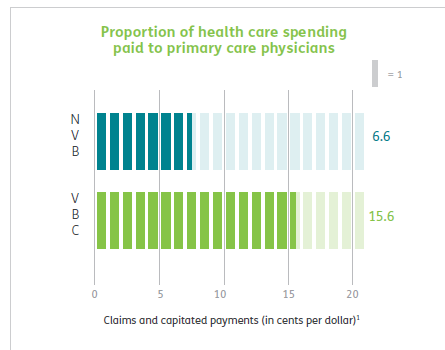
Humana has 4m Medicare advantage members with ~2/3rds of those in value-based care arrangements. The report has lots of data about how Humana makes everything better for those Medicare Advantage members and how VBC shows slightly better outcomes at a lower cost. But that wasn’t really what caught my eye. What did was their chart about how they pay their physicians/medical group

What it says on the surface is that of their Medicare Advantage members, 67% are in VBC arrangements. But that covers a wide range of different payment schemes. The 67% VBC schemes include:

  • Global capitation for everything 19%
  • Global cap for everything but not drugs 5%
  • FFS + care coordination payment + some shared savings 7%
  • FFS + some share savings 36%
  • FFS + some bonus 19%
  • FFS only 14%

What Humana doesn’t say is how much risk the middle group is at. Those are the 7% of PCP groups being paid “FFS + care coordination payment + some shared savings” and the 36% getting “FFS + some share savings.” My guess is not much. So they could have been put in the non-VBC group. But the interesting thing is the results.

Continue reading…

Torben Nielsen, CEO, Uptiv Health

Early this month I caught up with Torben Nielsen who is now CEO of Uptiv Health. Another one from the Redesign Health factory, Uptiv Health came out of stealth recently with the goal of improving the experience and reducing the cost of those patients who have to have regular infusion treatments. Uptiv Health just raised $7.5m and is opening its first location in Detroit at the end of August 2023, with a goal of becoming the health home of those chronic disease patients. Why do we need a new offering in infusion care? Torben will tell you–Matthew Holt

assetto corsa mods