
Today on THCB Spotlights, Matthew talks to Brooke LeVasseur, who is the CEO of AristaMD. AristaMD provides eConsults to empower providers to get patients faster access to care. The average wait time to see a specialist is one to two months, and the proportion of referrals to specialists that never happen can be incredibly high, at 40% in Medicare populations for instance. AristaMD aims to provide an efficient way for primary care providers to tap into the expertise of specialists to immediately start executing on a treatment plan without the patient having to wait or travel. Tune in to find out how AristaMD is actually rolling this out and get a demo of the platform.

Christina Liu
Sexism vs. Cultural Imperialism

By SARAH HEARNE
As I was getting ready for bed last night a friend shared a tweet that immediately caught my attention.
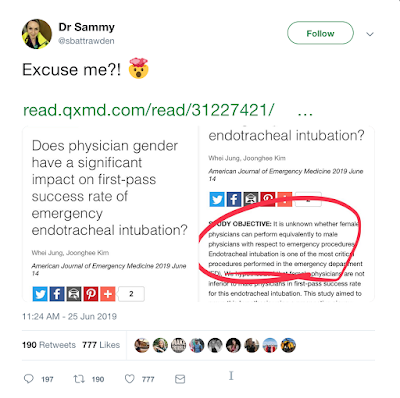
The tweet was of a paper that has just been published online, titled “Does physician gender have a significant impact on first-pass success rate of emergency endotracheal intubation?” and showed the abstract which began,
It is unknown whether female physicians can perform equivalently to male physicians with respect to emergency procedures.
Understandably, this got the backs up of a lot of people, myself included. Who on earth thinks that’s a valid question to be researching in this day and age? Are we really still having to battle assumptions of female inferiority when it comes to things like this? Who on earth gave this ethics approval, let alone got it though peer review?
I then took a deep breath and asked myself why a respected journal, The American Journal of Emergency Medicine, would publish such idiocy. Maybe there was something else going on. The best way to find out is to read the paper so I got a copy and started reading. The first thing that struck me was the author affiliations – both are associated with hospitals in Seoul, South Korea. The second author had an online profile, he is a Clinical Professor of Emergency Medicine. I couldn’t find the first author anywhere which made me think they are probably quite early in their career. The subject matter wasn’t something I could imagine a male early career researcher being interested in so figured they are probably female (not knowing Korean names I couldn’t work out if the name was feminine or masculine).
Why the Health Care System Is Incapable of Reducing Its Own Costs: A Brief Structural System Analysis

By JOE FLOWER
Leading lights of the health insurance industry are crying that Medicare For All or any kind of universal health reform would “crash the system” and “destroy healthcare as we know it.”
They say that like it’s a bad thing.
They say we should trust them and their cost-cutting efforts to bring all Americans more affordable health care.
We should not trust them, because the system as it is currently structured economically is incapable of reducing costs.
Why? Let’s do a quick structural analysis. This is how health care actually works.
Health care, in the neatly packaged phrase of Nick Soman, CEO of Decent.com, is a “system designed to create reimbursable events.” For all that we talk of being “patient-centered” and “accountable,” the fee-for-service, incident-oriented system is simply not designed to march toward those lofty goals.
Health in 2 Point 00, Episode 87 | Omada, Call9 & Politics
Today on Health in 2 Point 00, Jess and I are getting in the spirit of things with this week’s Democratic debate. In Episode 87, Jess asks me about Omada Health’s $73 million raise, bringing its total to $200 million, and about what happened with nursing home telehealth startup Call9 shutting down. We turn to politics with Trump telling HHS to have hospitals publish their price list—and it’s unclear that this is even going to make a difference—and to health care coverage in the Democratic debate. —Matthew Holt
Whole Genome Sequencing Heads for Consumers – Rodrigo Martinez of Veritas Genetics
By JESSICA DaMASSA, WTF HEALTH
DNA testing companies like 23andMe and Ancestry have made DNA testing mainstream, with adoption skyrocketing among consumers. Meanwhile, health tech startups like Veritas Genetics are starting to push the trend even further – from genotyping to whole genome sequencing. What’s the difference? Well, genotyping looks at less than half of 1% of your genome, while whole genome sequencing looks at over 99% of your genome.
Veritas is betting that consumers are ready for what’s revealed by looking at more than 6.4 billion letters of DNA and are promising that the value of that information will only get richer as time goes on and the science that makes sense of our genome achieves new breakthroughs.
In fact, Veritas is positioning their $999 test as “a resource for life” and Rodrigo Martinez, their Chief Marketing & Design Officer who I chat with here, shares a vision for the future that includes asking Alexa to scan your genome before taking medications or risking allergic reactions to foods.
This is fascinating proposition for the future of health (investors are jazzed too, having poured $50M into the company), but ethical questions abound. How do you make this information useful and actionable? How do you handle situations where major health issues are reveled? And what about data privacy? This is about as personal as personal health information can get. Rodrigo weighs in…
Can we move on?
By CHADI NABHAN MD, MBA, FACP
Every so often, my cynical self emerges from the dead. Maybe it’s a byproduct of social media, or from following Saurabh Jha, who pontificates about everything from Indian elections to the Brexit fiasco. Regardless, there are times when my attempts at refraining from being opinionated are successful, but there are rare occasions when they are not. Have I earned the right to opine freely about moving on from financial toxicity, anti-vaxers, who has ‘skin in the game’ when it comes to the health care system, the patient & their data, and if we should call patients “consumers”? You’ll have to decide.
I endorse academic publications; they can be stimulating and may delve into more research and are essential if you crave academic recognition. I also enjoy listening to live debates and podcasts, as well as reading, social media rants, but some of the debates and publications are annoying me. I have tried to address some of them in my own podcast series “Outspoken Oncology” as a remedy, but my remedy was no cure. Instead, I find myself typing away these words as a last therapeutic intervention.
Here are my random thoughts on the topics that have been rehashed & restated all over social media outlets (think: Twitter feeds, LinkedIn posts, Pubmed articles, the list goes on), that you will simply find no way out. Disclaimer, these are NOT organized by level of importance but simply based on what struck me over the past week as grossly overstated issues in health care. Forgive my blunt honesty.
The rAIdiologist will see you now

By RIZWAN MALIK, MBBS
The year is 2019 and Imaging By Machines have fulfilled their prophesy and control all Radiology Departments, making their organic predecessors obsolete.
One such lost soul tries to decide how he might reprovision the diagnostic equipment he has set up on his narrow boat on the Manchester Ship Canal, musing at the extent of the digital take over during his supper (cod of course).

What I seek to do in this short paper is not to revisit the well-trodden road of what Artificial Intelligence, deep learning, machine learning or natural language processing might be, the data-science that underpins them nor limit myself to what specific products or algorithms are currently available or pending. Instead I look to share my views on what and where in the patient journey I perceive there may be uses for “AI” in the pathway.
Health in 2 Point 00, Episode 86 | Lightning Round!
Today on Health in 2 Point 00, Jess and I are back from Europe and there is a LOT going on in health tech right now. In Episode 86, Jess asks me about United Health’s big moves, between acquiring PatientsLikeMe and their acquisition of DaVita Medical going through; integrated mental health company Quartet Health raising $60 million; Xealth closing a $14 million round (maybe now they’ll make Epic relevant); Collective Health’s $205 million raise led by SoftBank,; Vida’s $30 million round led by Teladoc (who knows why Teladoc didn’t just acquire Vida); European telehealth company Zava raising $32 million; and finally, Phreesia going IPO (wasn’t Livongo the one to watch?). —Matthew Holt
Patient Privacy Rights: Comment on Regulatory Capture


By ADRIAN GROPPER, MD and DEBORAH C PEEL, MD
To ONC and CMS
We begin by commending HHS, CMS, and ONC for skillfully addressing the pro-competitive and innovative essentials in crafting this Rule and the related materials. However, regulatory capture threatens to derail effective implementation of the rule unless HHS takes further action on the standards.
Regulatory capture in Wikipedia begins:
“Regulatory capture is a form of government failure which occurs when a regulatory agency, created to act in the public interest, instead advances the commercial or political concerns of special interest groups that dominate the industry or sector it is charged with regulating. When regulatory capture occurs, the interests of firms, organizations, or political groups are prioritized over the interests of the public, leading to a net loss for society. Government agencies suffering regulatory capture are called “captured agencies.” (end of Wikipedia quotation.)
The extent to which HHS has allowed itself to be influenced by special interests is not the subject of this comment. This comment is just about how HHS and the Federal Health Architecture can act to more effectively implement the sense of Congress in the 21st Century Cures Act.
A Rose by Another Name

By SAURABH JHA, MD
Can we reduce over diagnosis by re-naming disease to less anxiety-provoking makes? For example, if we call a 4.1 cm ascending aorta “ecstasia” instead of “aneurysm” will there be less over-treatment? In this episode of Radiology Firing Line Podcast, Saurabh Jha (aka @RogueRad) discusses over diagnosis with Ian Amber, a musculoskeletal radiologist at Georgetown University, Washington.



