Categories

Month: August 2009

Health Reform Bills Would Be Great For the Business Of Health Care

Editors Note:  This piece by veteran THCB contributor, Robert Laszewski, first appeared on Kaiser Health News. The piece is republished here with permission.

Democrats-cap-and-trade-bill-house-renewable Have you noticed how none of the big health care business special
interests is running any negative health care reform ads? Why should
they when each is poised to gain billions of dollars from it?

As
President Barack Obama has said many times, any health care bill that
costs about $1 trillion would be paid for, roughly half and half, with
savings in the health care system and new revenues (taxes).

All
told, health care providers will likely get hit by $500 billion in
federal payment reductions over 10 years from what they would have
received otherwise. This is their "savings" contribution to help pay
for the overhaul effort. It amounts to no more than a couple of
percentage points less than they would have received anyway.

But
more importantly, the Congress is getting ready to spend $1 trillion
over the same 10 years mostly to expand Medicaid and provide subsidies
to the uninsured to help them purchase private health insurance and be
able to pay their medical bills. The health industry, by giving up $500
billion, gets millions more patients armed with public and private
health insurance cards. Not a bad deal—particularly when the other $500
billion needed to finance the bill comes from new levies on taxpayers,
not bigger industry cuts.

The details show an even prettier picture for the business of health care.

Continue reading…

What can $100 get you?

I don’t use THCB much to point out what good we all can do—I keep that for my year-end letter—but my favorite charity (Saigon’s Childrens Charity) is at its financial year end and just sent me the reports for the kids I support. I’ve asked people who want to talk to me in the past to “buy a kid a bike.” And as it’s late on a Friday and I’m about to go out and take my wife to dinner, I thought you might all think about alternate uses for the $100 I’m about to spend (Yes, she’s a cheap date). Here’s what $100 buys for a very, very poor kid in Vietnam (and because of the recession donations are off this year, so they need more help).

Continue reading…

We’ll be back here in 2016, unless

I’ve been meaning for a while to put up a common sense post that points out that if we don’t do reform now, we’ll end up with cost at close to $30K per family as opposed to the $15K as they are now, and in turn that will mean 80–100 million uninsured as opposed to 50–60 million we have now, and of course the end result will be a health care industry that looks like General Motors.

But luckily Joe Paduda just wrote the post for me and added a date—go read at Managed Care Matters.

Which just leads to one conclusion. The health care industry had better buckle down with the Blue Dogs, put more on the table, and get something passed that they can live with now. AND in addition, they need to figure out some way to stop the loony fringe at the town halls and listening to Rush Limbaugh from making the next best alternative be doing nothing—which is what they want.

Otherwise the conversation they’ll be having with the President and the Chinese central bank in 2016 will be very, very unpleasant.

Innovation and Absence of Evidence vs. Evidence of Absence

Congress

Jon Gabel from the National Opinion Research Center has an excellent op-ed piece in today’s New York Times. The basic argument is summarized in his conclusion:

“The Congressional Budget Office’s integrity is beyond questioning. But the record shows that it has substantially overestimated the cost of health care reform three times out of three. As Congress now works on its greatest push for reform in generations, the budget office needs to revise the methods it uses to make predictions about costs.”

Far from being an arcane methodological debate, CBO’s approach has profound consequences for health care reform and for the long-term health and economic conditions of the country. As Gabel puts it:

“The budget office’s cautious methods may have unintended consequences in the current health care reform effort. By underestimating the savings that can come from improved Medicare payment procedures and other cost-control initiatives, the budget office leads Congress to think that politically unpopular cost-cutting initiatives will have, at best, only modest effects. This, in turn, forces Congress to believe it can pay for reform only by raising taxes, which then makes reform legislation more difficult to pass.”

The reason that CBO has underestimated savings from past reforms of Medicare is that it makes the assumption that — without convincing empirical evidence of an initiative’s cost impact — it basically “scores” it as delivering zero savings. No doubt that CBO is consistent and conservative, but that doesn’t necessarily produce the most accurate budgetary forecast.

Perhaps more so than any other area in the federal budget, there are an enormous number of unknowns in health care. CBO has historically built its model on the premise that absence of evidence equates with evidence of absence.

But there is a major distinction. “Evidence of absence” means that we have an empirical reason to believe that there is no effect of an intervention (in this case on cost). In that case, it makes sense to score zero savings.

In contrast, “absence of evidence” simply means that we do not have sufficient evidence that an intervention produces any effect.  The problem is that, by definition, any true “innovation” (defined by Merriam-Webster as “the introduction of something new”) has no evidence. Which is to say: CBO has effectively ruled out scoring savings for true innovation.

Perhaps some would argue that’s an overstatement in that we certainly commonly use the term innovation to describe something that has been around long enough to be tested. Yes and no. There’s no doubt that new and innovation are relative terms, but there are still important reasons why that approach for CBO remains flawed.

First, evaluation takes time. To design a study, appropriately manage it, collect and analyze data, submit to peer review, and publish often takes many years.

Second, the level of evidence that CBO typically requires takes A LOT of time.

Third, innovation often comes from combining different initiatives and strategies that create a combined effect greater than the sum of their parts. Information therapy, patient decision aids, comparative effectiveness research, and other delivery system reforms may have a powerful impact when thoughtfully and appropriately combined together.

Fourth, the pace of innovation and the greatest innovative impacts can be dramatically robust. There is no way, in its current model, for CBO to capture those things that will have the most important effects on the federal health budget.

Like Jon Gabel, I don’t question the CBO’s integrity or analytical capacity, but I do believe that its methodological approach requires amendment. As I have written before, we — as health services researchers (and I admit to being one myself) — need to maintain our analytical rigor while being as creative in our research methods as the innovators are at innovating.

We should not shy away from the empirical idiosyncrasies that innovative care delivery initiatives create. Rather, we should rise to the challenge by employing a broader set of research and analytical skills to tackle these compelling research questions about new innovations. Indeed, the new care delivery strategies create opportunities for health services researchers to develop their own innovative research techniques.

I hope that health services researchers out there are up to that challenge.

If we aren’t, we will continue to create perverse public policy incentives.

Joshua Seidman is the president of of the Center for Information Therapy that aims to provide the timely prescription and availability of evidence-based health information to meet individuals’ specific needs and support sound decision making.  He frequently blogs for THCB and the Center for Information Therapy Blog, where this post first appeared.

SHARETHIS.addEntry({ title: “Innovation and Absence of Evidence vs. Evidence of Absence”, url: “http://ixcenterblog.org/archives/737” });

“Meaningful Use” Criteria as a Unifying Force

Vince-20kuraitis09-small

Over the past several years, many diverse initiatives have arisen offering partial solutions to systemic problems in the U.S. health care non-system.

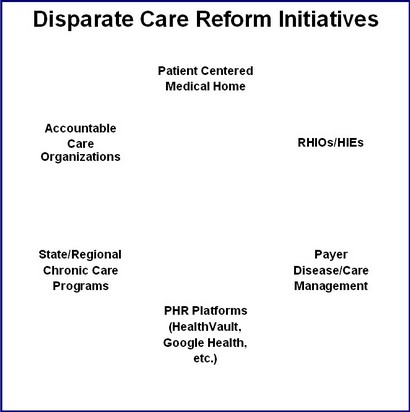
We see Meaningful Use Criteria recommended by the HIT Policy Committee as a unifying force for these previously disparate initiatives. These initiatives have included:

  • Patient Centered Medical Homes (PCMHs)
  • Regional Health Information Organizations (RHIOs)/Health Information Exchanges (HIEs)
  • Payer Disease/Care Management Programs
  • Personal Health Record Platforms — Google Health, Microsoft HealthVault, Dossia, health banks, more to come
  • State/Regional Chronic Care Programs (e.g., Colorado, Pennsylvania, Improving Performance in Practice)
  • Accountable Care Organizations — the newest model being proposed as part of national reform efforts

Today

While there are some commonalities and overlap, to-date these initiatives have mostly arisen in isolation and are highly fragmented — they’re all over the map. Here’s a graphic representation of the fragmentation that exists today:

MU1

Tomorrow

The HIT Policy Committee recently recommended highly detailed Meaningful Use criteria for certified EHRs.  Doctors and hospitals who hope to receive HITECH Act stimulus funds will have to demonstrate that they are meeting these criteria; the criteria are not yet finalized.

The Committee website describes the central role of the Meaningful Use criteria:

The focus on meaningful use is a recognition that better health care does not come solely from the adoption of technology itself, but through the exchange and use of health information to best inform clinical decisions at the point of care.

The HIT Policy Committee also is recognizing that there are multiple routes to achieving Meaningful Use beyond the traditional EMR 1.0, e.g., modular Clinical Groupware software.

While some might view the Meaningful Use criteria as limited to the world of health IT — something happening “over there” — we see much more going on. We believe the Meaningful Use criteria are becoming a powerful unifying force across the health system, with potential to converge previously disparate initiatives.  Here’s our conceptual representation:

MU2

Let’s consider a couple examples to demonstrate how convergence is occurring.

RHIOs were formed primarily with a mission of developing health IT infrastructure for local data exchange; they had little need to think about how care providers, health plans and others would actually use the data.

Patient Centered Medical Homes have been built around seven principles (e.g., physician directed medical practice, care coordination) — none of which directly relate to a need to develop health IT infrastructure; the fact that IT infrastructure is necessary to implement these principles has been assumed but not defined.

RHIOs focused on health IT with little thought about objectives, while PCMHs had grand objectives with little thought about needs for health IT.

All this is changing.

RHIOs are recognizing that achieving meaningful use of data is essential; PCMH initiatives are recognizing the need for a robust IT infrastructure and the need to match their efforts to Meaningful Use criteria.

Here are some broader implications about Meaningful Use criteria becoming a unifying force:

  • These diverse initiatives will have more commonalities and will look more and more alike
  • Expect previously disconnected regional initiatives to start talking to one another about collaboration.
  • A common phrase we are hearing is “We need to do a crosswalk of Meaningful Use criteria with our initiative/organization/application functionality.”
  • Vendors must ask: “What are we doing to contribute to Meaningful Use of EHRs”
  • Care providers (doctors and hospitals) must ask: “How are vendor offerings helping us to achieve Meaningful Use of EHRs?”

These are positive developments.  Meaningful Use criteria are becoming a powerful unifying force toward integrating our fragmented health system.

Vince Kuraitis JD, MBA is a health care consultant and primary author of the e-CareManagement blog where this post first appeared. David C. Kibbe MD MBA is a Family Physician and Senior Advisor to the American Academy of Family Physicians who consults on healthcare professional and consumer technologies.  Steve Adams is Founder and CEO of RMD Networks, a Denver, Colorado based company.

“Money driven medicine” on PBS tonight

Tonight the documentary based on Maggie Mahar’s book Money-Driven Medicine is on Bill Moyers’ show on PBS.

Meanwhile if you haven’t seen this clip of Oklahoma Republican Senator Tom Coburn seriously suggesting to a completely desperate woman that her neighboors should be the ones helping her look after her husband with a traumatic brain injury, you’ll be illuminated by how out of touch (and that’s putting it very kindly) he and lots of his colleagues are on the real life actual needs of people suffering now as opposed to inciting vitriol from the fringe over vague concerns in the future.

Can a Collection of Official Statements Be Called a “Blog”?

American Medical Association president, J. James Rohack has begun sharing his thoughts on the U.S. health care system, health reform and other issues affecting patients and physicians in a new blog, according to the AMA.

There’s one problem: the AMA presidency is an elected position whose occupant has roughly the same freedom of expression as a senior Iranian clergyman or a member of Vladimir Putin’s cabinet. The AMA, so virulent for so many years in opposition to the group practice of medicine, yields to no one in its practice of group consensus medical politics. All communications by AMA officers and board members are strictly scripted to adhere to official positions.

In other words, an AMA blog is simply repackaged blarney. Don’t consult Dr. Rohack expecting even the barest glimpse of a genuine “second opinion.”

Michael Millenson is a writer, consultant and frequent speaker on healthcare topics. His work appears frequently in these pages and on other blogs, including the Huffington Post.

Health Care Reform’s Deeper Problems

Uscapitolindaylight

Congress’ health care reform debate has highlighted how American governance is broken and the difficulty of addressing our national problems.

Take, for example, whether health care is in crisis at all. Conservative commentators argue that America’s health system is fine, that our excellent care simply costs more than other countries’ poorer quality, and that most uninsureds can afford coverage. They ask why we should revamp a great system for the two or three percent of Americans who get less.

This misrepresents reality, though. Care and outcomes are often superior in other developed nations. In America, the ranks of the uninsured and under-insured have skyrocketed, from insurance costs that have grown four times general inflation for a decade. Health coverage is employers’ most unpredictable major cost, a threat to their businesses’ competitiveness, and they have increasingly offloaded costs onto employees. So while  the marginalized uninsured are an important problem, declining coverage for the mainstream is the greater worry. Most know that, even with insurance, any major health problem can spell financial ruin.

As businesses and individuals have been priced out of health coverage over the last four years, commercial health plan enrollment has plummeted by as much as 20 percent, or about 36 million people. The Kaiser Family Foundation reports that 40 percent who lose group health coverage probably become uninsured.

Fewer people buying coverage means less money to pay for health care products and services, so the industry is experiencing an unprecedented financial decline. With reforms looming, it has fiercely advocated for universal coverage, which would provide stable funding for a larger patient population. Meanwhile, the industry has opposed changing business mechanisms that encourage waste, even though experts agree that one-third or more of all health care cost is unnecessary or inappropriate. But this raises an important question. Why not spend less by recovering wasted dollars, and then improve access?

The industry has pressed its goals through lobbying, which lets special interests exchange campaign contributions for policy influence. The non-partisan Center for Responsive Politics reports that, between January and June, the industry gave Congress more than $260 million. One lobbyist commented, “A person can reach no other conclusion than this is a quid pro quo [this for that] activity.”

The funds have gone mostly to Democrats, the party in power now, and are producing their contributors’ desired results. The current proposals expand coverage, but do little to reduce cost, failing to heed any of health care’s management lessons from the last 25 years. For example, they won’t re-empower primary care, which other nations have found will maintain a healthy populace for half the cost of our specialist-dominated approach. They fail to make care quality and cost transparent, which would let health care finally work as a market, and help identify the best health care vendors. They continue to favor fee-for-service reimbursement, which rewards delivering more products and services rather than rewarding results. And they all but ignore our capricious medical malpractice system, which most doctors say encourages defensive practice.

These problems and their solutions are structural, and are well understood within the industry. If reform does not pursue these structural approaches, health care will continue to drag down the larger economy. Our current problems will remain and intensify, at enormous cost.

Out of this experience, the American people should become aware of a couple of harsh truths.

First, so long as Congress willingly exchanges money for influence, American policy will favor special interests rather than the public interest. We’ll be unable to meaningfully address our national problems: energy, the environment, education, and so on.

Second, so long as partisans distort the truth to discredit their opponents, rather than focusing on our very real problems, America’s future will continue to be compromised.

Which is to say that we have deeper problems than an inability to fix health care.

Brian Klepper, PhD is a health care analyst based in Atlantic Beach. David C. Kibbe MD MBA is a physician and Senior Advisor to the American Academy of Family Physicians.

David C. Kibbe MD MBA is a Family Physician and Senior Advisor to the American Academy of Family Physicians. Brian Klepper PhD is a health care analyst.

More by these authors:

U.S. v. Europe — What’s Your Risk of Dying?

Want to have some fun with numbers? Check out a brand new “Death Risk Rankings” website, which was sent my way today by Dr. Paul Fischbeck of Carnegie Mellon University in Pittsburgh. He and his colleagues have compiled data and made a user-friendly interface that allows you to compare the risk of dying within periods of time at various ages of various causes. It also allows the user to set variables like sex and race as well as age. Very cool.

So what did learn in my first pass through the data?

If you’re a 50- to 59-year-old man (guess how old I am), your chances of dying in the next ten years are better if you live in the U.S. than in Europe: 7.8 percent versus 8.2 percent. However, all of the difference was due to a single factor: the higher rate of cancer deaths in Europe, which is undoubtedly due to the much higher rate of smoking.

But the situation is completely reversed if you’re a 50- to 59-year-old woman. For late middle-aged women, the chances of dying in the next ten years is much higher in the U.S.: 4.7 percent versus 3.9 percent. Cancer death rates are almost exactly the same in the two regions, but U.S. women over 50 are much more likely to die of heart disease, diabetes, infectious diseases and respiratory diseases — in short, everything that a good health care system that stresses prevention can help.

And did you know that if you reach age 80, your chances of dying in the next year are about one in ten? I was initially disturbed by that number. But after thinking about it for a few moments, I realized that if I were 80, I’d probably think those were pretty good odds. Moreover, if I still have the energy to play 18 holes of golf at age 80, I’ll probably think I have a pretty good chance of beating them. And if I didn’t have the energy to play 18 holes, who’d want to live anyway?

Merrill Goozner has been writing about economics and health care for many years. The former chief economics correspondent for the Chicago Tribune, Merrill has written for a long list of publications including the New York Times, The American Prospect and The Washington Post. His most recent book, The $800 Million Dollar Pill – The Truth Behind the Cost of New Drugs ” (University of California Press, 2004) has won acclaim from critics for its treatment of the issues facing the health care system and the pharmaceutical industry in particular. You can read more pieces by Merrill at  Gooznews.com, where this post first appeared.

assetto corsa mods

