
I had shoulder surgery on Monday and today I’m getting information about what happened delivered into the big LLMs. Follow along with me as I figure out how to get the information in there and what it tells me. — Matthew Holt
HealthEx — The Demo with Claude & the CEO Speaks!
I spent some time figuring out and getting a little help in uploading my health records to Claude, using HealthEx. I did the demo with Ruheed Mohamed, the head of technical services, and then I interviewed CEO Priyanka Agarwal, MD. This shows how Healthex gets data and incorporates it into Claude, and where Priyanka thinks the business is going, and why she wants to change the way consumers get health care data.–Matthew Holt
Transcript of Interview with Priayanka Aggarwall MD (2nd half of video. First half you need to watch!)
Matthew Holt: Hey, Matthew Holt, quick THCB, spotlight. And this is a bit of an adjunct to the, work I’ve been doing trying to figure out how the new, big LLMs like, Anthropic’s Claude and OpenAI’s ChatGPT are now working their health angle and getting health records. And I’m very lucky to have with me Priyanka Agarwal. Priyanka is a, UCSF trained MD who is the CEO of HealthEx, which does what exactly, Priyanka?
Continue reading…Owen Tripp, Included Health–How to Fix AI
It’s been a while since I talked with Owen Tripp, CEO of Included Health. They’ve now introduced Dot their AI companion which had a big upgrade last week. We talked a little about that and I snuck in their video comparing the Dot Experience with a standard LLM. But the conversation really got into how do we make AI safe and trustworthy–which is definitely the hot topic these days. Owen is putting together a coalition of the willing to work on that exact topic. I’ll be watching closely–Matthew Holt
This was such a great discussion I wanted to publish the transcript. The way I do that is to copy the YouTube-generated transcript and drop it into Claude to smooth it over. I then read it, and if I think it’s made an error, I dip back into the video and listen to what actually happened and make a correction. This is all to say: I think this transcript is pretty accurate, but it might have a bunch of AI- and human-generated mistakes.
Continue reading…Gozio – Patient Navigation & Directions!
I had a great conversation and demo with Katie Logan and Christine Smith from Gozio a while back. Finally got it up on THCB. Gozio provides two types of patient navigation for health systems. One as a digital front door helping patients navigate to doctors, services and tools like virtual care and appointments from the hospitals, and actual navigation from the parking lot to the clinic/bedside. Why should hospitals hire Gozio (and spent a few $100k+) when some of this stuff is buried in MyChart in a typical health system? Calls go down, visits go up and Google ratings go up. They are in 25-35 systems now and aiming for many more.–Matthew Holt
This was such a great discussion I wanted to publish the transcript. The way I do that is to copy the YouTube-generated transcript and drop it into Claude to smooth it over. I then read it, and if I think it’s made an error, I dip back into the video and listen to what actually happened and make a correction. This is all to say: I think this transcript is pretty accurate, but it might have a bunch of AI- and human-generated mistakes.
Continue reading…Ran Shaul, K Health
K Health started life as symptom checker and spent a lot of time working with Elevance/Anthem. But in recent years has become a sophisticated LLM tuned to patients and now is working exclusively with major health systems as a front door including Mayo, Cedars Sinai and now Atlantic Health providing PatientGPT and Virtual Primary Care. I had Ran Shaul, Chief Product Officer come on THCB Spotlight to show how K Health is being used in various ways across health systems. He showed me various demos and I also asked him about the relationship with Epic, and what the future of care delivery with LLMs is going to be. Ran thinks we might need more doctors not less!–Matthew Holt
This was such a great discussion I wanted to publish the transcript. The way I do that is to copy the YouTube-generated transcript and drop it into Claude to smooth it over. I then read it, and if I think it’s made an error, I dip back into the video and listen to what actually happened and make a correction. This is all to say: I think this transcript is pretty accurate, but it might have a bunch of AI- and human-generated mistakes.
Continue reading…Pre-Surgical Complications (Part 6) — The Decision
By MATTHEW HOLT
Strap in for the tale of why your hero is spending most of his life down YouTube rabbit holes of cardiology videos while blundering his way around many many medical centers and exposing many problems with American health care even before he gets close to the operating table. Yes it’s Matthew Holt’s pre-surgical complications – the complications that have arisen before he even gets his failing aortic valve fixed. And yes this is the last for now of a multi-parter! Part 1, Part 2, Part 3, Part 4 Part 5
By now I have met with expert physicians and their teams at 5 major medical centers (UCSF, Stanford, Cleveland Clinic, Cedars Sinai & West Virginia University). I have spent hours talking to the AI gods at Claude, ChatGPT and Inciteful Med, annoyed the hell out of all the cardiologists and other doctors I know, and basically got enough contradictory advice that it’s all up to me.
The main decision comes down to whether I should get a TAVR or the RAVR. And because I approached Cedars about the BELIEVERS clinical trial rather than going direct to Dr Makkar, they put me into that process. The trial randomizes patients into either TAVR or RAVR, likely performed by Dr. Dominic Emerson who is the Director of Robotic Cardiac Surgery, Smidt Heart Institute, and one of the surgeons mentioned by Dr Badhwar. (I had a quick chat with him after he called me while I was on a ski boat in Lake Tahoe, although due to the shoulder pain I had not gone wakeboarding!)
The study documentation stressed – and this was backed up unprompted by one of the study coordinators – that I could back out at any time. So if I were randomized into the RAVR cohort, I still had the choice to pull out and ask Dr Makkar to do a TAVR on me anyway, or of course go to West Virginia and get surgery there.
And of course there is still the question of how risky a TAVR on my valve will be. I did take Dr Yeung’s advice seriously, and a study that Dr Makkar oversaw back in 2020 did show that (for patients considerably older than me) the risk of all cause mortality at 2 years in bicuspid valve TAVR patients was higher with bad calcification (like me). On the other hand, Dr Makkar told me that his unpublished data between TAVR and SAVR at 5 years showed no difference. He also directly told me that I was a good candidate for a TAVR and he has done more bicuspid TAVRs than anyone else. He’s also working on techniques that break up the calcification on the “join” before the TAVR, although it’s unclear if he’ll do that in the BELIEVERS trial and to me
I originally wanted a TAVR because it was a much easier recovery than surgery. I also have two more major surgeries to go through within the next few months, and it would be a big stress on me and my family to make that three. Plus, I both would be happy to contribute to a medical study and am pretty confident that in a decade or so, cardiology will have advanced a lot more and I probably wouldn’t need open heart surgery even if the TAVR valve fails sooner than the 10-15 years I am hoping to get out of it.
So I crossed my fingers and hoped that the computer would randomize me into the TAVR group at Cedars and obviate the need for any uncomfortable decisions about pulling out of the trial. And it did. I’ll be getting it done in early September.
This isn’t exactly Lebron James making The Decision, although that show lasted only 75 minutes and also went on way too long!
Some concluding thoughts
I would obviously rather have not had to write this little memoir. But given I went through it, there are several conclusions smacking me in the face.
Continue reading…Pre-Surgical Complications (Part 5)
By MATTHEW HOLT
Strap in for the tale of why your hero is spending most of his life down YouTube rabbit holes of cardiology videos while blundering his way around many many medical centers and exposing many problems with American health care even before he gets close to the operating table. Yes it’s Matthew Holt’s pre-surgical complications – the complications that have arisen before he even gets his failing aortic valve fixed. And yes this is a multi-parter! Part 1, Part 2, Part 3, Part 4
Claude told me that Dr Amy Fiedler at UCSF was an expert in RAMT (right anterior minithoracotomy–the non endoscopic rib entry technique). I sent a note to my original Cardiology group on the UCSF MyChart system saying that I understood she did this surgery and could I have an appointment with her? You can see from my messages with them below that the appointment was set up.
It should not have been.
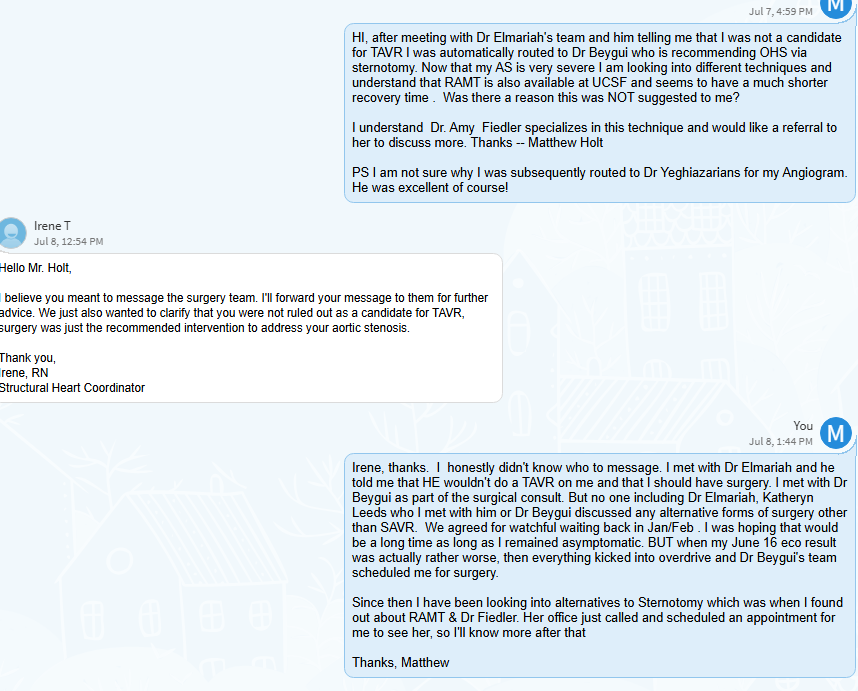
I had a very brief conversation with Dr Fiedler and almost immediately it became apparent I was wasting her time. She told me she does not do that RAMT surgery for valve replacement and she specializes in heart transplants, and some other specialized heart surgery. I think that Claude had read the web page about her doing minimally invasive cardiac surgery and put 2 + 2 together and made 5. But to be fair her UCSF webpage didn’t give me the level of detail she gave me in the video call, and the UCSF cardiology team set up the call even though I presume someone there knows that she didn’t do the thing I was asking about.
To be clear, Dr Fielder was very gracious and very helpful in her advice. I just felt bad for wasting 15 minutes of her time. To reiterate, the time of a cardiac surgeon is way more valuable than mine. I left telling her I hoped I would never need her services!
***
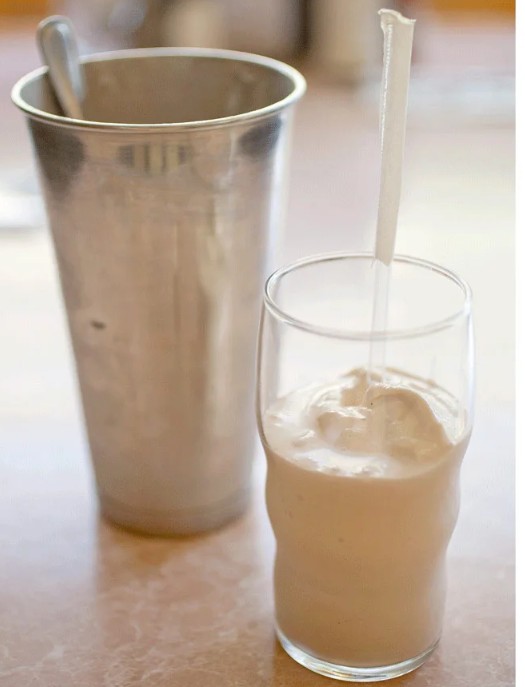
Next stop was to drive down to Palo Alto and pop into the Creamery for a chocolate malt and cheeseburger in advance of meeting Dr Yeung, the cardiologist. The med tech did a four limb blood pressure test on me and also a full 12 lead EKG. I of course had had all that earlier at UCSF, and wasn’t sure why I was having more. But anyway, she soon left saying Dr Yeung was coming.
Instead Dr Anson Lee came in. He’s the cardiac surgeon working on the valve team. He basically told me that Dr Yeung wouldn’t do a TAVR on me. Now I wasn’t expecting to see him (nor did I know who he was till I looked him up after he left the room) but we had a very helpful conversation about valve surgery and the best ways to do it. Then he went and got Dr Yeung. Together they pulled up a colorized 4D CT scan of my valve. (I assume it came from the CT I had in January). Dr Yeung showed me in precise detail why he thought giving me a TAVR now was a bad idea. (Basically too much calcification on the fused part of the leaf, and it’s too oval, which would make the procedure risky and likely not fit properly). He told me that if I had the surgery, someone would easily put a TAVR in my surgically implanted valve in 12-15 years, and that’s all I would need–unless I plan on living forever or to 100!.
Dr Lee told me that if he was getting it done he’d have a full sternotomy, although he actually does mini-sternotomies. He also was the only person thus far to tell me NOT to do it if I am asymptomatic. His logic is that something like 1/150 patients die during the surgery so don’t have it if you don’t need it (i.e. are asymptomatic). The reason he’d want a full sternotomy for his choice of entry was to give the surgeon the least complicated shot at the valve.
He also said that his mini-sternotomy patients can drive after 2 weeks, not 4-6. Which seems to contradict what the UCSF team told me about the same procedure.
But in my case, needing knee surgery and shoulder surgery, the shock of those on the heart would count as “symptoms”. So Dr Lee told me I should get the surgery if I was going to get the shoulder or knee fixed. But he also said that the higher echo reading might have been a false negative, and it might be years before I have symptoms.
I’m not sure my trip to Stanford left me much clearer. But the chocolate malt was damn good.
***
Next up was connecting with the oft-cited team doing RAVRs at University of West Virginia led by Dr Vinay Badhwar. Both Dr Lee and Dr Fiedler unprompted said that he was the surgeon when it came to the robot valve replacement and his email was available online. (Most doctors don’t make their email easily available). I had Claude write an email describing my clinical situation and sent it to him late one night.
The next morning before I got up, there was a reply from Dr Badhwar in my inbox, and shortly thereafter, his team was all over me. They got my information, got access to my imaging at UCSF, and his physician assistant Amy Simsa called me a day later to describe the process. Within a week I had a video consult with Dr Badhwar and his team. In terms of responsiveness they were by far the best organization to deal with. Stanford, UCSF, Cleveland, Cedars et al could take a few lessons!
The only slight wrinkle was that I got a robocall on a Sunday from the facility telling me where to check-in to my appointment–clearly not set up for telehealth. I noted this in a brief email to his office and got a reply from a human (who I will not identify to spare their blushes) at 5.15pm on a Sunday night! I’m not sure they’re not working too hard.
Although Dr Badhwar was very modest and very keen to tell me about others working with him as he spreads the gospel of RAVR, he and his team have clearly done more of these more successfully than anyone else and are the world experts. If I want a RAVR it’s almost certain that I have to get on a plane, and so I will likely end up in Morgantown, WV–which is about an hour south of Pittsburgh for those of you who missed geography day in high school. That’s not a sentence I thought I would ever write!
***
My last (for now) call was with the CEDARS team setting up the BELIEVERS trial. I spoke with Dr Raj Makkar. He said he had done 8,000 TAVRs and more than anyone else on bicuspid patients. He disagreed with Dr Yeung and Dr Elmariah. He says that my valve was suitable for a TAVR, and he said that the risk of stroke during TAVR was less than the risk of death from SAVR. He also said that they are about to publish 5 years of data showing that the resilience of TAVR valves was the same as SAVR valves. He suggested using a 26mm valve on me, and that it would likely last 10-12 years, and that not only would he be able to do a TAVR in TAVR on that one, but he had already been doing 3rd TAVR in TAVR in TAVR.
I asked if I showed up at his clinic but not for this trial would he have done a TAVR on me? He said emphatically “yes”. He does use the Sentinel Cerebral Protection System which essentially captures any calcification dislodged from ascending up the aorta to the brain, although my friend Claude tells me the data on whether that prevents a stroke is murky. Frankly Dr Makkar was very self assured and had I met him at the start of this journey I wouldn’t have bothered going anywhere else! Of course, because he wants to do the trial and get that data out in the world, he wants me in the trial, and I might be randomized into the surgical group.
This is I hope the end of the pre-surgical part! With the slight exception that I haven’t actually yet made a decision about what to do!
UPDATE: Now I have made a decision in Part 6
Matthew Holt is publisher of THCB
Pre-Surgical Complications (Part 4)
By MATTHEW HOLT
Strap in for the tale of why your hero is spending most of his life down YouTube rabbit holes of cardiology videos while blundering his way around many many medical centers and exposing many problems with American health care even before he gets close to the operating table. Yes it’s Matthew Holt’s pre-surgical complications – the complications that have arisen before he even gets his failing aortic valve fixed. And yes this is a multi-parter! Part 1, Part 2, Part 3
Getting in touch
But while knowing this stuff may be simple, actually getting to speak to the people at these medical centers is way more complicated. First you have to set up the data.
I knew they would want to see my images. The good news was that although I couldn’t see any of the images in my UCSF MyChart account, there’s a number to call on the bottom of the reports if you want to “download the image” and a very nice tech was able to upload all my images to a website that I could see called AmbraHealth (now part of Intelrad) within a couple of hours. Now I can share them with other people similar to sharing a Google doc.
But that was the easiest part.
I will spare you the blow by blow account but for example it took a long time for the people in the office of the main investigator at Cedars to figure out who the person managing the trial was so they could put me in touch with her. After I finally got to leave her a message she rang me back. I played phone tag with her for about a week. I did end up getting her email and sending out a bunch of my image reports and then she went on vacation and I didn’t hear from her for two weeks. First contact to appointment took 6 weeks.
At the same time I was trying Stanford Cardiology in order to try to get an appointment with Dr Yeung. First time I called after about 10 mins on hold I was told that I needed to have a referral. (Even though I’m on PPO style plan that doesn’t need one).
I pinged my long suffering PCP team at One Medical and asked them for a referral to talk to Dr Yeung which they sent out. A few days later I called the cardiology team at Stanford and eventually – I mean eventually, it was literally a 10 minute hold – they told me the referral wasn’t through yet. I asked if I could get them some images in advance, they said no. They were able to set me up on MyHealth which is their equivalent of the Epic’s MyChart. Funnily enough they had information on me from an emergency room visit I made there in the 1990s. But because I did not have an appointment set up yet I was not able to communicate using the messaging function on MyHealth.
So I called back a few days later and after another seven or eight minute hold I was told that I had an appointment set up for me and it was on MyHealth. But bizarrely the referrals and visits are buried in the “billing” section of MyHealth and then the appointment was on a sub-menu! And of course even though I could see it there was no way to communicate about the appointment.
This was even stranger as Stanford booked me both an echocardiogram and what’s called a CT angiogram which is a non-invasive angiogram using a CT machine. I had had both of these done at UCSF within the previous month.
Continue reading…Pre-Surgical Complications (Part 3)
By MATTHEW HOLT
Strap in for the tale of why your hero is spending most of his life down YouTube rabbit holes of cardiology videos while blundering his way around many many medical centers and exposing many problems with American health care even before he gets close to the operating table. Yes it’s Matthew Holt’s pre-surgical complications – the complications that have arisen before he even gets his failing aortic valve fixed. And yes this is a multi-parter! Part 1, Part 2
The first thing was to message the cardiac scheduling team to postpone the surgery set up for July, not least reason being because England was going to be in the World Cup final two days after that and I didn’t want to be in intensive care in case they weren’t showing the game. Yes, yes, I know Messi and the cheating FIFA refs made sure that sadly didn’t happen!
I agreed with them to put a date on the calendar for September. But that didn’t stop a prep nurse calling me on Monday 29th June asking me about surgery on July 17th. She was most surprised to find that it wasn’t happening. Yet another time when the message didn’t quite get through.
Time to really figure out what this heart surgery involves.
Essentially if I wasn’t watching soccer from late June onwards I was trying to figure out what was known about valve replacement surgery. It was actually hard to find out both what the data is regarding TAVRs and the varying ways that surgical valve replacement can be done.
It turns out that going in through the chest bone, known as sternotomy, is the most usual way to do the surgical replacement of the heart valve but it’s not the only way.
This discovery took me a lot of effort not only asking chatGPT and Claude about the process but also trying to figure out who does what. I also spent a lot of time asking for advice and honestly not getting much useful on the ValveReplacement SubReddit and looking on heartvalvesurgery.com, a website that seems to be sponsored by some surgeons and medical centers but is run by a patient called Adam Pick. I have been down the rabbit hole there and on YouTube and have more or less had to figure this out myself.
I was also reminded of the classic 1996 Fortune piece by then Intel CEO Andy Grove who was trying to figure out which approach to use to treat his prostate cancer. Basically he realized that the radiologists and the surgeons didn’t talk to each other and didn’t compare results, and he – the patient – had to figure it out from the rather poor data available, and talking to other patients on Compuserve! Well, it was 1996.
It turns out that there are several different options possibly available to me. But in terms of coordination and the patient journey, I’m not sure that we’ve come a long way since Andy Grove’s piece 30 years ago.
Continue reading…Pre-Surgical Complications (Part 2)
By MATTHEW HOLT
Strap in for the tale of why your hero is spending most of his life down YouTube rabbit holes of cardiology videos while blundering his way around many many medical centers and exposing many problems with American health care even before he gets close to the operating table. Yes it’s Matthew Holt’s pre-surgical complications – the complications that have arisen before he even gets his failing aortic valve fixed. And yes this is a multi-parter! Part 1 here
So on the Friday afternoon I was readying for my video call when there was a car parking emergency. I had to move two Sprinter vans and a car belonging to guests who were all out apres skiing out of our driveway so my wife could get her car out of the garage to get to an appointment she had. Although I was as quick as I could, I was about 10 minutes late for Dr Beygui but he very nicely called me up wondering if I was still okay to do it, was very cordial even though I made him wait, and we had a nice chat. He basically didn’t give me any new information in this conversation and yes UCSF did get paid for it! He was mostly assuming that I couldn’t walk a couple of blocks without getting short of breath but at the end of it we agreed that because I was in good physical shape and able to go snowboarding all day I would go ahead with a knee surgery later in the summer and only come back to him when I became symptomatic.
Starting in March I got the requisite knee imaging (I had an MRI and 2 X-rays confirming my meniscus is gone and knee was pretty trashed), met with Dr Bini and the ortho team and started prepping for the surgery later that summer–which basically meant going to the gym and doing lots of weights and resistance training on my knees.
A little later I got an unexpected call from Dr Beygui’s physician assistant who told me that he was still trying to line me up for the open heart surgery. I told him I was still keener on a TAVR. He said that I shouldn’t have a TAVR because the TAVR valves only last 5 to 7 years. Yeung from Stanford’s original report told me they lasted about 10 to 12 years. Elmariah the UCSF cardiologist said that they thought they lasted 10 plus years but there was no good data. Given you can probably have one TAVR and then have another put inside when the first one fails and then maybe even another (TAVR in TAVR in TAVR), these numbers actually matter!
Here’s the crux of the TAVR issue. If you can add 10 + 10 + 10 that gives you another 30 years of life which sounds pretty good to somebody in their early 60s. But if you can’t get more than 5 to 7 years out of a TAVR and can only do one more “TAVR in TAVR”, then you’re getting 10 to 15 years before you need to have a very complicated open heart surgery because it’s now replacing two different artificial valves. In that case I might not survive and I wouldn’t even be old enough to be President!
As you can see this decision is starting to get a little bit complicated.
But the good news was that I could stop thinking about it because my heart wasn’t getting worse and the orthopedics (and anesthesia) team at UCSF was happy to do the knee replacement.
As we were all steaming down this path I got a call from Dr Beygui’s scheduling assistant. My initial agreement had been to have an echocardiogram 6 months after the last one which would actually have been after the knee surgery. I’m not sure how much coordination between the departments there was given what happened a bit later but Dr Beygui requested that I have an echocardiogram before any surgery. As I was going in anyway to have a CT in mid-June to prep for the knee surgery, I said fine.
In another great drama of American health care it turns out that my insurance had changed. For most of the first half of the year I purchased a Blue Shield of California HMO on the ACA exchange called Covered California. In May my wife got a job and we then moved over to being covered by her employer’s insurer (well, ASO TPA as it turns out) Cigna.
Cigna and the entire University of California Health system decided to have a dispute which threatened that Cigna would not cover UCSF starting on July 1st. I won’t go into the crazy logic of why an insurance plan that one buys on an annual basis starting in January has contracts with providers that expire in the middle of the year, but welcome to America. Because of this the orthopedic team moved my surgery date up into late June just 4 days after all the prep imaging including that echocardiogram.
Oh and a few weeks earlier I had had a very minor snowboarding fall going very slowly in soft slushy snow. I banged my shoulder but for some reason it didn’t get any better. I actually went and had some physical therapy which seemed to help, but as I was hanging out so much at UCSF, I also had an appointment with the shoulder specialists. They sent me for a pretty uncomfortable MRI and the result from that was that I had total tears in all my rotator cuff tendons. The recommendation for that is surgery that also has a long recovery, but if you ignore it for too long the muscles can atrophy. Claude was very depressed for me when it interpreted that MRI report!
A spanner in the works
Those of you familiar with sod’s law can guess what happens next. The result of the echocardiogram was that the aortic stenosis had gone from being severe to being very severe. The precise number was that my peak velocity went from 4.6 m/s in Jan to 5.1 m/s in June just 4 and ½ months later.
I discussed this with my trusted health confidant and Claude guessed that this might be a problem and the anesthesia team might not want to have me get the knee surgery.
The next sequence of events reveals that nobody in American healthcare talks to each other.
Continue reading…



