I can’t believe I somehow missed when OpenAI introduced DALL-E in January 2021 – a neural network that could “generate images from text descriptions” — so I’m sure not going to miss now that OpenAI has unveiled DALL-E 2. As they describe it, “DALL-E 2 is a new AI system that can create realistic images and art from a description in natural language.” The name, by the way, is a playful combination of the animated robot WALL-E and the idiosyncratic artist Salvator Dali.
This is not your father’s AI. If you think it’s just about art, think again. If you think it doesn’t matter for healthcare, well, you’ve been warned.
Here are further descriptions of what OpenAI is claiming:
“DALL·E 2 can create original, realistic images and art from a text description. It can combine concepts, attributes, and styles.
DALL·E 2 can make realistic edits to existing images from a natural language caption. It can add and remove elements while taking shadows, reflections, and textures into account.
DALL·E 2 can take an image and create different variations of it inspired by the original.”
Here’s their video:
I’ll leave it to others to explain exactly how it does all that, aside from saying it uses a process called diffusion, “which starts with a pattern of random dots and gradually alters that pattern towards an image when it recognizes specific aspects of that image.” The end result is that, relative to DALL-E, DALL-E 2 “generates more realistic and accurate images with 4x greater resolution.”
Each week I’ve been adding a brief tidbits section to the THCB Reader, our weekly newsletter that summarizes the best of THCB that week (Sign up here!). Then I had the brainwave to add them to the blog. They’re short and usually not too sweet! –Matthew Holt
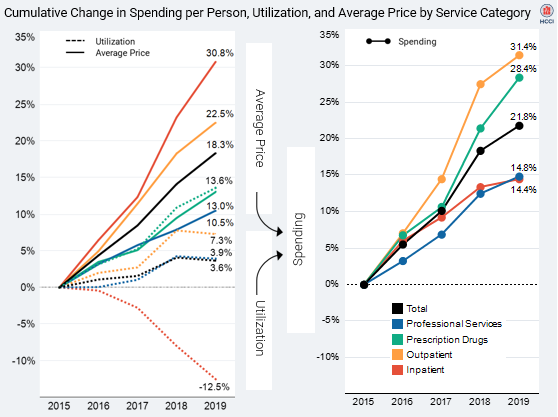
None of this is any great surprise. Over the past three decades, the big hospital systems have become more concentrated in their markets. They’ve acquired smaller community hospitals and, more importantly, feeder systems of primary care doctors. Meanwhile they’ve cut deals with and acquired specialty practices. For more than two decades now, owned-physicians have been the loss leader and hospitals have made money on their high cost inpatient services, and increasingly on what used to be inpatient services which are now delivered in outpatient settings at essentially inpatient rates. Prices, though, have not fallen – as the HCCI report shows.
Source: HCCI
The overall cost of care, now more and more delivered in these increasingly oligopolistic health systems, continues to increase. Consequently so do overall insurance premiums, costs for self insured employers and employees, and out of pocket costs. And as a by-product, the reserves of those health systems, invested like and by hedge funds, are increasing–enabling them to buy more feeder systems.
More traction in Pharmacy Benefits Management (PBM) innovation, this time coming out of care-navigation-plus-PBM startup Rightway. CEO Jordan Feldman and Chief Pharmacy Officer Scott Musial (who Jordan calls the “Godfather of PBMs”) drop in to talk about their 1500 employer client base and how the business is now even winning over health plans who are tired of working with the ‘Big Three PBMs.’
The NextGen PBM story is the headliner here, with Rightway customers saving an average 18% in their first year with the “new-to-the-world PBM” the company has built.
What’s different? Two big things. First, the PBM’s payment structure for the employer. Jordan shares how these are usually rebates-driven or based on spread pricing; Rightway is actually innovative in offering the PBM benefit on a per-member-per-month basis instead.
That leads to the second twist, which is based on gaining cost savings for the employer by pairing the PBM with navigation. According to Scott, this changes the conversation from one that’s solely focused on managing the price of the drugs to managing how employees are utilizing the formulary instead – creating opportunities for lower-priced generics or alternatives that Rightway is happy to point to because it’s not dealing with rebates or dispensing.
So, who is Rightway competing with? Navigators like Accolade, Inc. or Included Health? PBMs like CVS/Caremark, Optum or Express Scripts? Or other emerging ‘combo’ businesses like Transcarent?
We get into the competitive landscape, more about PBMs than you might have ever wanted to know, and what Jordan and Scott are hearing from hard-hit employers looking to recruit and retain employees in the face of the Great Resignation.
Well at least my hair is under control today. What’s not under control is the chatter about Olive from Erin Brodwin at Axios, even if I don’t get Jess’ joke about the internet of Health Care. Meanwhile deals in nursing recruitment for IntelyCare ($115m), Avi Medical (50M Euros), Eleos Health ($20m), Evernow ($20m) and $25m for Vivosense–note my total inability to say their investor’s name!–Matthew Holt
We think we know robots, from the old school Robbie the Robot to the beloved R2-D2/C-3PO to the acrobatic Boston Dynamics robots or the very human-like Westworld ones. But you have to love those scientists: they keep coming up with new versions, ones that shatter our preconceptions. Two, in particular, caught my attention, in part because both expect to have health care applications, and in part because of how they’re described.
Hint: the marketing people are going to have some work to do on the names.
———–
Let’s start with the robot called by its creators – a team at The Chinese University of Hong Kong — a “magnetic slime robot,” which some in the press have referred to as a “magnetic turd robot” (see what I mean about the names?). It has what are called “visco-elastic properties,” which co-creator Professor Li Zhang explained means “sometimes it behaves like a solid, sometimes it behaves like a liquid…When you touch it very quickly it behaves like a solid. When you touch it gently and slowly it behaves like a liquid”
The slime is made from a polymer called polyvinyl alcohol, borax, and particles of neodymium magnet. The magnetic particles allow it to be controlled by other magnets, but also are toxic, so researchers added a protective layer of silica, which would, in theory, allow it to be ingested (although Professor Zhang warned: “The safety [would] also strongly depend on how long you would keep them inside of your body.”).
The big advantage of the slime is that it can easily deform and travel through very tight spaces. The researchers believe it is capable of “grasping solid objects, swallowing and transporting harmful things, human motion monitoring, and circuit switching and repair.” It even has self-healing properties.
Watch it in action:
In the video, among other tasks, the slime surrounds a small battery; researchers see using the slime to assist when someone swallows one. “To avoid toxic electrolytes leak[ing] out, we can maybe use this kind of slime robot to do an encapsulation, to form some kind of inert coating,” Professor Zhang said.
As fate would have it, the news of the discovery hit the on April 1st, leading some to think it was an April Fool’s joke, which the researchers insist it is not. Others have compared the magnetic slime to Flubber or Venom, but we’ll have to hope we make better use of it.
It is not yet autonomous, so some would argue it is not actually a robot, but Professor Zhang insists, “The ultimate goal is to deploy it like a robot.”
———-
If magnetic slime/turd robots don’t do it for you, how about a “magnetic tentacle robot” – which some have deemed a “snakelike” robot? This one comes from researchers at the STORM Lab at the University of Leeds. STORM Lab’s mission is:
We strive to enable earlier diagnosis, wider screening and more effective treatment for life-threatening diseases such as cancer…We do so by creating affordable and intelligent robotic solutions that can improve the quality of life for people undergoing flexible endoscopy and laparoscopic surgery in settings with limited access to healthcare infrastructures.
In this particular case, rather than using traditional bronchoscopes, which might have a diameter of 3.5 – 4 millimeters and which are guided by physicians, the magnetic tenacle robot offers a smaller, more flexible, and autonomous option. Professor Pietro Valdastri, the STORM Lab Director, explained:
A magnetic tentacle robot or catheter that measures 2 millimetres and whose shape can be magnetically controlled to conform to the bronchial tree anatomy can reach most areas of the lung, and would be an important clinical tool in the investigation and treatment of possible lung cancer and other lung diseases.
Moreover, “Our system uses an autonomous magnetic guidance system which does away for the need for patients to be X-rayed while the procedure is carried out.” A patient-specific route, based on pre-operative scans, would be programmed into the robotic system. It could then inspect suspicious lesions or even deliver drugs.
Dr. Cecillia Pompili, a thoracic surgeon who was a member of them team, says: “This new technology will allow to diagnose and treat lung cancer more reliably and safely, guiding the instruments at the periphery of the lungs without the use of additional X-rays.”
The robot was tested on a 3D replica of a bronchial tree, and will next be tested on lungs from a cadaver. It will likely take several years to reach clinical settings. The team has also created a prototype of a low-cost endoscope and a robotic colonoscopy system, among other things.
We demonstrate that the proposed approach can perform less invasive navigation and more accurate targeting, compared with previously proposed magnetic catheterization techniques… we believe that atraumatic autonomous exploration of a wide range of anatomical features will be possible, with the potential to reduce trauma and improve diagnostic yield.”
“It’s creepy,” Professor Valdastri admitted to The Washington Post. “But my goal … is to find a way to reach as deep as possible inside the human body in the least invasive way as possible… Depending on where a tumor is, this may be the only way to reach [it] successfully.”
Nitish V. Thakor, a professor of biomedical engineering at Johns Hopkins University, told The Post: I can imagine a future where a full CAT scan is done of the lungs, and the surgeon sits down on a computer and lays out this navigation path of this kind of a snake robot and says: ‘Go get it.’ ” He also sees potential for uses outside the lungs, such as in the heart.
Similarly, Dr. Janani S. Reisenauer, a surgeon at The Mayo Clinic, declared to The Post: “If it’s a small, maneuverable autonomous system that can get out there and then do something when it’s out there, that would be revolutionary.”
———-
Personally, I’m still holding out hope for nanoparticles, but these kinds of soft, flexible robots could be important until we get there. Sure, maybe people will be reluctant to be told they have to ingest magnetic slime – much less a magnetic turd – or have a snakelike robot put down their throats, but it may beat having a scope inserted or being cut open.
The researchers can keep working on the robots; others of us can work on better names.
Kim is a former emarketing exec at a major Blues plan, editor of the late & lamented Tincture.io, and now regular THCB contributor.
I’m delighted to have a new contributor on THCB today. Blake Madden writes an excellent health care business newsletter called The Healthy Muse, which I highly suggest you subscribe to. Recently he gave his take on Optum’s latest big acquisition and it’s the first of I hope many pieces of his we’ll run on THCB–Matthew Holt
by BLAKE MADDEN
On March 29, UnitedHealthcare’s Optum announced its acquisition of LHC Group for $170/share. The transaction values LHC at about $6.4 billion including debt.
I know we all joke about working for UnitedHealthcare one day, but it’s terrifying when you think about their sheer scale. Even scarier when you look at Optum’s growth:
Optum Revenue in 2012: $29.4 billion
Optum Revenue in 2021: $155.6 billion. Like. What.
LHC Group is an important acquisition for Optum. Payors are continuing to morph into ‘payviders’ and UHG / Optum has a huge competitive advantage given its 60k aligned physician base. Acquiring LHC Group accelerates this payvider trend but also allows UHG to catch up to Humana, who now owns all of Kindred, in the post-acute sphere.
Meanwhile, Optum is deploying its grand vision of integrated care delivery right before our eyes. It’s happening whether you like it or not.
Even though I provided a first-impressions breakdown on Twitter related to the deal, I had to break this deal down into more detail and give you guys my thoughts on why the LHC acquisition is so significant.
Let’s dive in.
Investment and Deal Thesis.
LHC Group is well-positioned on a few fronts in the fast-growing home health sector:
They’re partnered with 435 health systems, giving Optum access to hundreds of hospital joint ventures.
Home health and at-home care is a MUCH more desirable care setting for Medicare beneficiaries. Comfort and patient experience is a huge factor.
Of all post-acute care settings, home health is the most cost-effective. Home health costs way less than skilled nursing. Lower costs = lower medical loss ratio for United. By keeping patients out of SNFs and hospitals, these programs could disrupt facility-based care delivery in the coming years.
From a demographics standpoint, home health benefits from an aging baby boomer population. Medicare will cover 79 million people by 2030 a major secular trend for healthcare. I’m sure you’re all WELL aware of that!
PDGM and other headwinds for smaller agencies will run out of relief funding, resulting in consolidation. This consolidation will benefit larger home health platforms.
In summary, LHC Group is a great operator in a high-growth industry: Home Health.
What’s with my baseball hat? Find out in this episode! Apparently, someone thinks my hair is a bit out of control and needs some trimming. In this episode of Health Tech Deals, Jess and I review Clarify Health raising $150 million; Season raising $34 million; Altoida grabbing $20 million; nirvanaHealth getting $60 million; and Pluto Health raising $9 million–Matthew Holt
Two hundred and ten years ago, on September 7, 1812, a Putinesque commander, narrowly won a battle, but lost a war and entered a downward cycle that ended his reign. The battle was the Battle of Borodino, a town on the river Moskva, 70 miles west of Moscow. The commander was Napoleon.
The facts are clear-cut: Napoleon arrived with 130,000 troops, including his 20,000 Imperial Guards, and 500 guns. Opposing him were 120,000 Russians with 600 guns. The battle engaged from 6 AM to Noon. The French took 30,000 casualties, while the Russians lost 45,000 men, but survived to fight another day.
As Leo Tolstoy describes the scene of carnage on page 818 of his epic novel, War and Peace, in 1867, “Several tens of thousands of men lay dead in various positions and uniforms in the fields and meadows where for hundreds of years peasants of the villages…had at the same time gathered crops and pastured cattle. At the dressing stations, the grass and soil were soaked with blood over the space of three acres. Crowds of wounded and unwounded men of various units, with frightened faces, trudged on…Over the whole field, once so gaily beautiful with its gleaming bayonets and puffs of smoke in the morning sun, there now hung the murk of dampness and smoke and the strangely acidic smell of saltpeter and blood. Small clouds gathered and began to sprinkle on the dead…”
But in the next paragraphs, it becomes clear that Tolstoy’s intent and focus is not to describe why and how Napoleon had won the Battle of Borodino, but rather how this was the beginning of the end of his army and the Napoleonic reign.
Tolstoy writes: “For the French, with the memory of the previous fifteen years of victories, with their confidence in Napoleon’s invincibility, with the awareness that they had taken part of the battlefield, that they had lost only a quarter of their men, and that they still had the intact twenty-thousand-man guard, it would have been easy to make the effort (to advance and annihilate the Russians)….But the French did not make that effort….It is not that Napoleon did not send in his guard because he did not want to, but that it could not be done. All the generals, officers, and soldiers of the French army knew that it could not be done, because the army’s fallen spirits did not allow it….(They were) experiencing the same feeling of terror before an enemy, which, having lost half his army, stood as formidably at the end as at the beginning of the battle. The moral strength of the attacking French was exhausted…(For the Russians, it was) a moral victory, the sort that convinces the adversary of the moral superiority of his enemy and of his own impotence, that was gained by the Russians at Borodino.”
The Russians not only retreated, but did not stop in Moscow, continuing another 80 miles beyond their beloved city. But as Tolstoy describes, “In the Russian army, as it retreats, the spirit of hostility towards the enemy flares up more and more; as it falls back, it concentrates and increases.”
As for the French, they take Moscow but stop there. Again from Tolstoy, “During the five weeks after that, there is not a single battle. The French do not move. Like a mortally wounded beast, which, losing blood, licks its wounds, they remain in Moscow for five weeks without undertaking anything, and suddenly, with no cause, flee back…without entering a single serious battle…”
Putin’s aging dreams of conquest likely are Napoleonic in scale. But as his hesitant forces observe the Borodino-like human carnage that they have unleashed on Mariupol, at the estuary of the Kalmius and Kalchik rivers, and prepare to enter Kyiv, the first eastern Slavic state which, a Millennium ago, acquired the title “Mother of Rus Cities”, their vulnerability and lack of “moral strength” is already apparent. Lacking a rational stated goal other than dominance, the young Russian conscripted soldiers and their commanders must certainly grow more concerned day by day. They too have become entrapped, and are “experiencing the same feeling of terror before an enemy, which, having lost half his army, stood as formidably at the end as at the beginning of the battle.”
As for Putin, like Napoleon, he may feel the winds of fate blowing heavily on his shoulders even now. Napoleon did make it back to Paris. But three years after the Battle of Borodino and the 5-week occupation of Moscow, he met his Waterloo on June 16, 1815, at the hands of the Duke of Wellington. He died in exile on the island of Helena on May 5, 1821. In his last will, he wrote, “I wish my ashes to rest on the banks of the Seine, in the midst of that French people which I have loved so much.”
Putin likely feels a similar love for Mother Russia, but ultimately the Russian people may choose not to return the affection.
This is the third part of former Kaiser Permanente CEO George Halvorson’s critique of Medpac’s new analysis of Medicare Advantage. Part 1 is here. Part 2 is here. Eventually I’ll be doing a summary article about all the back and forth about what Medicare Advantage really costs!-Matthew Holt
Risk status and RAF
What is on the MedPac radar screen and what keeps their attention and what actually takes up several long portions of the annual report this year is the other factor that changes the payment levels to the plans — the risk status of their enrollees.
The capitation levels that are paid to the plans are affected very directly by the health status levels of the actual enrollees.
Risk levels for the members set and change the payment levels for the plans. The very first capitation programs didn’t factor in relative risk status for the members, and it was possible for some care sites to make major profits on capitation just by enrolling healthier than average people and by being paid an average cost level for each area for the people they enrolled.
That initial payment process has evolved very intentionally into having diagnosis-based cost factors that attempt to link the health status of the members and a fair payment level for the plans. The plans identify for the risk filing process the diagnosis levels for the members and their payment levels as plans are directly affected by the risk levels they report for their members.
People have had some concern about whether some parts of that coding process have been done badly, incorrectly or with purely avaricious intent.
There have been significant levels of concern expressed about whether the plans might be able and willing to produce and present inaccurate and distorted information in the process. That alarm was triggered in part by the fact that some of the plans made getting that information into their annual filings a high priority and some were more successful than others in that process.
It is good to have accurate diagnosis information.
We actually should as a nation and a health care macro system want to see an expansion of our data base and our medical records on basic levels of diagnostic information.
As a nation and as a macro care system we should definitely want to have full diagnosis information for each patient. Care can be better when caregivers have the right diagnosis for all of their patients.
How CMS has changed Risk Adjustment
CMS just did a brilliant thing and completely eliminated the filing system and process for risk coding and data.
The CMS Hierarchical Conditions Categories Risk Adjustment Model was just killed. CMS just took the system that has created the vast majority of concerns and churn about the issues of coding intensity and shut it down.
It no longer is a factor for any risk scores. CMS will still look at the relative risk levels of patients but will get that information completely from patient encounter filings and direct patient information and not from any plan filings or reports.
An entire industry of organizations working to enhance risk scores just became obsolete and irrelevant.
Well Health is flying under-the-radar as a white-label patient communications platform that lets more than 400 healthcare providers text message their patients via their hospital’s EMR. In the “is it a feature or is it a company?” debate that often surrounds digital front door startups, I ask CEO Guillaume de Zwirek why Well Health has decided to go out as an infrastructure play rather than own the patient relationship itself. How does he see this strategy lending itself to long-term growth?
One of the best-funded startups that I’ve never heard of (they’ve quietly raised $97 million from the likes of Dragoneer, Lead Edge Capital, Twilio Ventures and others) we get into the details behind the business model, the tech that’s supporting their patient comms platform, and why I haven’t heard about these big fundraises.