
We’ve heard a lot of whining over the years from private insurers about how they have to pay more because Medicare pays less. But now Wellpoint is going to essentially use the ACA as cover to put all of its hospitals on a pay for performance plan–obviously related to the ACO ideas we’re hearing from CMS. The WSJ reports that all hospitals in Wellpoint’s networks are going to be paid future increases based on a formula for outcomes, patient safety and patient satisfaction. Thus far private insurers have been laggards in that they haven’t really mixed up payment schemes to incent better behavior by providers–even though nothing was stopping them. They always claimed they would eventually. Maybe eventually is now.
Above the Fold
How Should Medicare Pay for Medical Care?
By JOHN GOODMAN
There are basically five possibilities. To compare them, let:
S = each unit of service, or a package of services
P = the price of each unit of service, or the price of a package of services
Then the government can:
1. Dictate every service it will pay for and the price it will pay for each of them (fix S and P), leaving providers to compete only on amenities, including waiting times.
2. Dictate S, but leave providers free to compete on P, say, through a system of competitive bidding.
3. Dictate P, but leave providers free to compete on what S they will provide for that price.
4. Initially fix S and P, but leave providers free to opt out, substituting different bundles of S & P as long as government’s cost goes down and quality of care goes up.
5. Initially fix S and P, but allow patients to opt out, managing a portion of the funds directly and making their own purchasing decisions.
Alert readers will recognize (4) and (5) as NCPA solutions, (3) as the Rivlin-Ryan plan, and (1) as the status quo. But I’m getting ahead of the story.
Under the current system (Method 1), Medicare establishes a list of about 7,500 physician tasks it will pay, and sets the price for each of them. These prices differ, however, for every city, town, and hamlet in the land. So that in fact there are millions of prices that Medicare is administering every day.
One important drawback of this system is that it’s in no one’s interest to curtail spending. Every provider maximizes profit and every patient maximizes utility by exploiting the reimbursement formulas.
Cloud Only is Dead for Health
A lot of people are intrigued with using “cloud” applications and storage for personal health data. This week we’re seeing what I think is the final nail in the coffin of “cloud only” for anything important. You gotta have offline backups: two huge cloud vendors – Amazon and now Google – have demonstrated that even they can go down, leaving their users absolutely powerless.
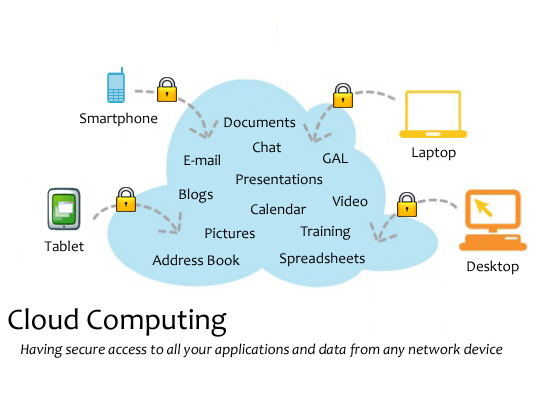
Cloud computing (Wikipedia) is hugely attractive to software developers and businesses. As shown in this diagram from Wikipedia, the idea is that you do your computing using storage or tools that are on some computer somewhere out there “in the cloud.” You don’t know or care where, because somebody out there takes care of things. As your business or database grows, “they” take care of it.
And it’s real – it works.
But when “they” screw up, you could be screwed.
Last month Amazon Web Services went down for a couple of days. PC Magazine posted a good summary, and many of us learned that well known companies like Hootsuite and Foursquare don’t actually own the computers that deliver their product: they rent services from Amazon Web Services (AWS).
So when AWS went down, there was nothing they could do to help their customers.Continue reading…
Sorry, been busy!
You may have noticed that I haven’t been hanging around THCB much this week so far. Well I have a great excuse. This is my wife Amanda and our new daughter Colette. She was born on Sunday at 6 am and mom and baby are doing very well!
The Quantified Self and the Future of Health Care
 The Quantified Self is a global collaboration of users and tool-makers interested in the personal meaning of personal data. There are now Quantified Self groups in more than twenty cities around the world. Our inspiration is the Homebrew Computer Club. Once upon a time, computers were thought to be useful only for scientists, managers, and planners. But a few people saw things differently: they argued that computers were for all of us. That notion seemed very strange. What would an ordinary person do with a computer? But it turned out that the personal uses of computers were not just an important use, but the most important use.
We at the Quantified Self think of data the same way. Nearly every day, we hear about a new system to track human behavior. There is sensor-based tracking of sleep, activity, location, heart rate, blood glucose, metabolism, even facial expression. There are web services to track mood, diet, menstrual cycle, productivity, and cognition. (This is just a sample, to give a sense of range, and not an endorsement of any particular approach.) Often, when I talk to my friends in the health care field, they are eager to know how exploring these tools might be justified in conventional health care terms: return on investment, treatment outcomes, patient compliance, etc. This managerial view of data is part of the important conversation that happens every day on the The Health Care Blog. But for the remainder of this post, I’d like to ask you put these questions aside. Seeing something of the big culture change happening outside health care might prove useful for solving some of the seemingly intractable problems inside it.
There are three reasons people track themselves:
They have a specific goal, such as losing weight, keeping fit, sleeping better, ameliorating a chronic condition, or training for an athletic competition.
They are generally curious. Surprisingly often, people find their tracking data valuable even in the absence of narrowly-defined utility. These self-trackers see their data as a kind of mirror on the self, helpful in maintaining overall self-awareness. (Like keeping a diary.)
They want to establish a baseline with which to measure future changes. This often goes along with a belief that the data will become more powerful over time. Personal data, in this sense, is an investment that will pay off in the future, and is part of an exploratory, pioneering worldview.Continue reading…
The Lightweight Romney Health Plan
 Mitt Romney has outlined his new health plan. He outlined five key steps in an op-ed in USAToday. Here is a summary:
Step 1: Give states the responsibility, flexibility and resources to care for citizens who are poor, uninsured or chronically ill.
Step 2: Reform the tax code to promote the individual ownership of health insurance.
Step 3: Focus federal regulation of health care on making markets work…For example, individuals who are continuously covered for a specified period of time may not be denied access to insurance because of pre-existing conditions. And individuals should be allowed to purchase insurance across state lines, free from costly state benefit requirements. Finally, individuals and small businesses should be allowed to form purchasing pools to lower insurance costs and improve choice.
Step 4: Reform medical liability. We should cap non-economic damages in medical malpractice litigation.
Step 5: Make health care more like a consumer market and less like a government program. This can be done by strengthening health savings accounts that help consumers save for health expenses and choose cost-effective insurance.
It looks to me like his health care outline is more intended to make conservative Republicans happy then to really propose ways to reform America’s health care system.
There isn’t one new idea here and it all comes straight from the 2010 Republican campaign playbook.Continue reading…
The Social Life of Health Information
By SUSANNAH FOX
“I don’t know, but I can try to find out” is the default setting for people with health questions.
The internet has changed people’s relationships with information. Data collected by the Pew Internet Project and the California HealthCare Foundation consistently show that doctors, nurses, and other health professionals continue to be the first choice for most people with health concerns, but online resources, including advice from peers, are a significant source of health information in the U.S.
These findings are based on a national telephone survey conducted in August and September 2010 among 3,001 adults in the U.S., with interviews conducted in either English or Spanish and including 1,000 cell phone interviews. The full report, “The Social Life of Health Information, 2011,” is available at pewinternet.org.
The survey finds that, of the 74% of adults who use the internet:
- 80% of internet users have looked online for information about any of 15 health topics such as a specific disease or treatment. This translates to 59% of all adults.
- 34% of internet users, or 25% of adults, have read someone else’s commentary or experience about health or medical issues on an online news group, website, or blog.
- 25% of internet users, or 19% of adults, have watched an online video about health or medical issues.
- 24% of internet users, or 18% of adults, have consulted online reviews of particular drugs or medical treatments.
- 18% of internet users, or 13% of adults, have gone online to find others who might have health concerns similar to theirs.
- 16% of internet users, or 12% of adults, have consulted online rankings or reviews of doctors or other providers.
- 15% of internet users, or 11% of adults, have consulted online rankings or reviews of hospitals or other medical facilities.Continue reading…
The Dual Online Identities of Physicians
 Like everybody else, physicians are expanding their online personal identities. At the same time, they are trying to comply with codes of conduct that help consumers trust them and their profession.
There’s no problem so long as the personal online activities of physicians don’t jeopardize their obligations as professionals, which means that there is a problem, unfortunately.
In a recent study for example, 17% of all blogs authored by health professionals were found to include personally identifiable information about patients. Scores of physicians have been reprimanded for posting similar information on Twitter and Facebook, posting lewd pictures of themselves online, tweeting about late night escapades which ended hours before they performed surgery, and other unsavory behaviors.
As I mentioned Monday, medical students and younger physicians who grew up with the Internet have to be particularly careful, since they had established personal online identities before accepting the professional responsibilities that came with their medical degree.
Medical schools, residency programs and teaching hospitals can help young professionals manage their dual lives online. Some have implemented curricula and policies that foster appropriate use of social media, but surprisingly these programs are not widespread. In a recent study of medical schools that had experienced at least one incident in which a student used social media inappropriately, only 38% had adopted formal policies to handle future incidents. An additional 11% reported they were developing such policies. We can do better than this.
Non-teaching hospitals, CME providers and professional organizations like the American Medical Association can also help providers navigate the online world. The AMA’s recent guide to Professionalism in the Use of Social Media provides helpful guidance in this regard.
Silicon Valley roars back…in healthcare too?
Recently, the Wall Street Journal has been writing article after article about how Silicon Valley is suddenly as hot again as in 1995. And anyone driving into San Francisco these days will have views of the city obscured with big “we’re hiring” billboards from the Groupons, Zyngas, Rockyous, and whathaveyous of the world.
In the past healthcare innovation and startups/new value creation has proceeded independent of that tech-scene and it has been much slower, dominated by buying behavior from giant incumbents who thought NIH stood for Not In Healthcare. But as my colleague and Health 2.0 co-founder Matthew Holt likes to put it: change starts at the edges. And we have seen Health 2.0 start small at the edges with the growth of patient communities, followed by other models connecting patients, payers, and providers in new ways (e.g. American Well, athenahealth, Castlight).
On May 18 SDForum is organizing a one-day event highlighting the change that is afoot in mainstream healthcare as a result of the innovation from the edges reaching the shores (and more) of mainstream health and wellness industries.
I am introducing the first keynote speaker (Holly Potter from Kaiser Permanente) and moderating a panel on one of my favorite topics: how data and innovation in analytics can make treatment and wellness decisions better, and hence create value, for all involved. While 80% of presenting companies are young (from only a few months in existence to 5 years from initial funding), there are also some pioneering established companies (Kaiser Permanente, Safeway, PAMF) who will touch upon topics like:
- how ONC’s push for ‘data Liberacion’ is one of several forces helping to make health decisions more data-driven
- how mobile/unplatforms, cloud-computing, and innovative use of analytics create new opportunities to understand patient behavior and introduce new, smart interventions
- how chronic disease treatment is starting a transformation (funky billboards in LAX not withstanding, Lisa)
- how new entrepreneurial energy is being backed by more and more funding (Healthtap is one of the companies who recently received funding and who will be on the panel that I moderate, Doximity is another company that fits that bill)
Finally, while some companies in general tech or consumer markets seem to pursue growth without a business model, this event shows how companies in healthcare who get it right (e.g. Limeade), can grow fast, do good, and become financially viable businesses. Maybe one day the WSJ will report on the exciting IPO window of healthcare technology innovation companies for a change. In the meantime, come and see what the future will look like by hearing from those who are building it now.
Marco Smit is President of Health 2.0 Advisors, the market intelligence arm of the Health 2.0 family.
The Unbearable Lightness of Being Mitt
By ROBERT REICH
One of my regrets in life is losing the chance to debate Mitt Romney and whip his ass.
It was the fall of 2002. Mitt had thundered into Massachusetts with enough money to grab the Republican nomination for governor. Meanwhile, I was doing my best to secure the Democratic nomination. One week before the Democratic primary I was tied in the polls with the state treasurer, according to the Boston Herald, well ahead of four other candidates. But my campaign ran out of cash. Despite pleas from my campaign manager, I didn’t want to put a second mortgage on the family home. The rest is history: The state treasurer got the nomination, I never got to debate Mitt, and Mitt won the election.
With Trump, Gingrich, Bachmann, and possibly Palin now in the race for the Republican presidential nomination, “GOP” is starting to mean Goofy, Outrageous, and Peculiar. Mitt would pose the most serious challenge to a second Obama term.
I say this not because Mitt’s mind is the sharpest of the likely contenders (Gingrich is far more nimble intellectually). Nor because his record of public service is particularly impressive (Tim Pawlenty took his governorship seriously while Mitt as governor seemed more intent on burnishing his Republican credentials outside Massachusetts). Nor because Mitt is the most experienced at running a business (Donald Trump has managed a giant company while Mitt made his money buying and selling companies.) Nor, finally, because he’s especially charismatic or entertaining (Sarah Palin can work up audiences and Mike Huckabee is genuinely funny and folksy, while Mitt delivers a speech so laboriously he seems to be driving a large truck).Continue reading…






