Joining Matthew Holt (@boltyboy) on #THCBGang on Thursday July 20 at 1pm PST 4pm EST are futurists Jeff Goldsmith; patient advocate Robin Farmanfarmaian (@Robinff3); Suntra Modern Recovery CEO JL Neptune (@JeanLucNeptune); and our special guest Investor at Bessemer Sofia Guerra (sofiaguerrar)
You can see the video below & if you’d rather listen than watch, the audio is preserved as a weekly podcast available on our iTunes & Spotify channels.
The All-in podcast is a fairly popular show that features successful silicon valley investors commenting about everything worth commenting on from politics to health. The group has good chemistry and interesting insights that breaks the mold of the usual tribal politics that controls legacy media analysis of current events.
Brad Gerstner, who is actually a guest host for this particular episode starts off by referencing something called Heartflow to evaluate the heart that has been recommended by one of the other hosts: Chamath Palihapitiya. Brad apparently asked his primary care physician about Heartflow and was instead directed to get a calcium scan.
Heartflow is a proprietary technology that purports to evaluate the presence of significant narrowing in the coronary arteries just by doing a heart CT scan. A calcium score is a low-dose CT scan used to identify the presence of calcium in coronary vessels.
The segment ends with a recommendation for everyone over the age of 40 to get some type of heart scan, so I thought it would be worth reviewing some of the main claims.
Question 1. Does Brad need a calcium scan?
Brad notes that his primary care physician told him he was young, fit, and had a low bad cholesterol (LDL) and needed a calcium scan rather than a heart flow scan. The answer to this question and the questions to follow depend on what outcome Brad is looking for. If the goal is to feel happier knowing if he has coronary calcium than the resounding answer is to get the calcium scan. But if the goal is to live longer and healthier, there is nothing to suggest a calcium scan will help. Most cardiologists believe that the lower the LDL, the better cardiovascular outcomes are. So if a calcium scan convinces Brad to NOT lower his LDL further either naturally or with medications, a calcium scan may be detrimental.
We have zero evidence to suggest patients who get calcium scans lower their risk of future mortality.
As health care continues to move in the direction of unaffordability, policy makers are considering a range of options to bring down health care costs. The Health Affairs Committee on Health Care Spending and Value has identified four broad areas for reform, including administrative savings, price regulation and supports for competition, spending growth targets, and value-based payment. These measures appropriately target health care’s supply side and the excesses that exist in the health care system.
In this blog, I would like to highlight another avenue for savings: one that focuses on the demand side of the equation. It is possible to reduce health care expenditures by reducing the demand for care. This is distinct from rationing, which is the denial of needed care. I’m referring to genuine health improvements that make health care less necessary in the first place. This type of health improvement is the sweet spot of health care cost containment, benefiting both patients and purchasers.
In a previous blog, I posed the question: in an ideal world, how much would we spend on health care? I posited that in a perfect world, we would spend zero on health care because no one would be sick. While such a perfect world may be unachievable, having the goal in mind can serve to guide our way in the present moment—like entering a destination into GPS.
Measures that promote genuine health improvement can alleviate the burden of illness while at the same time reducing the cost of care. They move us in the direction we want to go. In this blog I provide several such examples.
OK, for you amateur (or professional) epidemiologists among us: what are the leading causes of death in the U.S.? Let’s see, most of us would probably cite heart disease and cancer. After that, we might guess smoking, obesity, or, in recent years, COVID. But a new study has a surprising contender: poverty.
It’s the kind of thing you might expect to find in developing countries, not in the world’s leading economy, the most prosperous country in the world. But amidst all that prosperity, the U.S. has the highest rates of poverty among developed countries, which accounts in no small part for our miserable health outcomes. The new data on poverty’s mortality should come as no surprise.
The study, by University of California Riverside professor David Brady, along with Professors Ulrich Kohler and Hui Zheng, estimated that persistent poverty – 10 consecutive years of uninterrupted poverty – was the fourth leading cause of death, accounting for some 295,000 deaths (in 2019). Even a single year of poverty was deadly, accounting for 183,000 deaths.
“Poverty kills as much as dementia, accidents, stroke, Alzheimer’s, and diabetes,” said Professor Brady. “Poverty silently killed 10 times as many people as all the homicides in 2019. And yet, homicide firearms and suicide get vastly more attention.”
The study found that people living in poverty didn’t start showing increased mortality until in their 40’s, when the cumulative effects start catching up. The authors note that these effects are not evenly distributed: “Because certain ethnic and racial minority groups are far more likely to be in poverty, our estimates can improve understanding of ethnic and racial inequalities in life expectancy.”
In George Packer’s classic 2013 New Yorker article titled “Change the World: Silicon Valley transfers its slogans – and its money – to the realm of politics,” there is a passage worth a careful reread now a decade latter.
Packer shares an encounter with a 20-something techie critiquing his young colleagues who said, “Many see their social responsibility fulfilled by their businesses, not by social or political action. It’s remarkably convenient that they can achieve all their goals just by doing their start-up. They actually think that Facebook is going to be the panacea for many of the world’s problems. It isn’t cynicism—it’s arrogance and ignorance.”
Packer’s assessment at the time was “When financiers say that they’re doing God’s work by providing cheap credit, and oilmen claim to be patriots who are making the country energy-independent, no one takes them too seriously—it’s a given that their motivation is profit. But when technology entrepreneurs describe their lofty goals there’s no smirk or wink.”
Or, as others might say, “They believe their own bull shit.” Where many of us are currently focused on issues of values, fairness and justice, those in the shadows of Silicon Valley see the challenge to be inefficiency and incompetence, and the solution amenable to technologic engineering.
Joining Matthew Holt (@boltyboy) on #THCBGang on Thursday July 13 at 1pm PST 4pm EST are Queen of employer benefits Jennifer Benz (@Jenbenz); radiologist Saurabh Jha (@RogueRad), and policy expert consultant/author Rosemarie Day (@Rosemarie_Day1).
You can see the video below & if you’d rather listen than watch, the audio is preserved as a weekly podcast available on our iTunes & Spotify channels.
In May the Centers for Medicare and Medicaid Services (CMS) simultaneously published two proposed Medicaid rules (here and here) intended to improve moreover access and quality. Both discussed at length the agency’s commitment to “addressing health equity.” The first sentence in both identified health equity as a Medicaid program priority. The proposed “ensuring access” rule stated CMS “takes a comprehensive approach to . . . better addressing health equity issues in the Medicaid program.” CMS went on to state “we are working to advance health equity by designing, implementing, and operationalizing policies and programs” by “eliminating avoidable differences in health and quality of life outcomes experienced by people who are disadvantaged or underserved.”
Nevertheless, CMS’ interest in health equity is entirely performative. It is impossible to believe the agency is legitimately interested in “eliminating avoidable differences” because leadership is well aware the greatest health equity threat to Medicaid – and Medicare – beneficiaries is the climate crisis. This is because themost climate vulnerable Americans are Medicaid and Medicare populations. Yet, the climate crisis is never addressed much less mentioned in either proposed Medicaid rule. The word “climate” never appears in 291 Federal Register pages.
This is explained by the fact that despite the Biden administration’s “government-wide approach” approach to “tackle” the climate crisis, HHS has refused to address the threat the climate crisis poses by regulating the healthcare industry’s massive carbon footprint.
Children, 36 percent of whom are Medicaid beneficiaries, are uniquely vulnerable. Fine respirable particles resulting from fossil fuel combustion are particularly harmful because children breathe more air than adults relative to their body weight. Research published last year concluded the health effects to the fetus, infant and child include preterm and low-weight birth, infant death, hypertension, kidney and lung disease, immune-system dysregulation, structural and functional changes to the brain and a constellation of behavioral health diagnoses.
Medicare beneficiaries, already compromised due to higher incidence rates of co-morbidities, are at even greater risk related to arthropod-borne, food-borne and water-borne diseases because the climate crisis can increase the severity of over half of known human pathogenic diseases. Extreme heat episodes are particularly deadly. Over the past 20 years heat-related mortality among seniors has increased 54%.
Attention must be paid: the world is now hotter than it has been in 125,000 years.
A week ago, we broke the record for average global temperature. That record was broken the next day. Later in the week it was broken yet again. Yeah, I know; weather records are broken all the time, so what’s the big deal?
Bill Maguire, a professor at University College London, tweeted: “The global temperature record smashed again yesterday. The first four days of the week were the hottest recorded for Planet Earth. I would say welcome to the future – except the future will be much hotter.”
“Expect many more hottest days in the future,” agrees Saleemul Huq, director of Bangladesh’s International Centre for Climate Change and Development.
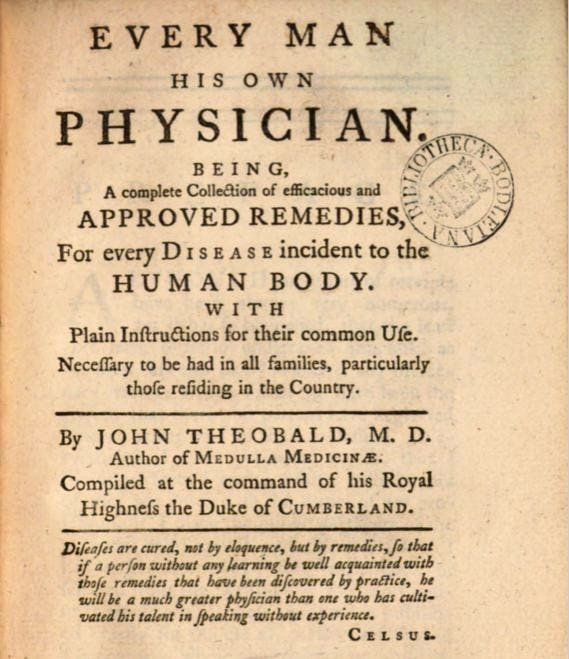
In the 18th-century, a pre-Google guide offered democratization of medical information
In 1767, as American colonists’ protestations against “taxation without representation” intensified, a Boston publisher reprinted a book by a British doctor seemingly tailor-made for the growing spirit of independence.
Theobald’s fellow physicians no doubt winced at the quotation from the 2nd-century Greek philosopher Celsus featured prominently on the book’s cover page.
“Diseases are cured, not by eloquence,” the quote read, “but by remedies, so that if a person without any learning be well acquainted with those remedies that have been discovered by practice, he will be a much greater physician than one who has cultivated his talent in speaking without experience.”
Translation: You’re better off reading my book than consulting inferior doctors.
To celebrate Americans’ independent spirit, I decided to compare a few of Dr. Theobald’s recommendations to those of his 21st-century equivalent, “Dr. Google.” Like Dr. Google, which receives a mind-boggling 70,000 health care search queries every minute, Dr. Theobald also provides citations for his advice which, he assures readers, is based on “the writings of the most eminent physicians.”
At times, the two advice-givers sync across the centuries. “Colds may be cured by lying much in bed, by drinking plentifully of warm sack whey, with a few drops of spirits of hartshorn in it,” writes Dr. Theobald, citing a “Dr. Cheyne.” Dr. Google’s expert, the Mayo Clinic Staff, proffers much the same prescription: Stay hydrated, perhaps using warm lemon water with honey in it, and try to rest. Personally, I think “sack whey” – sherry plus weak milk and sugar – sounds like more fun.
Joining Matthew Holt (@boltyboy) on #THCBGang on Thursday July 6 at 1pm PST 4pm EST were futurist Ian Morrison (@seccurve); writer Kim Bellard (@kimbbellard); health economist Jane Sarasohn-Kahn (@healthythinker); & patient advocate Robin Farmanfarmaian (@Robinff3);
Two special guests joined us today, Bob Rebitzer, these days at Manatt Health & brother Jim Rebitzer Professor at Boston University’s Questrom School of Business. We discussed their new book “Why Not Better & Cheaper“
The video is below. If you’d rather listen to the episode, the audio is preserved from Friday as a weekly podcast available on our iTunes & Spotify channels