Categories

Above the Fold

How I Learned to Stop Worrying and Love Obamacare

There is an ancient Arabic proverb: “The enemy of my enemy is my friend.” With this in mind, I can’t help but think that whatever Senator and leading Tea Party blowhard Ted Cruz opposes must be good. When Cruz decided to try to shut down America because he opposes Obamacare , well that sealed the deal for me. I say “Obamacare forever.”

Readers know that I think Obamacare has too many rules that create problems for payers and providers alike, and relies on some questionable practices for funding. I don’t like the rush to form ACOs or the lack of serious cost-effectiveness analysis (admittedly a concession to Republicans.) But Obamacare beats the hell (sorry Ted) out of Cruzcare, which, as far as I can tell, goes something like this: “Didn’t put aside enough money for that life-saving operation? Here is a prayer that might help.”

I used to sort of be a Republican. I voted for Bush (I won’t say which one in order to avoid embarrassment) and voted against Obama more than once (living in Illinois I had several opportunities.) And I hate that Obama is playing at President like someone playing poker with a winning hand.

This isn’t supposed to be about which politician claims the biggest pot for himself. But I will take a selfish and somewhat scornful Obama over Ted Cruz and the Tea Cozies any and every day of the week. And I will work to find the best Democratic leaders if all the Republicans can offer is Cruz and his TCs.

Shut down the government to finally fund Medicare and Social Security? Maybe. Shut down the government to achieve a rational tax code? Sure. Shut down the government to balance the budget? Now we are talking. But shut down the government to block the opening of the health insurance exchanges? How absurd!
Continue reading…

How Identity Verification Caused Chaos on the State and Federal Exchanges

We may be getting a better idea why the federal exchange and so many state exchanges aren’t working.

An article in Saturday’s Baltimore Sun, regarding Maryland’s problems, provides insight I have not seen elsewhere:

Problems began immediately after the exchange launched Tuesday, as people tried to create accounts and log onto the site.

State officials blamed the account creation process, in which people were routed to a federal questionnaire to verify their identity. The system, they said, became overwhelmed when so many people tried to access it.

So, it appears all of the exchanges are facing the same bottleneck at the federal level–the identity verification software the feds are running for themselves and the state exchanges.

Then the Sun article provided more insight:

Requiring people to create accounts to access the system may be one of the problems, said Jonathan Wu, co-founder of consumer finance website ValuePenguin, who has a computer science background. Some states, including Kentucky [which as been about the only state running well], let people browse insurance plans without an account, which was only needed to purchase insurance. Kentucky did not have as big a backlog, he said.

“It’s kind of an architectural and software issue,” Wu said. “You are not accounting for how people want to use the system.”

With personal accounts, the computer system has to work harder, storing information about everyone who accesses the website, he said. It also has to repeatedly confirm the identity of the person, which also can bog down the system, Wu said. He noted that all the functions on the website that don’t require an account have run smoothly.

“It has to match your account every step you make,” Wu said. “This causes extra overhead.”

Continue reading…

The Next Great Cure? A Cancer Doctor Explains Why He Supports the Affordable Care Act

What do Louis Pasteur, Jonas Salk, Sigmund Freud and Barack Obama have in common?  They all championed controversial medical revolutions and if not for their bravery in the face of conflict, billions would have died.

Sterilize instruments to kill invisible bugs? Inject disease particles to build immunity?  Look into our subconscious to explain everyday behavior?  Give basic healthcare to everyone?  Ludicrous.  That is why we named these advances after these men.

As an oncologist who has seen the fatal cost of our patchy, imbalanced and unfair healthcare system, I have to be at very least hopeful about ObamaCare; AKA the Affordable Care Act (ACA).  The list of benefits is so vast that whatever glitches happen along the way, I know that cancer patients will be helped:

-No pre-existing condition exclusion: So the 31-year-old programmer with Stage 1 breast cancer can change jobs without losing insurance.

-Healthcare coverage by parents until their child is 26: So families will not lose their homes paying for Hodgkin’ s disease in a 22-year-old.

-Guaranteed payment by insurers for patients entering experimental trials: So patients with any insurance can be involved in research, and everyone benefits from the latest advances.

-Free healthcare screening: So that my 58-year-old neighbor with a family history of colon cancer gets routine exams and life saving colonoscopies.

-Uniform healthcare insurance standards: So that the 45-year-old man with stomach lymphoma I saw last week, does not have to suffer and die because his employer brought a health policy, which excluded chemotherapy.

Continue reading…

One Man’s Quest to Sign Up for Obamacare

image

Day 4:

After spending more than two hours in the waiting room, I once again tried to create an account at healthcare.gov so my family could #GetCovered – as instructed by President Obama and Secretary Sebelius.

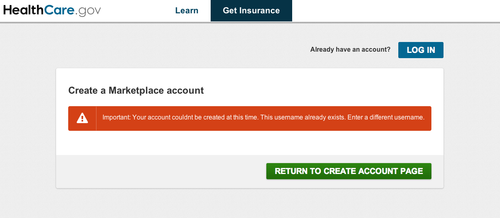
My first attempt at setting up an account today was thwarted when healthcare.gov said the user name I attempted to use was no good:

image

Ack! It says the username already exists? This was the username I had set up on Day One (backstory here), but the system ultimately didn’t recognize it. I feared some other Tony Jewell had used my cleverly placed underscore.

Continue reading…

With CDC Seasonal Flu Data Unavailable, An Electronic Medical Record Offers a Glimpse of Early Activity Levels

As Washington remains deadlocked on the implementation of the Affordable Care Act, the US government’s shutdown has resulted in the furlough of nearly 70% of the Centers for Disease Control‘s (CDC’s) workforce. CDC Director Tom Frieden recently shared his thoughts in a tweet. We agree whole-heartedly.  Although it’s all too easy to take the CDC staff for granted, they are the frontline sentinels (and the gold standard) for monitoring disease outbreaks.  Their ramp-down could have serious public health consequences.

We are particularly concerned about the apparent temporary discontinuation of the CDC’s flu surveillance program, which normally provides weekly reports on flu activity. Although flu season typically begins in late fall, outbreaks have occurred earlier in previous years. In 2009, flu cases started accumulating in late summer/early fall.  And given the potential for unique variants, such as the swine or avian flu, every season is unpredictable, making the need for regular CDC flu reports essential. We therefore hope to see the CDC restored to full capacity as soon as possible.

In the meantime, we would like to help by sharing data we have on communicable diseases, starting with the flu.


Because the athenahealth database is built on a single-instance, cloud-based architecture, we have the ability to report data in real time. As we have described in earlier posts, the physicians we serve are dispersed around the country with good statistical representation across practice types and sizes.


To get a read on influenza vaccination rates so far this season, we looked at more than two million patients who visited a primary care provider between August 1 and September 28, 2013 (Figure 1).  We did not include data on vaccinations provided at retail clinics, schools or workplaces.

This year’s rates are trending in parallel to rates over the last four years, and slightly below those of the 2012-2013 season. However, immunizations accelerate when the CDC, and consequently the media, announce disease outbreaks and mount public awareness campaigns.

Continue reading…

Affording the Affordable Care Act

As enrollment in the Affordable Care Act’s (ACA) new health care markets, or exchanges as they are also known, begins, much of the debate over the law is focused on insurance: Who will get coverage? How much will premiums cost? Should our state expand Medicaid? Yet health insurance is not an end in itself.

The point of insurance is to help people get the health care they need at prices they can afford and, in the event of serious injury or accident, to protect them from catastrophically high medical bills. What often gets lost in the debate is how the new law will affect Americans’ ability to buy health care.

While relatively little will change for most people who already get their insurance through employers, an estimated 49 million Americans will be affected by the new law, either becoming newly insured or changing their source of coverage. How will these changes affect consumer health care spending? Will the Affordable Care Act live up to its name?

Of course, ultimately only time and experience will tell. But in the meantime, the law is being implemented, and policymakers and consumers confronting the new health care market are seeking answers about the law’s likely impact, beyond politicized charges and countercharges about whether it will succeed.

Using the COMPARE microsimulation model, my RAND colleagues and I examined how the ACA will affect spending by consumers who are insured for the first time or who change coverage as a result of the law. Specifically, we looked at out-of-pocket spending (spending at the point of sale — copays, deductibles, and coinsurance, which is the fraction of spending not covered by insurance); total spending on health care, which includes out-of-pocket spending plus insurance premiums; and consumers’ risk of high medical care costs.

The analysis focused on 2016, the first year in which penalties for not complying with the individual mandate will be fully in effect, and considered two scenarios: one in which the ACA is fully in place and another that estimates outcomes without the ACA.

Continue reading…

Reports Suggest Exchange Numbers Are Very Low

“Well, Facebook Wasn’t Built In a Day.” – Unnamed Exchange Developer.

More than 4.8 million users visited Healthcare.gov for the grand opening of the federal health insurance marketplace on Tuesday, according to officials.

It didn’t go quite as planners had hoped. In fact, if there was an unofficial word of the day, it was glitch.

Many users of Healthcare.gov reported long delays and difficulty accessing the federal insurance marketplace,  experiencing “glitches” ranging from error messages to blank pages.  The problems were repeated at state-run exchanges around the country to varying degree, from California to New York.

Pundits like Wonkblog’s Ezra Klein were quick to point out that the political victory the GOP might have gained from the uncertain start was largely lost in the uproar in Washington over the government shutdown, which dominated news reports.

At least one frustrated user chronicled the experience (see related post ‘Descent into Madness: One Man’s Visit to Healthcare.gov, October 1st ). Others took to Twitter to express their outrage or show off their savage or finely-tuned senses of humor.

Users of the federal exchange reported problems including error messages (see above), funky dropdown menu behavior, page freezes, blips, broken links and long page load times — generally either a sign of high volume or inelegantly designed databases.

HHS officials declined to reveal how many people signed up for new insurance plans overall, leading some theorists to speculate that not very many people were able to make it through the process successfully. In point of fact, there were suspiciously few reports of users successfully completing the registration process at all, probably not a very good sign and possibly an indication of a disaster.Continue reading…

How the Federal Government Shutdown Is Hurting Healthcare: Agency by Agency

The shutdown could not stop the rollout of the state and federal exchanges.

That’s because the Obama administration, sensing a political fight in the offing with Republicans, wisely prepaid the bill for the insurance exchanges and other key components of the rollout.

On the other hand, the fiscal standoff is having a very real impact on the infrastructure that supports healthcare across the United States.   Agencies from the Centers for Disease and Control to the National Institutes of Health have seen their money turned off. Others have seen their staffing levels sharply reduced with non-essential employees furloughed.

It doesn’t take a wild imagination to imagine potential deadly consequences if something goes wrong. If for example, flu season strikes early or a drug recall  is needed.  Much of the pain will be felt over time.  As the shutdown drags on, you can expect problems that are brewing under the surface to become much more visible …

Here’s a review of what’s happening:

Centers For Disease Control and Prevention
Funding for monitoring of disease outbreaks turned off. Lab operations sharply scaled back. 24/7 operations center to remain online.  With some scientists predicting a severe 2013-2014 flu season, this is cause for concern …

National Institutes For Health
Enrollment in new clinical trials suspended, impacting thousands of patients suffering from serious diseases. No action on grant proposals. Minimal support for ongoing protocols.

Food and Drug Administration
Food safety inspections sharply cut back. Monitoring of imports eliminated.  Oversight of production facilities curtailed, again potentially an issue with flu season on the way.The good news? Because drug approvals are funded by industry “user-fees” FDA approvals of new drugs will continue.

Centers For Medicare and Medicaid Services
Key ACA related operations intact.  The bad news for docs and patients – claims and payment processing expected to continue but with slower service than usual. With purse strings tight, this is likely to become more of a problem as shutdown drags on. In the unlikely event that a shutdown continues for more than a month, the impact on physician practices could be much more serious.

Continue reading…

Descent Into Madness: An Account of One Man’s Visit to Healthcare.gov October 1st

image

As the owners of small businesses, my family has been curious to learn how much insurance would cost us once the Affordable Care Act kicks in – and what our choices of networks, providers and whatnot would be.

With the arrival of the October 1 open enrollment period, my first computer stop was healthcare.gov to begin comparison shopping among the four ACA plans vs. the COBRA plan that we have through the end of 2014.

Here’s how it went:

October 1, 2013

7:30 a.m. – I first encounter the Health Insurance Marketplace waiting room.

7:33 a.m. – The drop-down boxes on the security questions aren’t working.

Continue reading…

Who Knew That Blood, Sweat and Tears Could Start a Health Care Revolution?

The staid world of diagnostic testing is about to undergo a major disruption with huge advances in sensors and sensing technologies that live in or on our bodies, within our homes and offices, and even within our computers and networks.

Today we’re witnessing a massive shift in who will collect and control diagnostic and other health information. For the first time, as people and patients, we will have control over what we measure, when we measure it, and who has access to our personal data. This is made possible by a new generation of revolutionary biosensors that contain the power of clinical lab instruments in packages that are light, small, wireless and highly efficient.

This is a new world of sensors: they can be body-attached, monitor our immediate personal environment, or even work as pure software apps that extrapolate data from our health records. Using simple, non-invasive methods to take samples of tiny amounts of blood, traces of skin tissue, breath droplets or an image of the inner eye are just some of the new methods emerging. It is exciting to consider that several of these multifunctional sensors, working in concert with powerful mobile handhelds, offer us extraordinary data collection and diagnostic tool sets that will put us in touch with our health in ways never imagined before.

These advances in health sensing, available any time and anywhere, are game changing. A continuous stream of personalized health data will transform how doctors interact with their patients to address and solve health challenges. More importantly, it puts patients at the center of the care process. Personalized data means that specific therapies or drugs will be more effectively delivered and controlled, allowing doctors to fine-tune treatments and watch incremental physiological changes as they occur.

This technology will also disrupt the clinical diagnostics business by moving testing from specialized (and expensive) labs to pharmacies and then ultimately to our homes.

Continue reading…

assetto corsa mods