Today on Health in 2 Point 00, the big news is about another COVID vaccine… or is it the collapse of the telehealth and digital health market as we know it? On Episode 167, Jess asks me about Bridge Connector shutting down 2 months after getting a $25.5 million raise, UK-based online mental health platform Togetherall raising $10 million, Cerner partnering with Well Health for provider-patient communication services, Solv Health—the OpenTable for healthcare—raising $27 million, and Springtide raising $18.1 million for its clinic and platform for children with autism. —Matthew Holt
Healthcare’s Bridge Fire
By KIM BELLARD

We had a bridge fire here in Cincinnati last week. Two semis collided in the overnight hours. The collision ignited a blaze that burned at up to 1500 degrees Fahrenheit and took hours to quell. Fortunately, no one was killed or injured, but the bridge remains closed while investigators determine how much damage was done. It is expected to remain closed for at least another month.
Unfortunately, the bridge in question is the Brent Spence Bridge, which is the focal point for I-71 and I-75 between Ohio and Kentucky. It normally carries over 160,000 vehicles daily, and is one of the busiest trucking routes in the U.S. Over $1 billion of freight crosses each day. There are other bridges nearby, but each requires significant detouring, and none were designed for that traffic load.
What makes this all so galling is that it has been recognized for over 25 years that the bridge has been, to quote the Federal Highway Administration, “functionally obsolete” – yet no action was taken to replace it. This most recent disaster was a disaster hiding in plain sight.
Just like, as the coronavirus pandemic has illustrated, we have in health care.
The Brent Spence Bridge was opened in 1963, intended to carry a maximum of 80,000 vehicles daily. That had been surpassed by the 1990’s, causing calls to replace it with a newer, bigger bridge. At one time, Rep. John Boehner, from the Cincinnati area, was Speaker of the House and Kentucky’s Mitch McConnell was Senate Majority leader, yet were not able to obtain funding for the replacement, despite strong support from then President Obama and, in turn, President Trump.
Continue reading…Bayer G4A Agents of Change: Digital Health & the Future of Pharma
By JESSICA DaMASSA, WTF HEALTH
Lots of changes at Bayer G4A: a new investment thesis, new additions to their portfolio, a new Global Head of Digital Health to meet, and a hot new virtual health forum (a free one!) coming up on November 18, 2020. Dominick Kennerson and Sophie Park join us from Berlin, where they’ve got their eyes on the trends shaping the worldwide digital health market. Are pharma companies changing the way they look at digital health companies in the face of the pandemic? Have we gone, well, beyond “beyond the pill”? Dom says Bayer’s been ahead of the curve when it comes to prioritizing digital innovation, and that we’re all going to be “very surprised” in the next 12-18 months about what we see come out of one of the world’s largest life sciences companies. For more clues and additional insight on Bayer’s priorities when it comes to digital health and the future of pharma, give this interview a quick listen then register for G4A’s Agents of Change event. HINT: From the “mad genius” herself…the agenda for the event is Bayer G4A’s roadmap. Bold move!
For more on the Agents of Change event, visit www.g4a.health.
The Catalyst @ Health 2.0/Wipfli Survey on the State of Digital Health
By MATTHEW HOLT


Catalyst @ Health 2.0, supported by professional services firm Wipfli, is launching a survey about the state of Digital Health. We hope to get a comprehensive analysis of the impact of COVID-19 on digital health companies and the rest of the ecosystem. This survey should take under 8 minutes to complete (and probably less). For your time we will get you a copy of the results when they are released. As an added bonus TWO respondents drawn at random who complete the survey will get advertising for their company for 6 months on The Health Care Blog (worth $5,000).
We are interested in hearing from leaders working in digital health companies, or those connected to digital health in health systems, payers, life sciences, consulting or investment companies.
To take the survey CLICK HERE
NOTE–None of the data from this survey will be shared by Catalyst @ Health 2.0 (even with our friends at Wipfli) other than as aggregate survey results. So you can be assured that your answers are completely confidential.
Matthew Holt is Co-Chairman of Catalyst @ Health 2.0 & Publisher of THCB
THCB Gang Episode 32

Episode 32 of “The THCB Gang” was live-streamed on Thursday, November 12th. The video is below.
Matthew Holt (@boltyboy) will be joined by some of our regulars: WTF Health Host Jessica DaMassa (@jessdamassa), radiologist Saurabh Jha (@RougeRad), MD-turned entrepreneur Jean-Luc Neptune (@jeanlucneptune), benefits communications leader Jennifer Benz (@jenbenz), THCB’s Editor-in-Chief me (zoykskhan) and guest Jeff Goldsmith, President of Health Futures, Inc. The conversation followed the post-election frenzy around COVID-19 response, the vaccines, the ACA, and what a Dem. president means for the United States in terms of health care.
If you’d rather listen to the episode, the audio is preserved as a weekly podcast available on our iTunes & Spotify channels — Zoya Khan, producer
Covid-19, the “Quarantine 15” & Healthcare’s Focus on Weight Management in 2021
By JESSICA DaMASSA, WTF HEALTH
Potential digital health trend for 2021? Weight loss and weight management. Not only has obesity been an “epidemic” of its own for a number of years (40% of U.S. adults are obese, another 32% are overweight) BUT it’s also considered a risk-factor if infected with covid-19 and is a common co-morbidity for a number of chronic conditions. Add to that all the banana bread we’ve been seeing on Instagram and the “quarantine 15” memes that sum up the weight gain brought about by our increasingly sedentary, baked-goods-filled shelter-in-place lifestyles, and you can see where this is likely to go. So, how can health tech help? As healthcare payers and employers look toward weight management as a way to help prevent adverse health outcomes (covid-related or otherwise), we get some advice from Dr. Greg Steinberg, a clinical innovation expert who gained experience piloting novel, health tech solutions for weight management at Aetna. We demystify the relationship between healthcare payers and weight loss solutions, talk about what matters from a cost/value perspective, and, of course, find out what makes for optimal end-user success.
In Praise of Unsung Heroes
By KIM BELLARD

Even in this extraordinary year, this has been an extraordinary week. Last Tuesday we had what many believe to have been the most important Presidential election in recent times, maybe ever. The week also found the coronavirus pandemic reaching new heights. That was the week that was.
What struck me, though, is how both our election systems and our healthcare system rely on “ordinary” people to keep them going. They’ve never been more extraordinary than this year.
The pandemic first impacted voting earlier in the year, during primary season. Going to the polls suddenly seemed like potentially a life-threatening choice, and working at them practically suicidal. Dates of primaries were moved, many polling stations were closed, new voting procedures were put into place, and absentee ballots found a new popularity. And yet people turned out in droves to vote, often standing in line for hours.
President Trump upped the ante by constantly railing against absentee ballots and warning about voter fraud. Despite this, or perhaps because of it, record numbers of people voted early, in person or by mail. Several states had surpassed 2016 numbers of voters before Election Day. Tens of millions more showed up on Election Day. And, amazingly, Election Day passed with relatively few incidents.
Then the counting started.
Continue reading…Accolade’s CEO Raj Singh: IPO Backstory & Pop Health Predictions for 2021
By JESSICA DaMASSA, WTF HEALTH
When Accolade went public in July at a $1.2B valuation, the BIG question facing the health tech unicorn pre-dated the covid-19 pandemic and the chaos facing its clientbase of large, self-insured employers: Could they scale? Raj Singh, Accolade’s CEO, tackles the question head-on, buoyed by customer growth that has doubled twice over a fiscal-year-and-a-half and an expanded need for his company’s high-touch, concierge health benefits navigation services. As beleaguered employers struggle with making sure their employees have the health benefits they need to weather the pandemic, Accolade’s focus on making sure that those benefits remain as cost-contained as possible seems to be more attractive than ever. What else is resonating with self-insured employers these days? Raj talks about what will (and won’t) change when it comes to population health management in 2021 and gives us a reality check on whether or not employers and their employees are really using digital health tools like Livongo, Virta, Hinge, Kaia, Ginger, et. al when baked into their benefits ecosystem.
#Healthin2Point00, Episode 166 | $100 million, scandal, & more
Today on Health in 2 Point 00, we have scandal, drama, intrigue, $100 million and murder! Wait, no; not murder. On Episode 166, we catch up on more deals before Jess gets carried away again. The $100 million goes to Carbon Health in a Series C, which is another Bay Area-based primary care startup; they’re doing a lot of work in COVID testing and growing fast. Next we have many health plans uniting with Cigna Ventures, Humana, and Anthem all investing in Buoy Health which just raised $37.5 million in a Series C. That leads us to a scandal with the former CEO of Navigating Cancer suing Merck’s Global Health Innovation Fund. Finally, in the world of DTx, NightWare has received FDA clearance for its Apple Watch app designed to wake people with PTSD up from nightmares. —Matthew Holt
RWJF Emergency Response Innovation Challenges: Virtual Pitch Event on 11/19!
By ELIZABETH BROWN
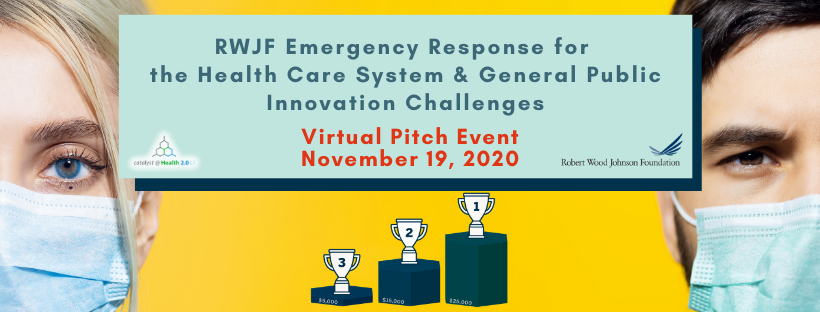
As COVID-19 brought to light the lack of emergency response preparedness in the health care system, the Robert Wood Johnson Foundation (RWJF) and Catalyst @ Health 2.0 saw an opportunity to highlight digital health’s potential to support health care stakeholders and the general public. RWJF and Catalyst partnered to launch two Innovation Challenges on Emergency Response for the General Public and Emergency Response for the Health Care System.
The Emergency Response Innovation Challenges asked innovators to develop a health technology tool to support the needs of individuals as well as health care systems affected by a large-scale health crisis, such as a pandemic or natural disaster. The Challenges saw a record number of applications— nearly 125 applications were submitted to the General Public Challenge and over 130 applications were submitted to the Health Care System Challenge.
An expert panel of judges across the health tech, venture capital, design, and emergency response industries evaluated the entries and selected three finalists from each challenge to compete at a virtual pitch hosted by Catalyst @ Health 2.0 on Thursday, November 19th at 10am PT/1pm ET. Registration for this event is now open! RSVP for the pitch event HERE.
Finalists will present their solutions to an audience of investors, provider organizations, health plans, tech companies, foundations, government officials and members of the media. During the pitch, a judge panel will select the first, second, and third place winner based on impact, UX/UI, innovation/creativity, scalability and strength of presentation. The winners will be awarded $25,000 for first place, $15,000 for second place, and $5,000 for third place. To learn more about the finalists, click on the links listed below, and to RSVP for the pitch event, click HERE.
Continue reading…