Strap in for the tale of why your hero is spending most of his life down YouTube rabbit holes of cardiology videos while blundering his way around many many medical centers and exposing many problems with American health care even before he gets close to the operating table. Yes it’s Matthew Holt’s pre-surgical complications – the complications that have arisen before he even gets his failing aortic valve fixed. And yes this is the last for now of a multi-parter!Part 1, Part 2,Part 3, Part 4Part 5
By now I have met with expert physicians and their teams at 5 major medical centers (UCSF, Stanford, Cleveland Clinic, Cedars Sinai & West Virginia University). I have spent hours talking to the AI gods at Claude, ChatGPT and Inciteful Med, annoyed the hell out of all the cardiologists and other doctors I know, and basically got enough contradictory advice that it’s all up to me.
The main decision comes down to whether I should get a TAVR or the RAVR. And because I approached Cedars about the BELIEVERS clinical trial rather than going direct to Dr Makkar, they put me into that process. The trial randomizes patients into either TAVR or RAVR, likely performed by Dr. Dominic Emerson who is the Director of Robotic Cardiac Surgery, Smidt Heart Institute, and one of the surgeons mentioned by Dr Badhwar. (I had a quick chat with him after he called me while I was on a ski boat in Lake Tahoe, although due to the shoulder pain I had not gone wakeboarding!)
The study documentation stressed – and this was backed up unprompted by one of the study coordinators – that I could back out at any time. So if I were randomized into the RAVR cohort, I still had the choice to pull out and ask Dr Makkar to do a TAVR on me anyway, or of course go to West Virginia and get surgery there.
And of course there is still the question of how risky a TAVR on my valve will be. I did take Dr Yeung’s advice seriously, and a study that Dr Makkar oversaw back in 2020 did show that (for patients considerably older than me) the risk of all cause mortality at 2 years in bicuspid valve TAVR patients was higher with bad calcification (like me). On the other hand, Dr Makkar told me that his unpublished data between TAVR and SAVR at 5 years showed no difference. He also directly told me that I was a good candidate for a TAVR and he has done more bicuspid TAVRs than anyone else. He’s also working on techniques that break up the calcification on the “join” before the TAVR, although it’s unclear if he’ll do that in the BELIEVERS trial and to me
I originally wanted a TAVR because it was a much easier recovery than surgery. I also have two more major surgeries to go through within the next few months, and it would be a big stress on me and my family to make that three. Plus, I both would be happy to contribute to a medical study and am pretty confident that in a decade or so, cardiology will have advanced a lot more and I probably wouldn’t need open heart surgery even if the TAVR valve fails sooner than the 10-15 years I am hoping to get out of it.
So I crossed my fingers and hoped that the computer would randomize me into the TAVR group at Cedars and obviate the need for any uncomfortable decisions about pulling out of the trial. And it did. I’ll be getting it done in early September.
This isn’t exactly Lebron James making The Decision, although that show lasted only 75 minutes and also went on way too long!
Some concluding thoughts
I would obviously rather have not had to write this little memoir. But given I went through it, there are several conclusions smacking me in the face.
Strap in for the tale of why your hero is spending most of his life down YouTube rabbit holes of cardiology videos while blundering his way around many many medical centers and exposing many problems with American health care even before he gets close to the operating table. Yes it’s Matthew Holt’s pre-surgical complications – the complications that have arisen before he even gets his failing aortic valve fixed. And yes this is a multi-parter!Part 1, Part 2,Part 3, Part 4
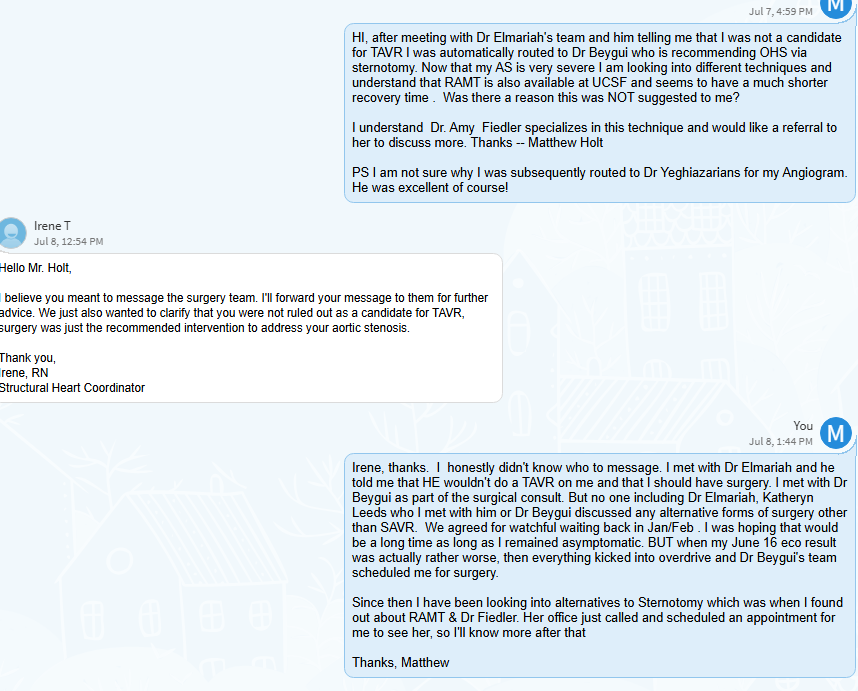
Claude told me that Dr Amy Fiedler at UCSF was an expert in RAMT (right anterior minithoracotomy–the non endoscopic rib entry technique). I sent a note to my original Cardiology group on the UCSF MyChart system saying that I understood she did this surgery and could I have an appointment with her? You can see from my messages with them below that the appointment was set up.
It should not have been.
I had a very brief conversation with Dr Fiedler and almost immediately it became apparent I was wasting her time. She told me she does not do that RAMT surgery for valve replacement and she specializes in heart transplants, and some other specialized heart surgery. I think that Claude had read the web page about her doing minimally invasive cardiac surgery and put 2 + 2 together and made 5. But to be fair her UCSF webpage didn’t give me the level of detail she gave me in the video call, and the UCSF cardiology team set up the call even though I presume someone there knows that she didn’t do the thing I was asking about.
To be clear, Dr Fielder was very gracious and very helpful in her advice. I just felt bad for wasting 15 minutes of her time. To reiterate, the time of a cardiac surgeon is way more valuable than mine. I left telling her I hoped I would never need her services!
***
Next stop was to drive down to Palo Alto and pop into the Creamery for a chocolate malt and cheeseburger in advance of meeting Dr Yeung, the cardiologist. The med tech did a four limb blood pressure test on me and also a full 12 lead EKG. I of course had had all that earlier at UCSF, and wasn’t sure why I was having more. But anyway, she soon left saying Dr Yeung was coming.
Instead Dr Anson Lee came in. He’s the cardiac surgeon working on the valve team. He basically told me that Dr Yeung wouldn’t do a TAVR on me. Now I wasn’t expecting to see him (nor did I know who he was till I looked him up after he left the room) but we had a very helpful conversation about valve surgery and the best ways to do it. Then he went and got Dr Yeung. Together they pulled up a colorized 4D CT scan of my valve. (I assume it came from the CT I had in January). Dr Yeung showed me in precise detail why he thought giving me a TAVR now was a bad idea. (Basically too much calcification on the fused part of the leaf, and it’s too oval, which would make the procedure risky and likely not fit properly). He told me that if I had the surgery, someone would easily put a TAVR in my surgically implanted valve in 12-15 years, and that’s all I would need–unless I plan on living forever or to 100!.
Dr Lee told me that if he was getting it done he’d have a full sternotomy, although he actually does mini-sternotomies. He also was the only person thus far to tell me NOT to do it if I am asymptomatic. His logic is that something like 1/150 patients die during the surgery so don’t have it if you don’t need it (i.e. are asymptomatic). The reason he’d want a full sternotomy for his choice of entry was to give the surgeon the least complicated shot at the valve.
He also said that his mini-sternotomy patients can drive after 2 weeks, not 4-6. Which seems to contradict what the UCSF team told me about the same procedure.
But in my case, needing knee surgery and shoulder surgery, the shock of those on the heart would count as “symptoms”. So Dr Lee told me I should get the surgery if I was going to get the shoulder or knee fixed. But he also said that the higher echo reading might have been a false negative, and it might be years before I have symptoms.
I’m not sure my trip to Stanford left me much clearer. But the chocolate malt was damn good.
***
Next up was connecting with the oft-cited team doing RAVRs at University of West Virginia led by Dr Vinay Badhwar. Both Dr Lee and Dr Fiedler unprompted said that he was the surgeon when it came to the robot valve replacement and his email was available online. (Most doctors don’t make their email easily available). I had Claude write an email describing my clinical situation and sent it to him late one night.
The next morning before I got up, there was a reply from Dr Badhwar in my inbox, and shortly thereafter, his team was all over me. They got my information, got access to my imaging at UCSF, and his physician assistant Amy Simsa called me a day later to describe the process. Within a week I had a video consult with Dr Badhwar and his team. In terms of responsiveness they were by far the best organization to deal with. Stanford, UCSF, Cleveland, Cedars et al could take a few lessons!
The only slight wrinkle was that I got a robocall on a Sunday from the facility telling me where to check-in to my appointment–clearly not set up for telehealth. I noted this in a brief email to his office and got a reply from a human (who I will not identify to spare their blushes) at 5.15pm on a Sunday night! I’m not sure they’re not working too hard.
Although Dr Badhwar was very modest and very keen to tell me about others working with him as he spreads the gospel of RAVR, he and his team have clearly done more of these more successfully than anyone else and are the world experts. If I want a RAVR it’s almost certain that I have to get on a plane, and so I will likely end up in Morgantown, WV–which is about an hour south of Pittsburgh for those of you who missed geography day in high school. That’s not a sentence I thought I would ever write!
***
My last (for now) call was with the CEDARS team setting up the BELIEVERS trial. I spoke with Dr Raj Makkar. He said he had done 8,000 TAVRs and more than anyone else on bicuspid patients. He disagreed with Dr Yeung and Dr Elmariah. He says that my valve was suitable for a TAVR, and he said that the risk of stroke during TAVR was less than the risk of death from SAVR. He also said that they are about to publish 5 years of data showing that the resilience of TAVR valves was the same as SAVR valves. He suggested using a 26mm valve on me, and that it would likely last 10-12 years, and that not only would he be able to do a TAVR in TAVR on that one, but he had already been doing 3rd TAVR in TAVR in TAVR.
I asked if I showed up at his clinic but not for this trial would he have done a TAVR on me? He said emphatically “yes”. He does use the Sentinel Cerebral Protection System which essentially captures any calcification dislodged from ascending up the aorta to the brain, although my friend Claude tells me the data on whether that prevents a stroke is murky. Frankly Dr Makkar was very self assured and had I met him at the start of this journey I wouldn’t have bothered going anywhere else! Of course, because he wants to do the trial and get that data out in the world, he wants me in the trial, and I might be randomized into the surgical group.
This is I hope the end of the pre-surgical part! With the slight exception that I haven’t actually yet made a decision about what to do!
The New York Times had an interesting profile this weekend about how Goodwill Industries is trying to revamp its online presence – transitioning from its legacy ShopGoodwill.com to a new platform GoodwillFinds — in the amidst of numerous other online resellers. It zeroed in on the key distinction Goodwill has:
But Goodwill isn’t doing this just because it wants to move into the 21st century. More than 130,000 people work across the organization, while two million people received assistance last year through its programs, which include career navigation and skills training. Those opportunities are funded through the sales of donated items.
Moreover, the article continued: “Last year, Goodwill helped nearly 180,000 people through its job services.”
In case you weren’t aware, Goodwill has long had a mission of hiring people who otherwise face barriers to employment, such as veterans, those who lack job experience or educational qualifications, or have handicaps. As it says in its mission statement, it “works to enhance the dignity and quality of life of individuals and families by strengthening communities, eliminating barriers to opportunity, and helping people in need reach their full potential through learning and the power of work.”
As PYMNTSwrote earlier this month: “Every purchase made through GoodwillFinds initiates a chain reaction, providing job training, resume assistance, financial education, and essential services to individuals in need within the community where the item was contributed.”
I want healthcare to have that kind of commitment to patients.
Healthcare claims to be all about patients. You won’t find many that openly talk about profits or return on equity. Reading mission statements of healthcare organizations yield the kinds of pronouncements one might expect. A not-entirely random sample:
Cleveland Clinic: “to be the best place for care anywhere and the best place to work in healthcare.”
A preventive breast cancer vaccine developed by Professor Vincent Tuohy of the Cleveland Clinic will be brought forward to the FDA for permission to begin clinical trials to see if it is safe and effective for use in women.
The vaccine was shown to be completely safe and 100% effective in preventing breast cancer in three animal models, (see study in Nature Medicine), and was also found to slow the growth of tumors that had already formed. The vaccine is especially powerful in inhibiting the growth of triple-negative breast cancer, the most aggressive form of the disease with the lowest survival rate.
Triple-negative breast cancer lacks estrogen, progesterone and Her2 receptors. It occurs in approximately 15% of cases is the kind of breast cancer most common in women who carry a BRCA mutation.
The initial clinical trials, called Phase I studies, will be conducted in two groups of volunteers, women with triple-negative breast cancer who have completed their treatment and are free of disease, and women who will be vaccinated shortly before undergoing bilateral prophylactic mastectomy (typically these are women like Angelina Jolie with BRCA mutations who elect to remove their breasts to lower their risk for cancer.)
The first group of women will be studied to determine the dose and effectiveness of the vaccine; the second will be studied to make sure the vaccine does not trigger an untoward immune response in breast tissue.
The vaccine targets an unique protein normally made only by women who are breastfeeding, alpha lactalbumin (ALA). In the 12 years Tuohy spent developing and researching his vaccine, he discovered that the majority of breast tumors express, or make, ALA. Priming the immune system with a vaccine so that it attacks any cell that makes ALA is the method by which Tuohy’s vaccine works.
Because the vaccine targets ALA, a protein necessary for successful lactation in healthy women, the vaccine would not be appropriate for use in women who are still in their childbearing years.
However, the majority of women diagnosed with breast cancer in the United States and other western countries are post-menopausal: at least 60% of the cases in the United States occur in women over 55; thus, Tuohy’s vaccine holds great potential as a preventive vaccine for the majority of women.
With an unprecedented amount of attention and dollars spent on healthcare-related research at academic medical centers, institutions are often blazing their own trails with regard to innovation and commercialization. In an attempt to consolidate a diverse array of approaches, Cleveland Clinic Innovations and the Council for American Medical Innovation have joined forces to release the first-ever comprehensive study of technological innovation and commercialization at the nation’s top healthcare institutions.
The Medical Innovation Playbook will offer an in-depth characterization of how each of the top medical centers has organized to stimulate innovation and its commercial application. The Playbook will include profiles of at least 75 academic institutions and medical centers that, when combined, will result in an easy-to-understand guide that will be a resource for practitioners, academic executives, trustees, policy makers, companies, entrepreneurs and investors.
If you doubt this is radical, go to your local hospital’s Web site. See if it publishes how many patients died during heart surgery last year.
At Cleveland Clinic that number is easy to find. The hospital performed 459 bypass surgeries and only three patients died in the hospital. That is about a third the rate of deaths recorded at other hospitals for the same procedure.
Yet Cleveland Clinic does not only publish data that casts itself in a favorable light. In the third quarter of last year, 3% of bypass patients had strokes after their operations, when that number should have been around 1%.
I called the hospital’s corporate office to find out more about the history of the Outcomes books, how they affect hospital operations, and if there were lessons to share. I asked to speak to the de facto “Chief Transparency Office” and assumed I’d be directed to a middle manager working in the office of public affairs or marketing.
Instead, I soon found myself on the phone with the CEO. It turns out that Delos “Toby” Cosgrove, who runs the $6 billion health system, is also the organization’s unofficial transparency officer. He was the guy who developed the Outcomes Book concept in the first place.
Innovation has been a driving force behind health care from the beginning, yet with the U.S. health care system in the midst of an unprecedented transformation and a focus on lowering costs, many are asking, “What will become of innovation?”
The answer to that question is also a potential solution for hospitals facing financial pressures – a solution that has the power to improve patient care as well.
A growing number of hospitals are looking to develop a new revenue stream through the commercialization of medical innovations. They’re not doing it alone.
Just as Cleveland Clinic collaborates with other health systems on cardiovascular or cancer care, Cleveland Clinic Innovations has formed a national Innovation Alliance network to collaborate on the commercialization of medical innovations.
Cleveland Clinic Innovations, the corporate venturing arm of Cleveland Clinic, has a track record of converting and commercializing medical expertise, creating 55 spin-off companies and more than 300 licensed technologies that began as doctors and researchers’ ideas. Those companies have received nearly $700 million in equity investment.
This summer I spent some time exploring how big teaching hospitals publicly report clinical outcomes to the public. For a given set of patients, how many live or die? And with what complications?
Patients can rarely find this information before getting elective surgery, or when deciding to commit to a given institution for a long-term course of treatment.
The problem is that right now there are few short-term incentives for hospitals to be transparent to the public. Patients are used to finding care based on proximity, word-of-mouth, and referrals from trusted physicians. (None of these are bad methods, by the way.)
Meanwhile insurers and public programs rarely pay for better outcomes, so they do not build networks that steer patients to quality. Paternalism pervades the entire system, where insurers and providers alike do not trust patients to shop for the best care.
Thus it is only the most long-term focused institutions that decide to become radically transparent. And there’s one that stands out above the rest: Cleveland Clinic.
The Ohio institution is already known for excellent care, especially in cardiology, for being a “well-oiled machine”, and for being an economic bright spot in the otherwise dreary environs of Cuyahoga County. (Sorry, as Pittsburgher it’s hard for me to say nice things about the Mistake By The Lake.)
But something else Cleveland Clinic should be known for is its public outcomes reporting. Every year since at least 2005 Cleveland Clinic has published Outcomes Books on its Web site. For each clinical category it releases data on mortality, complication rates, and patient satisfaction. It also mails paper copies of these books to specialists around the country as a kind of transparency-marketing. No other hospital system comes close to reporting this level of detail about the quality of its care.
The many challenges in healthcare today require great leadership. Access, affordability and quality are just a few of the overarching issues that call for and, in fact, demand great leadership from within healthcare.
Traditionally, the criteria for a physician to advance to a leadership position have included academic and/or clinical accomplishments, rather than the distinctive competencies needed to lead. Furthermore, traditional physician training and the unique characteristics of physicians — we tend to value autonomy and, outside of structured interactions (such as the operating room or intensive care unit), may have poorly developed team reflexes — can handicap developing leadership skills.
Though developing great leaders and embracing change are well-established characteristics of frontrunner organizations in many industry sectors, healthcare organizations have generally lagged behind. What’s more, many healthcare organizations are structured in silos or “fiefdoms,” which represent a challenging environment in which to lead. Only recently are healthcare organizations awakening to the importance of developing physician-leaders and, in this context, offering physician-leadership programs.
There isn’t a country on this planet where there isn’t someone dreaming of curing cancer. What if there was something even more spectacular than curing cancer? What if you could stop cancer right in its tracks and eliminate its existence. Prevent it. Squash it before it starts.
Vincent Tuohy, PhD, an immunologist at Cleveland Clinic, may be on a path toward living this dream. This month at our hospital’s quarterly meeting, Tuohy was awarded Cleveland Clinic’s F. Mason Sones Award for 2010 Innovator of the Year for his recent breakthrough that may one day prevent breast cancer and perhaps revolutionize our approach to fighting all cancers.
Tuohy has spent the past eight years working to create a vaccine to prevent breast cancer. He and his team have found that vaccination with the protein α-lactalbumin prevents breast cancer in mice. His results were published in Nature Medicine, one of the most respected science journals, last summer.
The study yielded dramatic results. A group of mice that were at high risk to develop cancer according to their genetic profile was selected. Half of the mice were given the vaccine and half were not. All the ones given the vaccine did not develop breast cancer. All the ones not given the vaccine developed breast cancer. Yes, these are mice, and human trials are yet to begin. It may be ten years before we have a finished product, but such overwhelming results are promising and exciting.Continue reading…




 With an unprecedented amount of attention and dollars spent on healthcare-related research at academic medical centers, institutions are often blazing their own trails with regard to innovation and commercialization. In an attempt to consolidate a diverse array of approaches,



