Categories

Category: Uncategorized

Up Next? Oral Health

“Can you imagine a time when we fully incorporate mental and dental health into our thinking about health?  What is it about problems above the neck that seems to exclude them so often from policy about health care?”

That’s what Institute of Medicine President Harvey Fineberg asked in 2009.  On April 8th the IOM released a new consensus committee report, “Advancing Oral Health in America”. That committee’s 2011 response to Dr. Fineberg was essentially—“not this time—change starts here.”  I had the great privilege of participating on that committee along with 14 others from a variety of backgrounds and expertise.  Certainly, we were daunted by the enormity of the nation’s oral health challenge but also hopeful that there are, in fact, tools and approaches that could begin to make a difference.

The IOM convened this committee based on a 2009 HRSA request for recommendations on a potential HHS oral health initiative.  The committee deliberated for almost a year while the long and contentious health care reform debate reverberated.  The specific charge for this committee was relatively narrow:  to provide strategic recommendations to HHS, specifically, regarding a department-wide oral health initiative.  Nevertheless, the national health care reform debate only served to highlight the concurrent need for reform in both oral health as well as health care, overall.

And there were a few ghosts in the mix, so to speak—namely past reports, statements, actions, initiatives in oral health—good faith efforts all—juxtaposed against the harsh fact that the problems remain.  More than 10 years prior, the surgeon general issued a landmark report entitled, “Oral Health in America”.  It described the poor state of oral health as a “silent epidemic”.  Unfortunately and in spite of that warning, that epidemic remained altogether too silent.  In fact, arguably, nothing fundamentally has changed in those 10 years.  Entirely preventable oral diseases remain prevalent.  Oral health is part and parcel of overall health care—but the professions treat them as distinct and separate.  Vulnerable groups continue to suffer from disparate oral health outcomes.  Continue reading…
Who Gets Autism?

The paper is from Leonard et al and it’s published in PLoS ONE, so it’s open access if you want to take a peek. The authors used a database system in the state of Western Australia which allowed them to find out what happened to all of the babies born between 1984 and 1999 who were still alive as of 2005. There were 400,000 of them.

The records included information on children diagnosed with either an autism spectrum disorder (ASD), intellectual disability aka mental retardation (ID), or both. They decided to only look at singleton births i.e. not twins or triplets.

In total, 1,179 of the kids had a diagnosis of ASD. That’s 0.3% or about 1 in 350, much lower than more recent estimates, but these more recent studies used very different methods. Just over 60% of these also had ID, which corresponds well to previous estimates.

There were about 4,500 cases of ID without ASD in the sample, a rate of just over 1%; the great majority of these (90%) had mild-to-moderate ID. They excluded an additional 800 kids with ID associated with a “known biomedical condition” like Down’s Syndrome.

So what did they find? Well, a whole bunch, and it’s all interesting. Bullet point time.

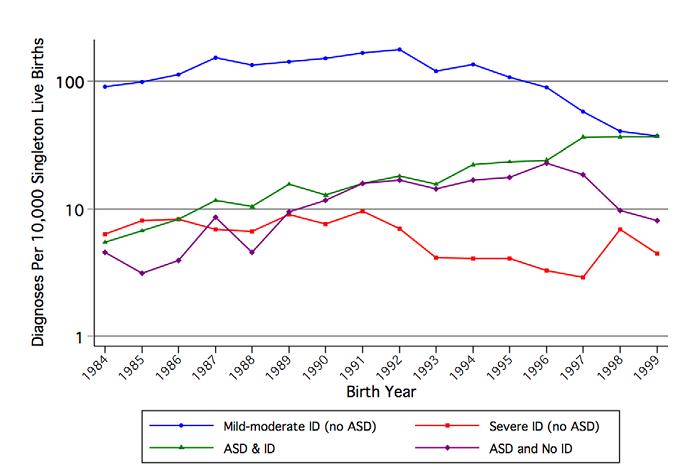
  • Between 1984 to 1999, rates of ID without ASD fell and rates of ASD rose, although there was a curious sudden fall in the rates of ASD without ID just before the end of the study. In 1984, “mild-moderate ID” without autism was by far the most common diagnosis, with 10 times the rate of anything else. By 1999, it was exactly level with ASD+ID, and ASD without ID was close behind. Here’s the graph; note the logarithmic scale:

Continue reading…

Interview with Andy Cohen, CEO, Caring.com

A couple of weeks back Andy Cohen, CEO and Founder of Caring.com stopped by Health 2.0’s offices to give us an update on the site. Having established itself as a go-to site for caregivers needing to figure out what to do when a loved one needs help, Caring has now branched out to develop assessment tools and communities. In this video interview you’ll get to hear and see a bit about that, and get more information about the company’s plans to be the “Babycenter” for the other end of life.

The Kübler-Ross Model of EHR Adoption

For over a hundred years the paper chart has been a trusted partner and best friend to many physicians and nurses. The paper chart was born the day a new patient walked into the office, a pristine, crisp and neatly color-coded folder, with just the right markings in carefully shaped calligraphy on its covers. As the years went by, the paper chart grew in size, acquired meaning and wisdom, and like most of us, became a bit tattered around the edges and heftier in the middle. It felt good to hold the elderly paper chart in your hands and its voluminous physical presence inspired confidence and trust. The paper chart is dead. In some places the paper chart’s pages are still turning slowly, but we all know its long, productive life has come to an end and someone should pull the plug and call it. Or do we?

In 1969 Elisabeth Kübler-Ross proposed a 5 stage model for typical grieving behavior. The various reactions from the clinical community to the apparent demise of the paper chart exhibit almost textbook adherence to the Kübler-Ross model, with each clinician advancing through the five stages of grief at his/her own pace*.

Denial – This is a joke. These people don’t understand medicine and this entire Obamacare thing will soon go away and we’ll return to normalcy. My practice is doing just fine on paper and my patients get all this fancy medical home care right here and always had. They actually get better care. Besides, I have patients to see and I am too busy to tinker with these fads that come and go every five years or so.Continue reading…

There Aren’t Enough Rich People To Pay For Medicare And Medicaid

I hear more and more of my progressive friends arguing, in the context of deficit reduction, that we should be raising taxes before getting aggressive about reducing the cost of Medicare and Medicaid — as well as Social Security.

To a point, I agree.

This country is in such a hole that it is senseless to deny that at least some new taxes will be needed to pay for all of the nation’s bailouts and accumulated debts.

For instance, progressives would like to end the $1 trillion cost over ten years of the Bush tax cuts for those making more than $250,000 a year.

I also believe that ending those tax cuts is necessary.

But if you’re looking to better understand the budget policy choices we face, I highly recommend the March 2011 Congressional Budget Office study, “Reducing the Deficit: Spending and Revenue Options.” The CBO prices out about all of the budget options.Continue reading…

The New Cost-Conscious Doctor

Doctors practicing in the U.S. are becoming increasingly conscious of the increasing costs of health care. Most consider themselves cost-conscious, and are considering the impact of their practice patterns — in terms of prescribing medicines, tests, and procedures — on the nation’s health bill. In fact, most physicians feel they have a responsibility to bring down health costs.

This perspective on physicians comes from the survey report, The new cost-conscious doctor: Changing America’s healthcare landscape, from Bain & Company, published in March 2011. Bain spoke with over 300 U.S. physicians to assess their perspectives on managing costs, drug and device usage, and standardized care protocols.

The top-line finding is that, regardless of physician demographic — whether male or female, salaried or productivity-based, specialist or generalized, urban or rural, young or mature, doctors uniformly see that they must change clinical practice patterns to accommodate the realities of health economics.Continue reading…

THCB Live: Health Dialog

Matthew Holt interviews David Wennberg, Chief Scientist for Health Dialog, at the World Health Care Congress.

Are Decision Support Tools Turning Doctors into Idiots?

A HealthLeaders article by Gienna Shaw notes that some physicians are reluctant to use computerized decision support (CDS) tools because they fear losing the respect of patients and colleagues. There’s some evidence to support this concern:

In one [study], even tech-savvy undergraduate and graduate computer science students preferred physicians who rely on intuition instead of computer aids.

“Patients object when they ask their doctor a question and then she or he immediately types in the question into their laptop and then reads back the answer. It gives patients the feeling that they just paid a $25 copay to have someone Google something for them,” [study author James] Wolf says.

Shaw argues that this is a transient phenomenon in any case because soon everyone will use CDS as payers demand it and the tools get built in to electronic medical records in a way that’s invisible to patients. She’s probably right, but she’s sparked some interesting thoughts.Continue reading…

And the Worst Health Care System in the World Is…

The United States, of course.

Oh, no, wait, it’s Canada.

Actually, I think it could be Germany.

Geez, now I think it might be the UK.

You could go on and on like this.  But you know what?

No matter how good or bad your system is, there are certain universal truths.

Here are four of them that might make you look at global health care a little differently.

First, health care is getting more expensive, all over the world.  A new study by the global consultant, Towers Watson (disclosure: Towers Watson is a Best Doctors client) found that the average medical cost trend around the world will be 10.5% in 2011.  In the advanced economies costs will rise by an average of 9.3%.  While Americans tend to think of rising medical costs as a uniquely American problem (they’ll rise by 9.9% here), it’s just not true.  Canadian costs will rise by 13.3%.  In the UK and Switzerland, they will increase by 9.5%, and in France by 8.4%.

Continue reading…

Facebook Misstep Costs RI Physician Fine, Job

In recent years many health care providers and managers have told me, time and again, that the health care world is accustomed to managing confidential patient information, and therefore doesn’t need much in the way of social media training and policy development.  This week brings news that should make those folks sit up and take notice.  A physician in Rhode Island, who was fired for a Facebook faux pas, has now been fined by the state medical board as well.  The physician posted a little too much information on Facebook — information about a patient that, combined with other publicly available information, allowed third parties to identify the patient.  The details of the story are available here and here.

The key takeaway from this story — and the Johnny-come-lately approach to health care social media taken by the Rhode Island hospital in question and the Boston teaching hospital that the Boston Globe turned to for comment — is that prevention is the best medicine.

Facebook and other social media are a fact of life, and cannot be ignored by health care providers and organizations.  They can even be used as a force for good.  As one example, take note of the recently-announced initiative by my colleague, Dr. Val, to start up a peer-reviewed tweetstream, @HealthyRT.  At he very least, health care providers and organizations should be monitoring social media for mentions so that they can reach out, as may be necessary, to address health care and public relations issues.Continue reading…

assetto corsa mods

