Categories

Category: Health Tech

George Boghos, Imagine Pediatrics

George Boghos is CEO of Imagine Pediatrics, a company founded out of former CMS Innovation head Adam Boehler’s Rubicon Partners fund. Imagine is a wraparound tech-based service helping some of the sickest kids in America–think kids on feeding tubes, cancer, mental health conditions, autism and more. They provide telehealth and on the ground services (like EMTs) that supplement typical pediatrics offices. the goal is to improve the kids’ and parents’ experience and of course save money on emergency admissions, and hospital admissions. It’s a new idea but one that certainly is having a moment as we need to support families and improve care for kids. And hopefully do it for less money. George told me how it all works. Not simple!–Matthew Holt

Man and Machine: A New Age for Medicine

By MIKE MAGEE

“As machines become more intelligent and can performance more sophisticated functions, a new relationship between human and automation is dawning. This relationship is moving from master-servant to teammates…” NASA Langley Research Center/2019

“DeepSeek’s Breakthrough Sparks National Pride in China,” screamed the Wall Street Journal headline last week. In the age of Trump’s promise that crippling tariffs would “put China in its place,” the shot across the bow of Silicon Valley’s AI hubris sent Nividia and its allies (and even the reemerging Nuclear power industry whose investors were convinced that AI’s ceaseless thirst for electric power would shift the public’s risk/benefit of nuclear energy in their favor) into the red this past week.

For Nividia, it was a tough way to start the week. As Forbes reported last Monday, “Nvidia lost $589 billion in market capitalization Monday, which is by far the single greatest one-day value wipeout of any company in history…” Of course, it rebounded 8.8% the following day, and by week’s end was near record highs.

As the industry struggles to define just how much of a threat China’s Open-Source cut-rate AI effort is, there is no disagreement on the coming impact of AI on nearly every sector of society, not the least of which is health care. As the NASA report from 2019 suggested, human “master” control of machines is increasingly tenuous, and to succeed we must embrace AI technologic applications as fully enfranchised “teammates.”

Medicine has historically embraced, and even championed their machines, as superhuman extensions of themselves, and featuring them as intricate to “doctoring.” Consider the ubiquitous image of doctor with stethoscope hanging from the neck. It arrived on the scene roughly two centuries ago, in France in 1816. Its creation is attributed to Rene’ Laennec, and was little more than a wooden tube he incorporated as a hearing device after experimented with rolled paper tubes. He likely got the idea after observing the effectiveness of “ear trumpets”, the hearing aid of its time. But it was modesty, according to some historians, that pushed the French doctor to action. He was apparently uncomfortable putting his ear on a woman’s heaving bosom to listen to her heart sounds. The device, an assist, offering better auscultation at the required distance.

Of course, we’ve come a long way since then. But if anything, health care professionals are more reliant than ever on machines. Consider AI-assisted Surgery. Technology, tools, machines and equipment have long been a presence in modern day operating suites. Computers, Metaverse imaging, headlamps, laparoscopes, and operative microscopes are commonplace. But today’s AI-assisted surgical technology has moved aggressively into “decision-support.”

Surgeon Christopher Tignanelli from the University of Minnesota says, “AI will analyze surgeries as they’re being done and potentially provide decision support to surgeons as they’re operating.”

Continue reading…

VC returns: Well, it’s stock trading…

By MATTHEW HOLT

There’s been a lot of discussion lately about whether digital health is a legitimate place for venture capital. There have been lots of huge failures, very few notable successes (and certainly no “biggest companies in the world” yet), while some real giants (Walmart/Walgreens/Amazon) have come in and then got out of health care.

I don’t have to tell you again that most of the publicly traded digital health companies are trading at pennies on the dollar to their initial valuations. But I will. Look at that chart below.

Heck even Doximity– which prints money (45% net margins!)–is trading at well under its post IPO high. My quick overview is that there are not very many publicly traded companies at unicorn status. With really only Doximity, HIMS and Oscar being very successful. (We can have a separate argument as to whether Tempus and Waystar are “digital health”). And there are many, many that are well off the price they IPOed at. All that at a time when the regular stock market is hitting record highs.

Which makes it interesting to say the least that Define Ventures just came out with a report saying that in general digital health has done well as a venture investment and that it was likely to do even better, soon.

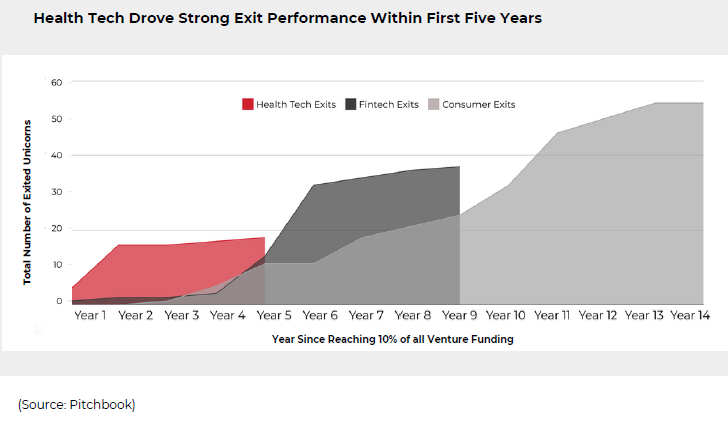
The report isn’t that long and is well worth a read but their basic argument compares digital health venture investments to those in fintech and consumer tech. Essentially it took digital health a lot longer to get to 10% of total venture investment than fintech or consumer tech, but it got there after 2020. Now more than 10% of all VC backed unicorns out there are health tech companies. Yes there was a retrenchment in 2022-3 but health tech investment fell less than other sectors in 2022-3 and is basically back in 2024.

The Define forecast forecast is interesting (it’s the chart below). Define posits that it took 4-5 years after the fintech and consumer tech sectors became 10% of VC dollars for them to start pumping out exits and IPOs. There are 30-50 each in those sectors now, but health tech was ahead of that with 18 exits already in the first 5 years after getting to 10% of VC dollars, and those exits were on average double the size of the fintech/consumer tech exits. (Although to be fair the health tech exits were when the market was higher after 2020)

In fact their analysis is that capital returned was about 10x investment.  You might say, but hey Matthew didn’t you just show me a chart that most of those 18 companies were public market dogs? And you’d be right.

Continue reading…

THCBGang Revisited: Ian Morrison

Ian Morrison died yesterday. 4 years ago in one of the early THCB Gang’s, we had a rash of late cancellations. So I talked to Ian solo about his journey, and his views about health care. I re-listened to it this morning and thought you might enjoy it

Ian Morrison

I got the very sad news today that Ian Morrison died peacefully at home yesterday. He had been sick and in hospice for some time but a few months back he told me that he was going for Jimmy Carter’s record. Ian was my first boss in American health care when I worked for him at Institute for the Future and he was as kind and lovely as he was funny and knowledgeable. I was very glad that when I started THCBGang during the pandemic that he was a regular member.

Ian spent decades working with everyone across health care in American and internationally, but as he used to say essentially was paid to insult people. That he did it so humorously and usefully was the reason he kept being invited back. Any Ian Morrison keynote at a big health care conference was both a chance to learn something and laugh hysterically.

He also never ignored the chance to help those trying to make health care fairer and more equitable, serving on the boards of Martin Luther King Jr hospital, the California Healthcare Foundation and many others. He remained a jovial Glaswegian socialist at heart.

Ian liked to say that he went from Scotland where death was imminent, to Canada where death was inevitable, to California where death was optional. Sadly that last crack wasn’t quite true.

My heart goes out to his wife Nora and their children and grandchildren. There’ll be a more formal obituary and a celebration of his life in the days and weeks to come–Matthew Holt

Jonathan Bush, Zus Health

It’s always fun to chat with Jonathan Bush. You kids today may not remember that he was the first CEO to take a cloud-based (Health 2.0!) company public back in 2007! Athenahealth didn’t end up challenging Epic because a cosmically evil hedge fund took it (and him) down as it was on its way to try to do that, but Jonathan has moved on and is now building a clinical data integration company called Zus Health. We talked Zus, digital health, whether there will ever be value-based care and more. 20 mins of digital health gold right here–Matthew Holt

Peter Yellowlees, AsyncHealth

Peter Yellowlees MD is CEO at AsyncHealth–this is a new company that is doing the intake interview for a psychiatrist or psychologist session. Peter demos how the AI agent asks questions, how a patient answers in real time. Then after submitting the answers, the AI creates both a full transcript in the back end, and then a summary which the clinician can use in advance of seeing the patient. You’ll see the real time transcript and patient summary. Very accurate and impressive. That saves a significant amount of time in the intake process and helps the patent get to the right type of treatment. It’s early days for Asynch Health, but you’ll quickly get the idea about how this use of AI might change one part of care–Matthew Holt

Aniq Rahman, Fabric Health

Aniq Rahman is the CEO of Fabric Health. In basically two years Fabric has changed its name (nee Florence) bought some health tech standouts in the fields of symptom checking and asynchronous care (Gyant, Zipnosis), a medical group (Team Health’s virtual care) and the telehealth part of Walmart (MeMD). In the 2010’s Aniq built an analytics company acquired by Oracle & turned to health care after seeing his father go through the system. What he is trying to build is a company that can help providers (and now others) go from soup to nuts in helping a consumer online. He explained how those pieces fit together to match the look and feel of the customers to support their staff but also to augment them with Fabric’s people where needed. Now, with the Walmart/MeMD acquisition they are adding employers (and payers and even life science companies). There’s a lot to be done here, and we had a great chat about where consumers are going to get their care, what else Fabric needs to do (Aniq is thinking provider directories next!), and what the secrets are about General Catalyst’s work at Summa Health (sadly not much inside info!!)–Matthew Holt

Maybe AI Doesn’t Read Blueprints

By KIM BELLARD

Gosh, who knew that Jan 13 would be an AI day, with at least three major announcements about “blueprints” for its development going forward? Of course, these days every day is an AI day; trying to take in all AI-related news can be overwhelming. But before some other AI news drowns them out, I wanted to at least outline today’s announcements.

The three I’m referring to are the Biden Administration’s Interim Final Rule on Artificial Intelligence Diffusion, OpenAI’s Economic Blueprint, and the UK’s AI-driven Plan for Change.  

The Biden Administration’s rules aim to preserve America’s lead in AI, stating: “it is essential that we do not offshore this critical technology and that the world’s AI runs on American rails.” It establishes who advanced chips can be sold to and how they can be used in other countries, with no restrictions on 18 key allies and partners.

It also sets limits on model weights for AI models, seeking to constrain non-preferred entities’ ability to train advanced AI models.

“The U.S. leads the world in AI now, both AI development and AI chip design, and it’s critical that we keep it that way,” Commerce Secretary Gina Raimondo said in a briefing with reporters ahead of Monday’s announcement

Not everyone is happy.

Continue reading…