Categories

Category: Health Policy

Barking Up The Wrong Tree: Affordability, Not Cost Growth, Is The Policy Challenge

By JEFF GOLDSMITH

A recent spate of commentaries on the continuing health spending moderation raise an important policy question:  If the cost curve is well and truly bent, why are we investing so much of our policy energy on bending it further, when the more pressing problem is the declining percentage of Americans that can afford our health system’s astronomical costs?

Health spending the past two reported years (2009 and 2010) have grown in the high 3 percent range, the lowest growth rates since Dwight Eisenhower’s last year in office (1960), five years before Medicare. Medicare’s actuaries have pointed to the recession as a root cause.  Yet even Medicare spending growth has subsided to about 5 percent in 2010, a development hard to attribute to recession since so few Medicare patients have first-dollar cost exposure. This analyst’s extensive industry contacts suggest no spending rebound in 2011 and 2012, despite an aging population and fee-for-service’s pernicious volume-increasing incentives in full force.

Pharmaceutical spending. The two most explosive cost problems of the 1980’s and 1990’s, pharmaceutical spending and imaging — which together now represent about 20 percent of total health spending — are now seeing low single digit growth, and seem likely to remain quiescent.  In the pharma case, the main contributor is the ruinous outflow of branded drugs from patent protection, and the failure to replace them with new protected drugs.  This outflow continues unabated until 2018.  Branded drug prescriptions are shrinking by 5 percent per year, and the only things preventing pharmaceutical sales from actually declining are brand price increases and growth in generics, which now represent almost 80 percent of prescriptions, according to IMS Health.  While specialty drugs (biologicals) remain a concern, those too begin losing patent protection in earnest in the next few years.

Continue reading…

The Psychology of the ObamaCare Debate

By PETER UBEL

“How can the government make us buy health insurance?  What gives them that right?”

Sitting on my left while our airplane raced above the clouds, Elizabeth was clearly upset about Obamacare.  She wondered why the bill had to be so long, and why Obama would endorse a plan that doubled her health insurance costs.  But nothing vexed her more than the individual mandate.

At least that’s what I though until I spoke with her at greater length, and she revealed a profound truth to me about people’s attitudes towards the mandate and towards Obamacare more generally: she showed me that deep down she liked the idea of the mandate, once she realized its important role in accomplishing goals people on all sides of the political spectrum care about deeply.

We were flying towards North Carolina the day before the Supreme Court held its oral arguments on Obama’s healthcare plan.  Elizabeth had heard a great deal about the mandate.  She read The Wall Street Journal regularly, in part because it was so relevant to her work in banking.  And she enjoyed watching Bill O’Reilly on Fox News, but not Hannity, who she thought was “too extreme”.  She was by no means a conservative extremist.  She had major concerns about the banking industry for example, and as a Christian felt strongly that income inequality is a moral problem that neither party was addressing in an effective manner.  But she was solidly Republican, no doubt about that, and she agreed with most people in that political party that Obamacare was hurting the economy.  And above all she believed the health insurance mandate was “un-American.”

Continue reading…

A Fork in the Road to Meaningful Use

By ADRIAN GROPPER

The deadline for comments to Stage 2 is upon us and a clear fork has emerged for federal regulators. The cats and dogs here are institutional vs. patient engagement. The institutional fork has been taken by the American Hospital Association. The patient fork is exemplified by the National Partnership for Women and Families. The primary argument is over patient access to their own information. The draft regulation suggests a 36 hour (or 4 days in other circumstances) delay. The AHA wants 30 days. Some patient advocates are seeking immediate and highly convenient access.

The fork in the road for federal regulators, with some $30 Billion dollars of incentives in hand, is whether to micromanage the institutions or to encourage patient-centered innovation. This choice is deeply entangled in the $Trillion realities of payment reform.

The micromanagement of institutions through increasingly complex regulations on EHR vendors, clerical and clinical staff seems like slow torture. We have institutions begging for relief. Large vendors are consolidating their lock-in business model as the barriers to entry into the health information market get higher and higher. Quality transparency is controversial and price transparency is almost unimaginable.

Continue reading…

Obama Supporters Put High Court on Trial

By BETSY MCCAUGHEY


As the U.S. Supreme Court deliberates the Obama healthcare law, the court itself is on trial.

Obamacare supporters are attacking the justices as “hacks dressed up in black robes,” calling for limits on their life tenure, and claiming judicial review is undemocratic.

Worse, President Obama and his Secretary of Health and Human Services Kathleen Sebelius are shoveling money into implementing the law as fast as possible and refuse to discuss an alternative. That’s irresponsible. What’s needed now is not court bashing but contingency planning.

The Obama administration and allies in Congress have nine weeks to plan how to pick up the pieces on a vast array of health insurance issues. It’s the President’s duty to have a plan. It will signal his respect for the nation’s system of checks and balances — something he has utterly failed to show.

Continue reading…

Heady Times for Health Care in the Cloud

By JONATHAN BUSH

In 1990, when I got my first health care job driving ambulances, not a soul in the New Orleans EMS department had a cellphone. Not even the head of the service. The mayor, his chief of staff and the police chief each had one. That was about it. These phones weighed like 15 pounds and were hardwired to a car battery. And we ambulance drivers documented our care on “run sheets” found on metal clipboards but, since so few people bothered to read them, we also wrote key vital signs and other metrics on a three-inch-wide piece of white tape smacked across the patient’s abdomen.

Today, everyone in New Orleans — and everywhere else — has a cellphone. These cellphones have the computing power to find, and add to, and direct everything that anyone would need to know about a patient anywhere in the world… but they don’t do it! Today’s “do-everything” cellphones are the size of your wallet, yet most ambulance crew run sheets are still paper, found on metal clipboards. And most good patient data is still found on those three-inch-wide pieces of tape.

Why? I’ll give you one good reason and one bad one.

Continue reading…

A Health Care Setup Both Sides Could Live With

By DONALD H. TAYLOR JR.

Before long the Supreme Court is expected to rule on the health care reform law, a decision that will have tremendous policy ramifications and could reshape the presidential election.

But even if the court overturns the Affordable Care Act, as some observers predict, that won’t change the reality that our country’s health care system is seriously broken. In short, regardless of what the court says, people will still be getting sick, costs will keep rising and too many people will be uninsured. And our federal budget will never be sustainable if we can’t bring health care costs under control.

The Democratic Party and progressives invested a huge amount of political capital in getting Congress to pass the ACA in 2010. The act was not perfect, but it did provide a start to the many years of work needed to create a sustainable health care system. In speeches, Republicans and conservatives acknowledge that our health care system is unsustainable and have spoken of a need to “replace”; however, in the two years since the ACA passed, they have failed to be clear about what they actually favor.

As we look to what we’re actually going to do about the problem, what’s clear is that progressives and conservatives both need to move beyond their familiar positions to find a new kind of deal. This seems politically impossible before November, but politicians on both sides would do themselves – and the country – a big favor if they quietly started devising a solution that everyone can live with, even if neither side gets everything it wants.

For progressives, universal coverage has always been the Holy Grail and dream deferred, not just of health policy, but of all social policy. I don’t think conservatives have a health policy interest that is so clear and heartfelt as universal coverage is for progressives, but if I had to take a stab, I think it is their belief that people don’t have enough “skin in the game” and are therefore wasteful of other people’s money.

Continue reading…

What if We Regulated Legal Services Like Health Care?

By JOHN R. GRAHAM

Well, the future of American health care is now controlled by lawyers. That may not be news – doctors, drug makers, and medical-device makers have long complained about the cost of lawsuits. But this different: The future of PPACA is in the hands of the Supreme Court. Hundreds of lawyers billed thousands of hours analyzing and preparing briefs for the case. And that’s after countless hours spent by Congressional staff lawyers putting the bill together in 2009 and 2010. The result? A “law” so confusing that even the legislators – themselves mostly lawyers – could not bother to even try to read it.

It makes one think: If the lawyers are designing the health-care system, shouldn’t they be forced to operate under regulations similar to those they’re imposing? How, for example, do lawyers get paid? Today, they negotiate fees with clients. That hardly seems fair. In health care, doctors don’t negotiate fees with patients, they get paid according to an opaque schedule determined by health plans. Lawyers should do the same. The solution is “legal insurance”. After all, who amongst us knows when we’ll need a lawyer? It is often an unpredictable expense, and yet the “market” seems to have failed to provide such insurance. Government must intervene.

Continue reading…

World Health Care Congress 2012 Live: Markus Fromherz, Xerox

[viddler id=cb5f16fc&w=560&h=270]

This three-part interview from World Health Care Congress with Markus Fromherz, chief innovation officer of Xerox Healthcare, covers some of the most exciting healthcare research and development going on at Xerox’s Palo Alto Research Center. Part one includes Markus’ thoughts on moving paper data to digital and describes the process in three layers – gaining access, drawing insight and taking action from what was learned.

Continue reading…

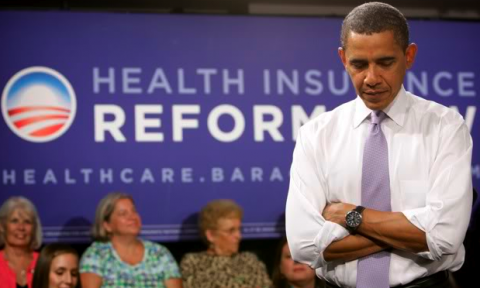
How Obama Botched and Bungled the Health Reform Message

Michael Millenson

By MICHAEL L. MILLENSON

While it’s comforting to just blame the GOP for the unhappiness with health reform threatening the president’s re-election, the truth is that Barack Obama repeatedly botched, bungled and bobbled the health reform message. There were three big mistakes:

The Passionless Play

While Candidate Obama proclaimed a passionate moral commitment to fix American health care, President Obama delved into legislative details.

When a Baptist minister at a nationally televised town hall asked in mid-2009 whether reform would cause his benefits to be taxed due to “government taking over health care,” Candidate Obama might have replied that 22,000 of the minister’s neighbors die each year because they lack any benefits at all. Instead, President Obama’s three-part reply recapped his plans for tax code fairness.

While Republicans railed about mythical “death panels,” and angry Tea Party demonstrators held signs showing Obama with a Hitler moustache, the president opted to leave emotion to his opponents. The former grassroots organizer who inspired a million people of all ages and ethnicities to flock to Washington for his inauguration never once tried to mobilize ordinary Americans to demand a basic right available in all other industrialized nations. In fact, he hasn’t even mobilized the nearly 50 million uninsured, who have no more favorable opinion about the new law than those with health insurance!

Continue reading…