Categories

Category: Health Policy

How the United States Supreme Court Saved My Life

By SPIKE DOLOMITE WARD

Not to be overly dramatic, but for me the Supreme Court decision on the Affordable Care Act was a matter of life and death. Because the law was largely upheld, I will be able to continue receiving treatment for breast cancer.

I was one of the early beneficiaries of the law. When I was diagnosed with an aggressive form of breast cancer late last year, I had no health insurance, which meant my options were extremely limited. No insurer would pick up someone in my circumstances. But luckily, the Pre-existing Condition Insurance Plan had already kicked in, and it made it possible for me to purchase insurance under a government program.

I was uninsured not because I’m a lazy, freeloading deadbeat but because my husband and I are self-employed. We had been purchasing health insurance on the individual market along with 6% of the rest of the population. But after exhausting all of our resources trying to keep up with premiums of $1,500 a month, we had no choice but to cancel it.

Continue reading…

Is This Health Reform Which I See Before Me?

By DAVID DRANOVE

In a recent column, Clarence Page ridiculed Republicans who claim that they want healthcare reform but oppose programs that dramatically reduce the number of uninsured. Republicans counter that the PPACA is not true reform because it fails to contain costs. It seems that our political commentators have finally joined a long standing debate among health policy experts. More precisely, they have joined two-thirds of that debate.

The healthcare system is often described as a three-legged stool, supported by access, cost, and quality. Policy makers have usually paid attention to the most “rickety” leg, sometimes to the detriment of the others. During the 1960s and 1970s, access was the biggest problem, and government gave us Medicare, Medicaid, and the community health center movement. These programs triggered a surge in healthcare spending, and by the mid-1970s through the mid-1990s, the emphasis shifted to cost containment. When government price controls and planning laws failed, the private sector stepped in with a “competitive” solution based on HMOs and selective contracting.

Continue reading…

States Should Opt Out of Medicaid — All The Way Out

By MERRILL GOOZNER

With over a dozen conservative states leaning against expanding Medicaid to cover poor workers without health insurance, perhaps it is time to resuscitate an idea embraced by President Ronald Reagan. Let the federal government take over Medicaid lock, stock and barrel.

In 1982 the president who ushered in the modern conservative era offered to assume federal responsibility for the program that now consumes over 22 percent of state government budgets in exchange for states taking over welfare. His offer built on a series of recommendations going back to 1969 by the U.S. Advisory Commission on Intergovernmental Relations, which called for a federal takeover of all public assistance programs.

President Obama’s health care reform law, if it survives the final hurdle of next November’s election, could give that idea new life. Under the Affordable Care Act, states are responsible for creating insurance exchanges where individuals and businesses can buy individual or group health plans.

Continue reading…

Roberts’ “Flying Squirrel” Maneuver Takes Down the Affordable Care Act

By JEFF GOLDSMITH

After a four month “death watch” in the mainstream media for President Obama’s health reforms (following an ineffectual defense in March’s Supreme Court hearings), instant analysts were quick to characterize last week’s Supreme court decision as a ringing vindication of the Affordable Care Act and a big political victory for a struggling President Obama.

However, on closer reading, the instant analysts were wrong. The Roberts Court actually punched a huge hole in the law, potentially reducing its historic coverage expansion by as much as a third. In addition, the Court’s ruling will set off serious political conflict in southern and mid-western states that will ripple through those states’ health care markets, and fracture hospitals’ and health plans’ support for health reform.

Unlike the Act itself, which was almost unreadable, the Court’s opinions were written in English and will reward readers with fresh understanding of this complex law. They reveal two incommensurable philosophical positions eloquently argued and improbably bridged. There were two big surprises: Justice Robert’s apparent last minute support of the Court’s liberal wing in preserving the mandate and the remarkable decision to render the Medicaid coverage expansion optional! (Justice Kennedy, the presumed swing vote, actually supported killing the entire law).

Continue reading…

A Healthcare Contract With America

By JOHN C. GOODMAN & PETER FERRARA

Critics of the Affordable Care Act (Obamacare) need an alternative vision. What follows is a short explanation of the core ideas posted at the Congressional Health Care Caucus and developed in greater detail in the book Priceless: Curing the Healthcare Crisis.

Tax Fairness: Families at the same income level should get the same help from government when they obtain private health insurance, regardless of where they obtain it. The federal government encourages the purchase of private health insurance through the tax system. Yet the current approach is arbitrary, regressive and unfair. Instead of paying taxable wages, employers are able to purchase health insurance for their employees with untaxed dollars. These employer-paid premiums avoid federal income taxes, federal payroll taxes (FICA), and state and local income taxes as well. This “subsidy” is worth almost half the cost of the insurance for a middle income family. Yet the same family receives virtually no tax relief if it purchases the insurance on its own.

Because of the way we subsidize private health insurance, the higher the family’s tax bracket, the greater the subsidy. A family earning $100,000 gets six times as much tax relief as a family earning $25,000. We are giving the most encouragement to those who need it least.

As an alternative, we should replace the current system of tax and spending subsidies with a system that offers everyone a uniform, fixed-dollar tax credit for the purchase of health insurance. The credit would be refundable, so that it would be available even to those with no tax liability. A reasonable goal, for example, would be a credit of $2,500 per adult and $8,000 for a family of four.

Universality: Unclaimed tax relief should be made available to local safety net institutions to be used in case the uninsured cannot pay their own medical bills. If an individual chooses to be uninsured, the unclaimed tax credit should be sent to a safety net agency in the community where the person lives. These funds would provide a source of finance in case the uninsured are unable to pay their medical bills.

Under this approach, the government pledges a fixed sum of money for every individual and money follows people. If everyone in Dallas County opts to obtain private insurance, there would be no need to fund a safety net and all the government’s support would be in the form of tax credits for health insurance premiums. On the other hand, if everyone in Dallas County opts to be uninsured, all the unclaimed tax credits would go to safety net institutions in Dallas.

This is an easy reform to implement, even if peoples’ insurance status changes often over the course of a year. All the federal government needs to know is how many people live in each community. If the tax credits claimed on income tax returns fall short of their potential for the community as a whole, the balance would be provided in the form of a block grant to be spent at the local level.

Continue reading…

Why States Won’t Opt Out of Medicaid Expansion

By AARON CARROLL

I’m reading a lot of articles, and seeing lots of tweets, that detail a running total of governors threatening to opt out of the Medicaid expansion. First of all, those are threats. They are very different than actual action. It’s also in the best interests of states to take this position as a negotiating tactic. In the end, though, I think it will be very hard for states to opt out. Here are some of the reasons why:

  1. This is a pretty good deal for states. They’re getting most of the tab picked up by the feds.
  2. It’s one thing to turn down high speed rail. It’s another to tell your constituents that they can’t have insurance entirely paid for by the federal government in 2014.
  3. As more and more states take the money, those that don’t will be more easily marginalized.
  4. History. States threatened not to join Medicaid the first time as well. All did, eventually. Now the program is so American that threatening to remove it is “coercive”.
  5. There will be enormous pressure from doctors, hospitals,pharma, etc. who potentially will lose a lot of money in uncompensated care. They have pretty good lobbying groups.

Continue reading…

Climbing the Medicaid Mountain

By TRUDY LIEBERMAN

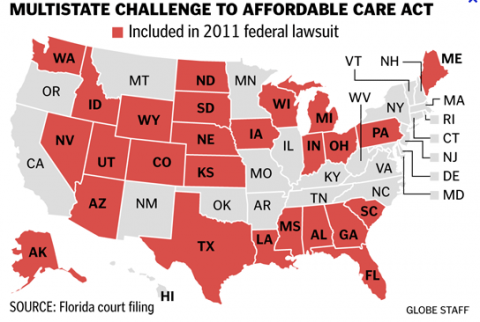
Multistate Challenge to the Affordable Care Act

The Affordable Care Act envisions a major expansion of health insurance in America, with some 30 million Americans gaining coverage. That figure includes some 17 million people with low incomes who were to get health insurance via an expansion of Medicaid eligibility. With eligibility raised—from 100 percent of the poverty level to 133 percent—many states will enlarge their Medicaid rolls and pay for it with federal funds, at least for a few years.

But the Supreme Court clouded that part of the vision last week, ruling that states cannot be penalized for refusing the federal money—thus leaving in doubt how many of the projected 17 million poor or near poor citizens will actually get coverage.

In short, the Supreme Court allowed the federal carrot to remain, but took away the stick. Matt Salo, the executive director for the National Association of Medicaid Directors, an organization for those who run state programs, summed it up for The Washington Post: “Prior to the court’s decision, failure to implement this expansion meant you [the states] lost all your Medicaid funding. Now you have a political and financial decision to make: Do you do this?”

Continue reading…

What Happens Next? 2.0 Edition

By JONATHAN BUSH

Those of us who worry about the government creeping into all our lives can now stop fussing and fighting, cry it all out, and move on to implementing the Affordable Care Act (ACA).

But first, we need two core competencies: the ability to integrate health information across providers AND (soon thereafter) the ability to separate signal from noise.

Both of these competencies will require a propagation of the cloud. Let me explain why.

Our work in the health care (EHR) marketplace remains the same as if the ACA had been reversed…and it’s the same work we SHOULD have done years ago. That is, to treat the information that gets generated during the provision of care as if the consumer was actually paying for it. Because, in fact, they ARE paying for it and always have been—but the disintermediation by both third-party payers and the government has allowed us, as providers of health care services, to get pretty sloppy with the information that gets created in the name of client care.

While they are becoming more empowered, consumers haven’t throttled us during those instances when they must submit to a second test because the first result got fumbled somewhere in the care chain. Now, as each state goes for the federal dollars provided to them in the Affordable Care Act (ACA), they’ll feel greater pressure to…well…not lose information, and be able to provide it to any appropriate care giver who needs it. All while still trying to balance their budgets.

Continue reading…

What Will the Supreme Court Decision Mean For the November Election?

By MAGGIE MAHAR

Thursday, when Chief Justice Roberts explained that the Affordable Care Act (ACA) is constitutional because the “penalty” that some Americans will have to pay is, for all practical purposes, a “tax,” you could hear tea cups shattering from Billings to Boca Raton. In conservative and libertarian circles, the initial reaction was shock, but it didn’t take long for President Obama’s opponents to rally.

The word “tax” might as well have been a pistol shot at a horse race. In the blink of an eye, Obama’s opponents were off and running, megaphones in hand, blasting the president for lying to the American people while hiking taxes under the guise of healthcare reform. Presidential candidate Mitt Romney’s campaign then began providing regular Twitter updates on the campaign contributions it was raking in following the decision. Friday, it announced that it had collected $5.5 million.

Will Republicans suceed in turning defeat into victory?

Sarah Palin is convinced that they will. On her Facebook page, she celebrated: “Thank you, SCOTUS. This Obamacare ruling fires up the troops as America’s eyes are opened.”   Palin, like Republican leader Mitch McConnell, believed that the Court’s ruling would galvanize Republic voters, sealing Romney’s victory in November.

This might be true if conservatives were not already so ardently committed to what McConnell has called his party’s “single most important” goal: “for President Obama to be a one-term president.”  As Democratic pollster Celinda Lake noted, “Republicans are already as energized as they can get.” It would be hard to turn up the dial on their passion. Opinion surveys have shown that Republican voters already were more motivated than Democrats to go to the polls this fall.   (In November, Obama’s challenge will be to get his supporters out, including those who are disillusioned that the president hasn’t done more to help the poor and the unemployed. )

Continue reading…

Should We Propose A Global Nutrition Treaty?

By SANJAY BASU

In 2003, 168 countries signed the world’s first public health treaty: the Framework Convention on Tobacco Control (FCTC). The FCTC legally bound countries to enforce major tobacco control measures, ranging from tobacco taxes to regulations on public smoking. Through a massive international effort, the FCTC has assisted countries to improve their tobacco prevention programs, and the treaty continues to be a basis for many new programs that are implementing evidence-based tobacco control strategies.

In an article in  PLoS Medicine, we publish new data showing that the food and beverage industry’s activities in low- and middle-income countries parallel that of the tobacco industry in years past; moreover, as cardiovascular disease and diabetes rates rise in poor nations, junk food, soda, and alcohol are statistically the major factors giving rise to deaths among working-age populations, and the newest evidence suggests that educational programs alone aren’t effective when markets are drowned by imports of cheap, unhealthy food and readily-accessible booze. So should the public health community push for a nutritional treaty or governance structure that parallels the successful introduction of the FCTC, but addresses “unhealthy commodities” like junk food? If so, what would such a structure look like?

Zooming out from the debates about soda taxes and similar public health controversies that pit individual freedom against public health desires to reduce disease rates, there are really a few core public health problems now facing global food systems: (1) that undernutrition and famine persist as over-nutrition (malnutrition in the direction of obesity) has appeared in the same poor households in many countries; and (2) that climate change has forced us to think about how to produce food for the world’s 9+ billion people in a manner that is environmentally sound (as highlighted in our recent discussion of Oxfam’s GROW campaign).

Continue reading…