Categories

Category: Uncategorized

Disrupted: How Computerization Is Changing the Practice of Medicine In Surprising Ways

Bob Wachter

The following is an excerpt from the preface of my new book, which  is tentatively titled: “Disrupted: Hope, Hype and Harm at the Dawn of Medicine’s New Age.”  Author’s note and request to THCB readers.

If you’re a 24-year-old who does not plan on getting sick for the next couple of decades, this is probably not the book blog post for you.

By the time you need our healthcare system, it will be wired in ways we can’t imagine today. By then, computers will have transformed healthcare – as they already have retail, publishing, photography, and travel – leaving it better, safer, and maybe even cheaper. Most of the kinks, perhaps other than what our society will do with boatloads of unemployed dermatologists, radiologists, and hospital administrators, will have been ironed out. I hope to live to see this day myself. It’ll be, as my kids say, hecka cool.

But for the rest of us – both those who need our medical system today and those who currently work in it – the path to computerization will be strewn with landmines, large and small. The challenges are everywhere. Medicine, our most intimately human profession, is being dehumanized by the entry of the computer into the exam room. While computers are preventing many medical errors, they are also causing new kinds of mistakes, some of them whoppers. Sensors and monitors are throwing off mountains of data, often leading to more cacophony than clarity. Patients are now in the loop – many get to see their laboratory and pathology results before their doctor does; some are even reading their doctor’s notes – yet are woefully unprepared to handle their hard-fought empowerment.

In short, while someday the computerization of medicine will undoubtedly be that long-awaited “disruptive innovation,” today it’s often just plain disruptive: of the doctor-patient relationship, clinicians’ professional interactions and workflow, and the way we measure and try to improve things. I’d never heard the term “unanticipated consequences” in my professional world until a few years ago, and now we use it all the time, since we – yes, even the insiders – are constantly astonished by the speed with which things are changing and the unpredictability of the results.

Before we go any further, it’s important that you understand that I am all for the computerization of healthcare. I bought my first Mac in 1984, back when one inserted and ejected floppy disks so often (“Insert Excel Disk 2”) that the machine felt more like an infuriating toaster than a sparkling harbinger of a new era. Today, I can’t live without my MacBook Pro, iPad, iPhone, Facetime, Twitter, OpenTable, and Evernote. I even blog and tweet. In other words, I am a typical, electronically overendowed American.

And healthcare needs to be disrupted. Despite being staffed with (mostly) well trained and committed doctors and nurses, our system delivers evidence-based care about half the time, kills a jumbo jet’s worth of patients each day from medical mistakes, and is bankrupting the country. Patients and policymakers are no longer willing to tolerate the status quo, and they’re right.

Continue reading…

What JCAHO Knows

flying cadeuciiHere’s a doctor’s health tip for patients that I’ll bet you haven’t heard before.

If you’re a patient who walks into a hospital for an elective procedure of any kind–surgery, or a diagnostic test–and you find out that Joint Commission reviewers are on site, reschedule your procedure and leave. Come back another day, after the reviewers have left.

Why? Because every single person who works there will be paying a lot of attention to Joint Commission reviewers with their clipboards, and scant attention to you.

The Joint Commission has the power to decide whether the hospital deserves reaccreditation. Administrators, doctors, nurses, technicians, clerks, and janitors will be obsessed with the fear that the reviewers will see them doing something that the Joint Commission doesn’t consider a “best practice”, and that they’ll catch hell from their superiors.

For you as a patient, any idea that your clinical care and your medical records are private becomes a delusion when the Joint Commission is on site. Their reviewers are given complete access to all your medical records, and they may even come into the operating room while you’re having surgery without informing you ahead of time or asking your permission.

Perhaps physicians and nurses have an ethical duty to inform patients when the Joint Commission is on site conducting a review. Right now, that doesn’t happen. Does the patient have a right to know?

Unintended consequences

How did any private, nonprofit organization gain this kind of power? Why do American healthcare facilities pay the Joint Commission millions each year for the privilege of a voluntary accreditation review? It’s a classic tale of good intentions, designed to improve healthcare quality, that turned into a quagmire of unintended consequences and heavy-handed regulation.

American surgeons in 1918 started a system of reviewing hospitals because they were rightly concerned about serious differences in quality of hospital care and standards of practice. They wanted to evaluate hospitals objectively and motivate substandard ones to improve. In 1951, the American College of Surgeons joined forces with the American Medical Association, the American Hospital Association, and other corporate members to form the Joint Commission for Accreditation of Hospitals (JCAH).Continue reading…

Breaking: Health 2.0 Fall Conference Lineup Is Out!

Screen Shot 2014-06-25 at 12.15.10 PM
Tech giants storming the digital health landscape will be center stage at Health 2.0’s 8th Annual Fall Conference in Santa Clara, CA. An impressive line-up of health and tech executives headline three full days of live demos and innovative sessions. Highlights include keynotes from visionary physicians Eric Topol and Patrick Soon-Shiong as well as Samsung Electronics President, Young Sohn in conversation with Health 2.0 CEO, Indu Subaiya. Leaders from Intel, Humana, IBM Watson, Qualcomm Life, Merck, athenahealth, eClinicalWorks and the Office of the National Coordinator for Health Information Technology (ONC) will showcase and discuss their latest technologies and initiatives on the main conference stage this fall. As always, Health 2.0 features over 150 live demos of new technology, 250+ speakers, 50+ sessions, more networking, and deals-done than anywhere else in health technology.

The main stage will feature the following panels:

Smarter Care Delivery: Amplifying the Patient Voice: Matthew Holt, Co-Chairman of Health 2.0, sparks the discussion on how new technology platforms, payors, and providers are working together for enhanced patient care delivery and engagement.

Consumer Tech and Wearables: Powering Healthy Lifestyles: Bringing together the most innovative wearables that are pushing individualized medicine into the future, Indu Subaiya, CEO of Health 2.0, leads this session focused on how consumers are experiencing new lifestyles centered around technology. Don’t miss the live fashion show featuring all the latest trends in digital health wearables!

Buy, Sell, Exchange: New Markets for Consumers, Employers, and Providers: Nearly a year after ACA implementation, this session will dive into the new ways benefits are being offered to consumers, how employers are buying care directly, and what new technologies are enabling change in direct care provision.

Data Analytics: From Discovery to Personalized Care: This panel focuses on how data analytics and powerful visualizations are pushing forward clinical research. Highlights will include genomics, non-invasive diagnosis tools, and integrated data collection are uncovering new discoveries, promoting personalized medicine and new care protocols.

Returning crowd favorites include 3 CEOs … (and a President!), The Unmentionables hosted by Alexandra Drane, The Frontier of Health 2.0 hosted by David Ewing Duncan, and Launch! with ten brand new companies unveiling their products for the very first time! Many more sessions and panels can be found on the Health 2.0 online agenda.Continue reading…

PCORI Works to Deliver the Comparative Evidence Health Care Stakeholders Need

Joe SelbyAt the Patient-Centered Outcomes Research Institute (PCORI), we believe comparative clinical effectiveness research (CER) is important and that we have a critical role to play in establishing the nation’s CER priorities. I’m pleased to say that many respondents to the latest National Pharmaceutical Council (NPC) survey think so as well.

While results of CER studies that we and others are funding have yet to be completed, and CER’s ultimate ability to transform our healthcare system is still years away,  nearly all respondents in this fourth annual survey agree that CER is here to stay and that it will become increasingly important in aiding decision making. Respondents also indicated that CER has not yet assessed the broader array of outcomes that matter to patients.

These are important insights.  The survey tracks the attitudes of researchers, policymakers, employers, business groups, insurers, and health plans. Engaging with these stakeholders – along with patients, caregivers, clinicians, and other providers – and ensuring that the work we fund provides evidence they can trust and use, are essential if CER is to realize its potential in guiding health care.

That’s why Congress authorized PCORI’s establishment as an independent, non-profit organization focused on ensuring that the broad healthcare community is meaningfully engaged in our work.  We’re governed by a diverse board that represents all stakeholders. And through an open and collaborative approach to research, we’re identifying the questions patients and other clinical decision makers need answered, so they can make better-informed choices that will lead to better outcomes.

We’ve already awarded $464.4 million to support 279 studies that advance patient-centered CER and we expect to commit another $1 billion over the next two years.


Continue reading…

Physicians Interactive Acquires MedHelp In Move to Bridge Consumer and Provider Worlds

Screen Shot 2014-06-25 at 9.47.51 AM

Earlier this week, Health 2.0 promised some big news showing how the provider and consumer facing worlds of Health 2.0 are coming together. Today, they officially shared that Physicians Interactive has acquired MedHelp. Both companies are stalwarts in the Health 2.0 world, and their merging serves as further evidence that consumer and professional facing tools are continuing to connect in new and meaningful ways.

Physicians Interactive has been onstage at Health 2.0 multiples times, but always in a professional facing role. Tools like Omnio, a provider-to-provider content sharing app, play to Physicians Interactive strengths, which center on accessing and communicating with an extensive provider network — some 300,000 doctors to be exact.

MedHelp, on the other hand, another Health 2.0 staple, is nothing if not a consumer-oriented tool. Their web-based online health community helps individuals actively manage their health with a host of tools, including patient forums, physician search engines, provider communication tools, and personalized trackers.

MedHelp has grown organically (CEO John deSouza always tells us “no bought traffic”!) and gone from communities to trackers to an active health data utility layer that takes in data from many devices and trackers. In one recent partnership, demoed at Health 2.0 last fall, MedHelp took a step towards connecting consumers and providers with an app that delivers both lab results and an expert opinion, if the consumer elects to receive one. However, connecting to providers was still on the edges of MedHelp’s capabilities.

Continue reading…

Where Are The Hot Spots For Antibiotic Resistance?

Tom Frieden CDCIn July, CDC will roll out a new way every hospital in the country can track and control drug resistant bacteria.CDC already operates the National Healthcare Safety Network (NHSN), with more than 12,000 health care facilities participating.  Now we are implementing a breakthrough program that will take control of drug resistance to the next level – the Antibiotic Use and Resistance (AUR) reporting module.  The module is fully automated, capturing antibiotic prescriptions and drug susceptibility test results electronically.

With this module, we’ll be able to create the first antibiotic prescribing index. This index will help benchmark antibiotic use across health care facilities for the first time, allowing facilities to compare their data with similar facilities. It will help facilities and local and state health departments as well as CDC to  identify hot spots within a city or a region.

We’ll be able to answer the questions: Which facilities are prescribing more antibiotics? How many types of resistant bacteria and fungi are they seeing? Do prescribing practices predict the number of resistant infections and outbreaks a facility will face?  Ultimately with this information, we’ll be able to both improve prescribing practices and identify and stop outbreaks in a way we have never done before.

This will help deploy supportive and evidence-based interventions at each facility as well as at regional levels to help stop spread among various facilities.

The need for a comprehensive system to collect local, regional, and national data on antibiotic resistance is more critical than ever. The system now exists, and we need quick and widespread uptake.

Rapid and full implementation of this system is supported through the proposed increase of $14 million contained in CDC’s 2015 budget request to Congress.

With the requested funding increase in future years, CDC would look to develop web-based tools and provider apps so physicians will gain access to facility- and community-specific data via NHSN on the most effective empiric antibiotic for the patient in front of them. For example, a physician in a burn unit treating a patient with a possible staph infection will know what antibiotics that particular microbe is likely susceptible TO and which ones are likely to be most effective.

Instead of broad-spectrum antibiotics being the default choice, as is often the case now, doctors will see recommendations for targeted narrow-spectrum antibiotics that are more likely to be effective and less likely to lead to potentially deadly infections such as C. difficile.

Continue reading…

2014 Black Book Survey Says Majority of Medical Practices Want Updated Software

Screen Shot 2014-06-26 at 2.07.25 PMThe new mantra for the medical practice is upgrade, integrate, and outsource according to the results of the Black Book Rankings™ 2014 Survey. Each year, Black Book gathers over 400,000 viewpoints on information technology through an interactive online survey and telephone discussions. The result is an annual barometer of HIT satisfaction and experiences.

This year, three clear trends emerged for practices looking to stay independent in a changing and challenging time in healthcare. While each trend holds its own unique benefits, it is clear from the survey that many practices are looking to implement all three—upgrade technology, implement integrated solutions, and outsource business functions like revenue cycle management.

According to the survey, nearly 90% of physician practices agree their billing and collections systems need upgrading. Over 65% of those practices are considering a combination of new software and outsourcing services. Here are the trends:

Move to Upgrade Outdated Software

Even with recent changes in the CMS EHR Incentive program, delaying the required use of a 2014 Edition CEHRT, many practices do not currently have an EHR that will enable them to attest for meaningful use. In addition, 91% of business managers fear that the ramifications of their outdated and/or auto-piloted revenue cycle management (RCM) systems, particularly those not integrated to EHRs, will force their physician to sell.

As a result of these challenges and other impending changes like ICD-10, 21% of practices are considering an upgrade of their RCM software within the next six to twelve months, and 90% of those are only considering an EHR centric module.

Practices considering upgrades to cloud-based solutions can see other benefits including reduced costs, seamless upgrades, more flexible access, and reduced concerns around storage and security.Continue reading…

The Long and Short of Health Numbers

Screen Shot 2014-06-24 at 6.09.38 AMThe notable five-year contraction in healthcare spending growth comes to an end next year, but not in a way that marks a dramatic reversal—at least, not yet. The Medical Cost Trend: Behind the Numbers 2015 report released today from PwC’s Health Research Institute (HRI) projects a medical cost trend of 6.8% for 2015, up only slightly from the 6.5% projected for this year. Our analysis, which measures growth in the employer-based market, incorporates input from health policy analysts, industry executives, earnings statements, government data and actuaries from more than a dozen insurance companies, whose companies cover a combined 93 million members.

Much of this is simple and not surprising based on historical analysis: the healthcare “economic recovery” lags behind the broader economy. So we are now beginning to see the recovery—with more employed workers and more disposable income—loosen up spending on things such as doctor visits and diagnostic tests. Many Americans, after postponing care, are once again spending on their health needs.

Some underlying nuances in the health numbers are more complex and uncertain: greater total spending on health services is not the same as higher costs per person. Even as private health spending ticks upward, evidence reveals that structural changes over the past few years have produced greater efficiency in the $2.8 trillion US health industry. As with any evolution, there is uncertainty. Some of our big healthcare investments today are a financial gamble. Most notably, the burst of high-cost “specialty” drugs could result in lower treatment costs on chronic conditions in future years or signal the start of painfully expensive pharmaceutical bills.

The most durable long-term factors holding down costs are those that instill a new philosophy about care delivery.  For instance, health systems and hospitals striving for “systemness,” in which care teams seek to achieve more by working together. They are focusing specifically in two areas: streamlining administrative work and consolidating and standardizing clinical programs, which can provide higher quality care through consistent processes and outcomes.

With about 60% of hospital budgets spent on labor, personnel costs are a top priority. Since 2012, hospital employment growth has slowed and is projected to continue on this trend—evidence that providers are achieving improved efficiency with fewer resources.

Continue reading…

Penalizing Hospitals For Being Unsafe

Ashish JhaAdverse events – when bad things happen to patients because of what we as medical professionals do – are a leading cause of suffering and death in the U.S. and globally.  Indeed, as I have written before, patient safety is a major issue in American healthcare, and one that has gotten far too little attention. Tens of thousands of Americans die needlessly because of preventable infections, medication errors, surgical mishaps, and so forth.  As I wrote previously, according to Office of Inspector General (OIG), when an older American walks into a hospital, he or she has about a 1 in 4 chance of suffering some sort of injury during their stay.  Many of these are debilitating, life-threatening, or even fatal.  Things are not much better for younger Americans.

Given the magnitude of the problem, many of us have decried the surprising lack of attention and focus on this issue from policymakers.  Well, things are changing – and while some of that change is good, some of it worries me.  Congress, as part of the Affordable Care Act, required Centers for Medicare and Medicaid Services (CMS) to penalize hospitals that had high rates of “HACs” – Hospital Acquired Conditions.  CMS has done the best it can, putting together a combination of infections (as identified through clinical surveillance and reported to the CDC) and other complications (as identified through the Patient Safety Indicators, or PSIs).  PSIs are useful – they use algorithms to identify complications coded in the billing data that hospitals send to CMS.  However, there are three potential problems with PSIs:  hospitals vary in how hard they look for complications, they vary in how diligently they code complications, and finally, although PSIs are risk-adjusted, their risk-adjustment is not very good — and sicker patients generally have more complications.

So, HACs are imperfect – but the bottom line is, every metric is imperfect.  Are HACs particularly imperfect?  Are the problems with HACs worse than with other measures?  I think we have some reason to be concerned.

Continue reading…

What Wall Street Can Teach Health Care About Targets and Measurement

Diabetes Curves

One thing the health care industry should admire about Wall Street capitalists is their ability to define their target and measure how well they are doing in achieving their aim. Most people would agree the aim of capitalism is profit (saying nothing of whether that is the right aim or not). The measures of that aim are reasonably straightforward using a standardized language of accounting rules. These standardized rules make it easy to compare one business to another using financial ratios (e.g., profit margin, return on capital, return on assets, etc.). When armed with knowledge of the rules and data to compute the financial ratios, deciding what to invest in becomes fairly straightforward—you invest in the opportunities that drive the highest profits over the shortest period of time.

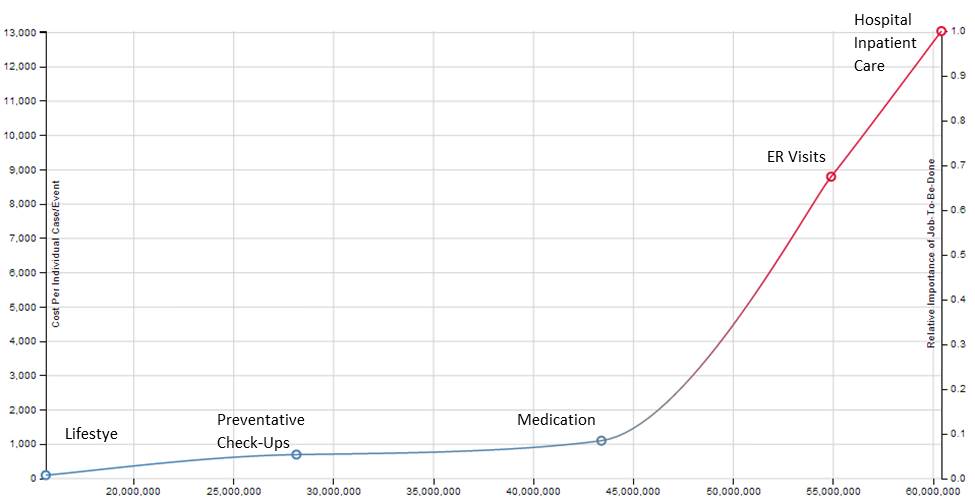
What is the aim of health care? Many of us would say it is health. If that is the case, however, we have been rotten resource allocators. Take diabetes, for example. In 2011 there were over 60 million care events in the US related to diabetes. The cost per episode is plotted on the chart below. It clearly shows (not surprisingly) that the sicker you get, the more expensive your care is. This is not to say that we shouldn’t spend anything on very sick patients. What it does indicate is that though we say we value health, we actually choose to spend our money on sickness.


What would need to change to aim the health care system at health (vs. sickness) and effectively measure our returns on that investment? Here are a few thoughts:

1-      Institute a common language for measuring health (and return on health investment)—Countries with developed capital markets almost always have a regulator that imposes a standardized language for financial measurement and reporting. In the United States this regulator is the Securities and Exchange Commission and the standardized language is Generally Accepted Accounting Principles (GAAP). Professor Regina Herzlinger of Harvard Business School has advocated for an ‘SEC’ for healthcare measurement and reporting. We join her chorus in advocating for this as a critical foundational need on which to base improvement going forward.

2-      Create business models that make money on health (instead of sickness)— Patients have jobs to be done related to both health and sickness. Unfortunately, in the US providers by and large can only be paid for treating sickness, so the incentive to create businesses truly focused on health has been low. That is changing with the advent of new payment models and technologies such as telehealth, remote monitoring, and predictive analytics. We encourage entrepreneurs to ambitiously pursue business models where providers can make money on health care independent of sick care.

Continue reading…

assetto corsa mods