
I had shoulder surgery on Monday and today I’m getting information about what happened delivered into the big LLMs. Follow along with me as I figure out how to get the information in there and what it tells me. — Matthew Holt
Above the Fold
Wall Street in the ER: How Private Equity Is Squeezing Local Hospitals

By ADAM LEE
Reflecting on a Private Equity (PE) internship in New York City reveals a major takeaway: financial engineering can be incredibly empowering, but applying it to public infrastructure often catches vulnerable communities in the crossfire.
The PE industry typically views the world through balance sheets, debt structures, cash flow optimization, and lucrative acquisitions. While these principles generate immense profit on paper, applying them to local healthcare—specifically safety-net hospitals—creates severe real-world tradeoffs.
Here are the major takeaways regarding the intersection of healthcare and business.
1. How Hospitals Get Saddled with an LBO
In the PE world, a Leveraged Buyout (LBO) is the primary acquisition method. An LBO pushes the debt onto the acquired asset, similar to convincing a bank that a newly purchased home will pay off its own mortgage.
For hospitals, this process typically follows a specific pattern:
- The PE firm borrows huge sums to purchase a hospital and its infrastructure.
- That borrowed debt lands directly on the hospital’s balance sheet.
- The firm sells the hospital’s land and buildings to a real estate company for quick cash.
- The hospital is left paying rent (with built-in escalators) just to operate inside its own building via a sale-leaseback arrangement.
The clearest example is Steward Health Care.
Continue reading…Healthcare Is Fighting the Wrong AI War

By KIM BELLARD
The Blue Cross Blue Shield Association is crying wolf about AI. Its new analysis claims that “hospital systems are increasingly billing patient hospital stays as more medically complex,” and that these upcodings cost BCBS plans almost $1b from 2023 to 2025. That’s just claims from hospital systems, just to BCBS plans, so the total number could be much higher.
Well, you might say, a billion here, a billion there – that’s just healthcare these days. Everything is going up. But BCBSA is less sanguine; it thinks the coding is part of a strategy, and it thinks AI is driving that strategy.
“If patients are truly sicker, we’d expect to see more treatment,” said Luke Chalker, BCBSA’s senior vice president of product and data science. “For example, we’re seeing significantly more anemia diagnoses at these hospitals without a corresponding increase in transfusions. The disconnect between diagnoses and treatment suggests that AI is identifying more billable conditions, not sicker patients.”
The analysis indicated that most (70%) of the increased costs came from secondary diagnoses that shifted payment into higher reimbursement categories, so the hypothesis is plausible.
The American Hospital Association, of course, is having none of it. An August 2026 ”fact sheet” on AI and coding intensity called claims of AI driving coding intensity “unsubstantiated,” citing numerous factors that drive coding intensity. It blamed insurers for having AI-supported “downcoding programs,” the purpose of which are “to arbitrarily and inappropriately reduce provider reimbursement for medically necessary care that has already been delivered.”
AHA also snarkily but accurately noted how many Medicare Advantage plans have been caught upcoding members to boost their Medicare payments, so it depends on where one is sitting.
It’s also worth noting that this year the Trump Administration rolled out a Medicare program — Wasteful and Inappropriate Service Reduction (WISeR) – to use AI to help identify “fraud, waste and abuse” – a.k.a., deny claims. It has not, to say the least, gone well.
Both sides are using AI, to each other’s detriment. Which is to say, our detriment.
Continue reading…Time to Stop “Calling it Reimbursement”

By JEFF GOLDSMITH
Back during the Jurassic period, at the beginning of my consulting career, senior colleagues at Ernst and Whinney took me to lunch to explain to the newby the facts of life in healthcare finance. The biggest takeaway from that long ago conversation: the entire history of hospital finance was built up on the revenue side. Managing costs was simply too challenging for most C-suites, because it inevitably required involvement with medical staffs who, at the time, were independent practitioners and beyond the hospital’s direct control. Therefore, the job of payers-governments and private insurers- was to “reimburse” hospitals for their expenses (that is, so long as the costs were “allowable”). The subtext of using the term “reimbursement” was : “We already spent the money and you owe us!”
In 2026, this mindset miraculously persists. This is despite the fact that Medicare, the largest and most influential payor for hospital services, has not reimbursed hospitals for the cost of inpatient care for more than forty years and for outpatient services in more than twenty! And the rest of the payment system is rebelling against the role as the residual payer for the hospital’s “unreimbursed” expenses.
The result of three generations of managements trained to these expectations is akin to football players who only trained their upper bodies and left the lower bodies to nature. Catching the ball is one thing; blocking and tackling with no lower body leverage is quite another.
Today’s C-suites lack the reflexes, management information and cultural support to respond substantively to the damaging blow that is HR 1, which will both reduce dramatically Medicaid payment and increase the number of uninsured patients by as much as 14 million. Controlling expenses today means engaging clinicians-physicians and nurses-and altering their workflows, staffing and incomes, a political nightmare for many managements.
The “reimbursement” mindset is a huge handicap standing between current leadership and actual control over their operations. For those in an indefensible cost position, it is so much easier to give up ownership, merge with a larger system and let someone else unburdened by local socio-political constraints and perhaps with better management controls clean up their extensive agenda of unfinished business. The reluctance of legacy managements to actually cut costs is a hidden contributor to the industry’s continuing consolidation.
Those who pay for care have had enough. The ability of care system leaders to shift those unmanaged costs onto the dwindling collection of full bore commercial payers is coming to an end. Commercial insurers are no longer willing to fund all the hospitals “unreimbursed” costs. Angry progressive policymakers and academics, egged on by Arnold Ventures, are agitating in state legislatures to cap commercial rates as a percentage of Medicare.
Sooner or later, hospital managements will take ownership of their piece of the healthcare affordability challenge. And they will be getting up early to hit the gym . . . and build the strength, balance and muscle memory to manage their entire business, not just their revenues.
Jeff Goldsmith is a veteran health care futurist, President of Health Futures Inc and regular THCB Contributor. This comes from his personal substack.
The Rural Radiologist Who Already Exists
By STEVEN GOODMAN
The future of rural healthcare won’t be determined by how much money is invested. It will be determined by how wisely that money is used.
That line gets nodded along to at every rural health conference, then quietly ignored the moment the conversation turns to solutions, because the solutions on offer are almost always capital solutions: build a wing, buy a scanner, recruit a specialist who will not, in fact, be recruited. I spent a career building infrastructure for GE Medical Systems, standing up systems for remote patient monitoring before “telehealth” was a word anyone used. The lesson that career taught me is one rural health policy still hasn’t absorbed: the expertise a small hospital needs is usually not missing. It’s just licensed in the wrong state.
The Equipment Isn’t the Bottleneck
Consider radiology, because it’s the clearest version of the problem. A critical access hospital in rural Wisconsin can afford a CT scanner. What it cannot afford, and cannot realistically recruit, is a subspecialist radiologist sitting in the building waiting to read scans that come in one or two at a time. That expertise exists — in large quantities, at hospitals and reading services in Chicago, Minneapolis, or Milwaukee, often sitting idle overnight.
The technology to connect the two has existed for two decades. A scan can move from a rural imaging suite to a subspecialist’s screen in seconds. What can’t move nearly as fast is the paperwork — and there’s more of it than most people outside a hospital credentialing office realize.
A radiologist licensed to practice in Illinois cannot legally read a scan for a patient in rural Wisconsin without a separate license, a separate credentialing process, and — even after clearing both — a payer-enrollment process that may not be worth the trouble.
Multiply that by every specialty a rural hospital can’t staff, and by every state line a patient’s data has to cross, and you get the actual shape of the rural healthcare gap. It isn’t a hospital-building problem. It’s a jurisdiction problem.
Three Fixes, None of Which Require a Capital Campaign
Fixing licensing and reimbursement rules would do more for rural healthcare than another round of capital funding
Continue reading…You Say “AI,” I Hear “Organoid”
By KIM BELLARD
I must admit, ever since I learned about, and wrote about (OI May Be the New AI), “organoid intelligence” over three years ago, I’ve been looking to do a follow-up. I mean, sure, AI is in a very exciting stage, but that stage no longer seems like the future; it seems more like the present, with implementation issues. It’s data centers, hacking, impacts on jobs, open weight versus closed, and so on. It’s market share, IPOs, and AI’s role in driving the stock market. People should certainly pay attention to it, but AI is not quite the open field that it was just a few years ago.
Organoids, on the other hand, are not quite here yet. They may – or may not – be the future of AI, among other things. I always like to look ahead to the next thing more than the at-hand, so when I saw some cool developments with organoids, I didn’t want to miss my chance.
Making some news last week, researchers at Harvard reported that they’d kept lab grown human brain organoids alive for over five years, three times the previous record. Not only that, but the organoids seem to “retain a memory of the time spent in vitro,” recording the passage of time, as it were.
“We didn’t know how far the development and maturation of human brain tissue could occur outside the context of the normal brain inside the head,” said Paola Arlotta, Golub Family Professor of Stem Cell and Regenerative Biology and senior author of the new paper. “This work showed that it’s actually possible to not just have these organoids survive in culture, but also continue to change, develop, and mature over stretches of time that had never been reached before.”
The team observed the organoid cells over the years, and found that they “faithfully modeled” the ways that human brain cells develop, including DNA methylation, a process in which genes are turned on and off during development, and which serve as a form of “brain clock.” When older and younger organoid cells were combined in a single organoid, the older cells stuck to the developmental stage they had been at, which researchers concluded meant they “recorded the passage of time and retain a memory of the developmental steps already performed.”
“We were a little bit shocked by the results,” Professor Arlotta said. “I like to call this a ‘time warp’ of development — they skip ahead.”
It’s obviously hard, and often unethical, to study actual human brain cells, so the researchers believe the organoids offer opportunities for more insights into brain development, as well as for testing drugs or predicting disease progression.
OK, you might say, that’s all very interesting and some great lab work, but it’s hardly AI, now is it?
Try this: last week The Yong Loo Lin School of Medicine, National University of Singapore (NUS Medicine), DayOne, a Singapore-headquartered global data center developer and operator, and Cortical Labs, a Melbourne-based biological computing startup, announced they were partnering to form a Biological Data Center Prototype. The Center uses Cortical Labs’ CL1 biological computing system to offer “practical, sustainability-aligned alternative to conventional silicon infrastructure in Singapore through wetware-based computing.”
Continue reading…The Least-Informed Person in the Room

By DAVID KIRK
My father called me from a hospital bed a few years ago. He had been admitted to a small hospital with an abdominal infection, and his surgeon had offered him an open operation. He wanted my clinical perspective. I knew that in his condition, he was unlikely to survive general anesthesia and the open procedure. I spoke to the surgeon myself and asked why he wouldn’t ask interventional radiology (IR) to drain the infection instead.
The surgeon told me that the hospital lacked the equipment required for IR, and without IR, the open operation was the best option on his menu. After hearing my assessment, he agreed and helped arrange the transfer to a hospital that could drain the infection.
I still think about how that single phone call may have saved my father’s life. His surgeon wasn’t negligent. He made the best decision based on the information in front of him. However, my father was able to put another option on the table because he knew a physician to call.
Most families don’t have a physician to consult when their doctor makes a recommendation. For generations, patients have only known what the person in the room with them chose to share, bounded by what their equipment and offerings could provide. Today’s patients, however, have artificial intelligence options in their pocket. A patient can now ask their preferred AI model, “Is surgery really my only option?” and get an answer that sounds confident and informed. Hungry for options, patients are asking these questions in enormous numbers.
In many ways, this is a welcome rebalance. It puts information in patients’ hands and allows them to play a more active role in their own healthcare, but it also opens the door to misinformation and distraction, and that can be life-threatening. Researchers at Mass General Brigham found that when given only a patient’s presenting symptoms, general-purpose AI chatbots failed to produce an accurate initial or differential diagnosis 80% of the time. In July, a Florida pastor sued OpenAI after ChatGPT provided him with “extremely dangerous medical recommendations” that delayed his treatment for pulmonary embolism. My primary care colleagues have shared how the presence of an AI-suggested diagnosis has transformed a 10-minute prescription refill into an hour-long conversation about something unrelated to why the patient came in that day.
Patients are also adopting AI much faster than their physicians. The West Health-Gallup Center on Healthcare in America reports that among US adults who use AI for health information or advice, 59% use AI tools to research on their own before visiting a doctor, and 56% use them to research after visiting a doctor. Physicians are using AI too, but for a different job. According to the AMA, more than 80% of physicians now use AI professionally, mostly for administrative work, yet only 13% are using it for diagnosis, the very thing their patients are asking it to do. The reality is that without AI support, most physicians are realistically only able to review 3% of a patient’s chart.
Now that patients have AI to help them advocate and question, the physician is at risk of becoming the least-informed person in the room.
Continue reading…Thinking of Healthcare Reform as a Movement

By TOMMY BEVERIDGE
Thought experiment. What if the United States had a vast network of primary care-oriented non-profit health clinics? Imagine if there were, say, 17,000 locations in the most needed corners of our country? What if these clinics had to see everyone, had to offer a sliding fee scale for their services, and be run by boards comprised of a patient majority? Just for fun, what if they also provided dental and behavioral health services, worked with local social programs, and helped coordinate with specialists and hospitals? Couldn’t that be a solid cornerstone for primary care-centric health reform?
Stop dreaming, say the skeptics. Stick to reality. It is real. Sometimes called Federally Qualified Health Centers, America’s Community Health Center (CHC) program is the usual source of care for 34 million people, or around 9% of the country. That’s a lot of people, and yet they have a fairly low public profile outside healthcare circles. One reason is that most people who go to a CHC don’t know it’s a CHC. It’s just the local clinic. It’s just their doctor. It’s not another government program to complain about. If you have a problem, you talk to the management, who are also your neighbors.
Of course, it’s also a government program. The federal government gives CHCs annual operating grants, prospective payments for Medicare and Medicaid, subsidized malpractice insurance, physician incentives, and host of other benefits in exchange for following strict program requirements. While the program operates under the standard writhing mass of legislation, regulation, guidance, and program oversight, the patient’s perspective is simply affordable, local health care with minimal complexity.
Where did all this come from? The Community Health Center Program originated with little fanfare around the same time as Medicare and Medicaid. It fit in neatly and discretely with President Johnson’s War on Poverty; little more than a demonstration project alongside the era’s far more massive reforms. From the beginning, program leadership understood the moral and political imperatives to serve all underserved communities, no matter the demographic. The first two CHCs opened in 1966 in the Mississippi Delta and in a low-income part of Boston. With a sample size of two, they were already urban and rural, black and white, north and south.
By 1980, CHCs served around 1 million people a year. By the end of the Reagan era, they served 5 million. By the end of George W. Bush’s second term, it was 18 million. During the struggles over the Affordable Care Act and COVID, CHCs continued their expansion with funding reauthorizations, even when other programs were cut. At 34 million patients, the program costs the federal government around $6 billion a year, not including reimbursements from insurance plans. There are many more CHC locations than there are McDonald’s.
The CHC program is also a movement. This dual status is the program’s secret to growing despite shifting political winds. CHCs have a deep bench of community advocates. A well-organized network of interested citizens is trained to interact with their state and federal representatives, demonstrating that they are a viable voting bloc not to be trifled with. Today, CHCs have affiliate state associations, more than one independent advocacy group, and an army of concerned citizens ready to show up at the Capitol and statehouses across the land.
Continue reading…Glucose Data Wants to Be Ambient

By IRAKLI KURTANIDZE
I have lived with type 1 diabetes for more than twelve years, and I check my glucose the way most people check the time: dozens of times a day, in glances that last a second or two. A continuous glucose monitor sits on my arm and produces a fresh number every few minutes. The sensor is a small miracle. What happens to that number after it leaves the sensor is where digital health still falls short.
The industry default is that CGM data lives in one place: the phone app. But life with a chronic condition does not happen inside one app. It happens in meetings, at a desk, in the kitchen, on the couch, in the car. Every time I have to stop what I am doing, find my phone, unlock it and open an app, a tiny tax is charged. The tax sounds trivial until you multiply it by fifty glances a day, every day, for the rest of your life. Friction quietly reduces how often people look, and looking is the whole point of continuous monitoring.
This leads to an uncomfortable inversion for anyone who builds consumer software: the best diabetes tools should minimize time in app, not maximize it. Engagement, session length, daily active minutes, the metrics most product teams are paid to grow, are exactly backwards for chronic disease. A person with diabetes does not want to engage with their glucose. They want to glance at it and get back to their life. The right KPI is glances made cheap, not minutes made long.
Patients understood this before the industry did. Around 2014 the Nightscout community, parents and engineers rallying under the hashtag #WeAreNotWaiting, rigged their own uploaders and cloud dashboards so a child’s glucose could be watched from a work laptop or a smartwatch. CGM in the Cloud was ambient glucose, built by volunteers, a decade ago. Officially sanctioned data access has improved since, but real-time access largely remains gated behind partner programs while public APIs stay retrospective, which is why open-source bridges still fill the gap today.
When our team built Sugar Sense, an app from a small Estonian health-tech company (Sugar Sense OÜ), we treated that history as the spec. The principle: meet the number where the person already is. So the same reading shows up on iPhone and Android, on an Apple Watch face, on the web, in a Windows system tray icon and a Mac menu bar icon next to the clock, in a browser extension, and through Alexa if you would rather ask the room. The app is listed in the Nightscout project’s community app list, and the core app is free. None of this is technically glamorous. Putting a number next to the system clock is boring engineering. It is also, for a person who glances fifty times a day, the difference between a tool and a burden.
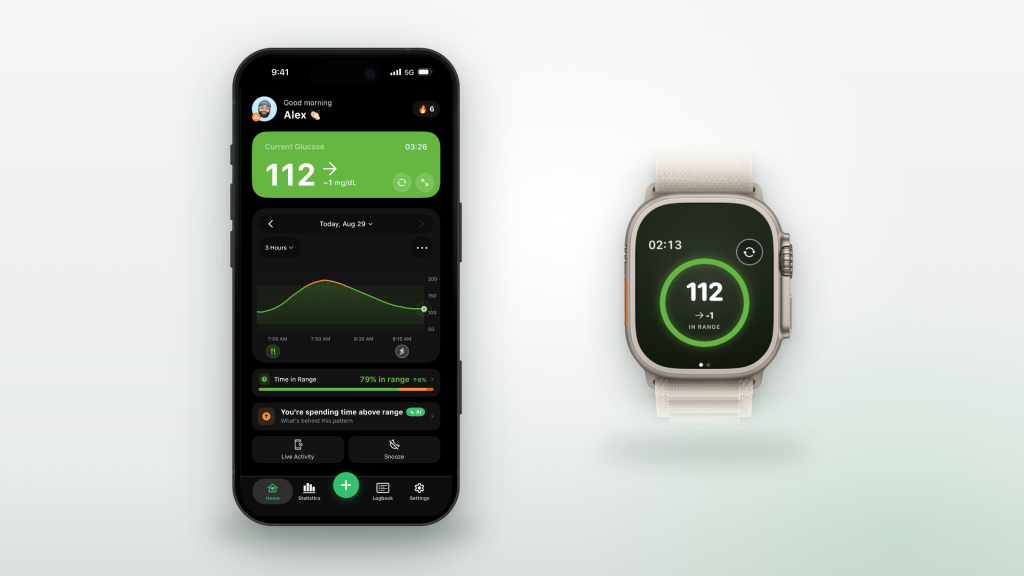
Ambient matters twice over for the people who love us. A parent at work, a spouse in another city, a grandparent learning to help: for them, real-time following turns background anxiety into a two-second glance. We made family following free in our app because access to a loved one’s safety signal should not sit behind a premium gate. The caregiver is not an edge case in chronic disease. Half the time, the caregiver is the user.
None of this is unique to glucose. Blood pressure, heart rhythm, oxygen saturation: chronic disease generates numbers that people live alongside for decades. The lesson from the CGM world is that this data should behave less like a document you open and more like the weather: ambient, glanceable, and shareable with consent, on whatever screen happens to be nearby. Builders in health tech should count the glances they made cheap. Patients are already counting.
Irakli Kurtanidze is the founder of Sugar Sense, a cross-platform CGM companion app, and has lived with type 1 diabetes for more than 12 years.
The pharmacy pays $1,302. The patient pays $299
By JOHN SAMARAS
A US retail pharmacy pays $1,302 to acquire one month of branded Wegovy. That figure comes from the Centers for Medicare and Medicaid Services National Average Drug Acquisition Cost file, effective August 19, 2026, for the 25 mg oral tablet at 30 tablets a month.
The cheapest cash price I verified on a seller’s own published page, for the same month of the same product, is $299. That is oral Wegovy at the maintenance dose, at Sam’s Club Member Health, which sells at the manufacturer’s published self-pay price, checked August 31, 2026.
The two numbers are more than a thousand dollars apart.
Where the second number comes from
Every Monday I check what each US GLP-1 telehealth program publishes as its price, on the program’s own page, and record it. Not the advertised starting rate. Not the prepaid annual plan divided by twelve. The all-in monthly cost of staying on the drug at a maintenance dose.
This month that record turned into an index. Across a fixed panel of 11 programs the median all-in price was $348 a month in August, the same figure in all five weekly checks. It did not move against July.
One program cut its price in August and none raised one. GoodRx for Weight Loss went from $388 to $338 on August 31, and it sits outside the panel. Three other apparent cuts in the record were mine rather than the programs’. Ivim Health and Sesame Care were sitting on prepaid plan rates, and my Costco through Sesame row was carrying $408 for a plan that was $398 all month. Putting each on the rate a reader can start on today lands in the series as a step. The revision log on the September release itemizes all three. The cheapest verified compounded semaglutide route held at $178 a month, at Mochi Health, which posts one flat all-in price at every dose. Sam’s Club Member Health was the cheapest verified branded route at $299 for the Wegovy pill. Both figures were checked on August 31, 2026.
The method fits in a paragraph. For the floors, take the lowest published all-in price in each route on every Monday of the month, then take the median of those weekly lows. For the median, take the middle of the fixed panel each Monday, then the median of those five weekly figures. The panel is fixed on purpose, so a change in which programs I track cannot read as a change in price. The number sits at a dated URL and does not change after publication. A correction becomes a numbered revision with a note.
NADAC measures acquisition cost
The distance between $1,302 and $299 is not pharmacy margin. NADAC measures what pharmacies pay their wholesaler. It says nothing about dispensing costs, the clinician visit, shipping, or what a manufacturer charges through a channel it owns.
46brooklyn Research has published NADAC dashboards free since 2019, and every derivative here rests on their work. What I added is the join: their acquisition data against verified consumer cash prices, which nobody had put side by side.
The two prices sit in different channels. Insurance routes a patient into the pharmacy channel, where the $1,302 sits. The $299 is a cash price, paid by a buyer with no coverage.
The packaging gap
The same NADAC file holds a second finding. Lilly sells Zepbound both as single-dose pens and as a multi-dose KwikPen. At 15 mg, a pharmacy pays $672 a month for the KwikPen and $1,051 a month for the equivalent single-dose pens. The only difference is the container. The spread is 1.56x, or $379 a month. At the 2.5 mg starting dose it is $482 against $1,052, or 2.18x.
Why nobody else has this number
Prices in this category move weekly and nobody records them. A patient cannot tell an introductory rate from a maintenance rate. A reporter covering a price cut has no baseline to say whether it was a cut at all, and the only public numbers are the ones a manufacturer put in a press release.
The fix is somebody writing the price down every week and publishing the method with a version number on it.
Everything above is free to reuse under CC BY 4.0, with a link and no registration. The CSV and the JSON sit at https://glpchart.com/price-index/. If you want a different cut, by state, by drug or by program, ask and you will have it inside a day.
From October the release lands on the first Tuesday of the month. The next one is October 6, 2026.
John Samaras is the founder of GLP Chart, which verifies the cash price of every US GLP-1 telehealth program every Monday. He writes about price, coverage and market structure, and leaves the clinical questions to clinicians.



