The resurgent debate about President Trump’s mental health prompts me to update a piece I wrote for THCB last June. That piece drew lively comments and debate.
It’s also the one-year mark of the Trump presidency.
As The New York Times editorial page recently asked, bluntly, on Jan. 11: “Is Mr. Trump Nuts?”
Since last summer, that question has gained more traction and spurred more earnest debate. The results from Trump’s medical and “cognitive” exam on Jan 12 are unlikely to quell concern. (More about those results below.)
Nearly every major newspaper and magazine has run stories. Print media columnists and TV commentators dwell on it constantly. It’s catnip for late night comedians. It’s been a trending topic on social media for months. And, of course, it’s a topic of discussion and banter almost everywhere you go.
Lawmakers have finally joined in, too, after reluctance for the better part of 2017. Some even render an opinion publicly.
Articles have begun to pop up in medical journals, too—most recently Dr. Claire Pouncey’s piece in the New England Journal of Medicine (Dec. 27, 2017).
And then there’s the book, which sparked Dr. Pouncey’s piece as well other articles and reviews since it came out last fall. I’m not talking about Fire and Fury: Inside the Trump White House by Michael Wolff—although that book is certainly relevant in this context.
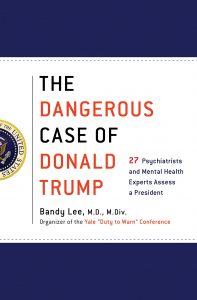
Rather, I’m talking about The Dangerous Case of Donald Trump: 27 Psychiatrists and Mental Health Experts Assess a President, edited by Dr. Bandy X. Lee, a specialist in law and psychiatry at the Yale School of Medicine.


 The Commonwealth of Kentucky, best known for its weirdly colored grass, fine bourbon and equestrian pageantry, is about to be destroyed by the Trump administration. Many will suffer and perhaps die because Kentucky obtained a Medicaid waiver to impose additional and often insurmountable hardships on poor people receiving their free health care from the State. Since all I need to know, I learned on Twitter, allow me to share with you some illuminating insights from the Twitterati.



 Not since Rene Descartes gazed from his garret window in early 17th-century Paris and wondered whether those were men or hats and coats covering “automatic machines” he saw roaming the streets has the issue of personal identity and your cranium been of such import. Descartes feared a world that he alone occupied due to deception by the devil. Today we face a different mind-body challenge in the form of a devil we know: Italian neuroscientist Sergio Canavero. He recently announced that the