Categories

Tag: Meaningful Use

EHR Redux

Kibbe It’s time to revive the discussion of electronic health record software in light of the new federal regulations that define criteria for meaningful use and also set criteria for the EHR technologies that must be implemented by doctors and hospitals in order for them to become, and be paid for being, “meaningful users of certified EHR technology.”

While most of the public commentary so far has been directed to the NPRM on meaningful use, the real news here relates to the de-construction of EHRs that is described in the interim final rule covering EHR standards and implementation specifications. Of course, the NPRM and IFR are by design tightly linked. But the NPRM on meaningful use is primarily a set of instructions for doctors and hospitals about how to participate in the incentive payment programs established statutorily under ARRA/HITECH. The rule on EHR technology certification criteria, on the other hand, is a playbook intended for vendors and developers who want to qualify their products to meet the expected demand by meaningful users in those programs.Continue reading…

The Info-Button Standard: Bringing Meaningful Use to the Patient

Regardless of the U.S. administration’s “meaningful use” requirements, if health information technology (HIT) is to become meaningful for patients, it must include the prescription of information and tools to help each patient better manage his or her own care.

Ask patients what they want from HIT systems, and they will tell you three things:

– “Tell me my diagnosis, what will happen, and what I can do myself to better manage the problem.”

– “Tell me my medical tests results and what they mean to me.”

– “Tell me my treatment options, and help me participate in the treatment decisions.”

The soon-to-be-finalized HL7 International Context-Aware Information Retrieval standard (nicknamed the HL7 “Infobutton” standard) makes it far easier for providers of electronic health records (EHRs) and personal health records (PHRs) to deliver just what the patient wants. And that is what will put the meaning into meaningful.

Using the HL7 Infobutton Standard for Information Prescriptions

The HL7 Infobutton standard has been widely adopted since 2007. It facilitates the delivery of a set of standardized information about the patient, the provider, and the activity of a specific care encounter or moment in care. An Infobutton manager (or equivalent) accessed by an EHR application can then pull from that set the information it needs for any relevant use case. In most cases the Infobutton has been used to bring up decision support information for the clinician.

Continue reading…

Why America Needs a Patient-in-Chief

“These are exciting and very promising times for the widespread application of information technology to improve the quality of healthcare delivery, while also reducing costs, but there is much yet to do, and in  my comments I want to note especially the importance of the resource that is most often under-utilized in our information systems – our patients.
– Charles Safran MD, testimony to the House Ways & Means subcommittee on health [Emphasis added]

Quite current, yes? No: Dr. Safran said those words in June 2004. And not much has changed.

My physician Dr. Danny Sands, mentored by Dr. Safran and colleague Warner Slack MD, heard similar sentiments from them decades earlier. And where are we today? Patients are still untapped, and we have the worst dysfunction in the history of healthcare. Perverse incentives and unintended outcomes are the rule, not occasional glitches, as costs spiral up and outcomes don’t.

As Consumer Reports recently said, in the ten years since the Institute of Medicine’s classic report To Err is Human documented as many as 98,000 deaths a year from preventable medical error, “not much has changed.”

These are signs of a system that’s governed without input from its customer – the patient.

Patients have the most at stake, but they’re invisible in Washington. We need to link them in; we need their passion, their commitment, their very-motivated contributions.

Continue reading…

“Meaningful Use” Criteria as a Unifying Force

Vince-20kuraitis09-small

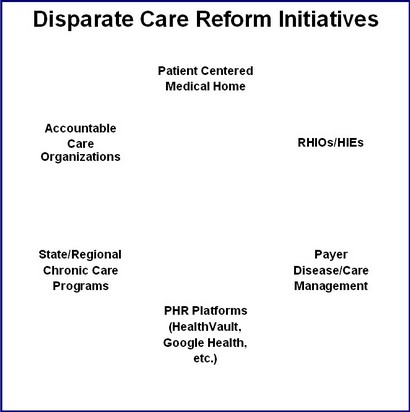
Over the past several years, many diverse initiatives have arisen offering partial solutions to systemic problems in the U.S. health care non-system.

We see Meaningful Use Criteria recommended by the HIT Policy Committee as a unifying force for these previously disparate initiatives. These initiatives have included:

  • Patient Centered Medical Homes (PCMHs)
  • Regional Health Information Organizations (RHIOs)/Health Information Exchanges (HIEs)
  • Payer Disease/Care Management Programs
  • Personal Health Record Platforms — Google Health, Microsoft HealthVault, Dossia, health banks, more to come
  • State/Regional Chronic Care Programs (e.g., Colorado, Pennsylvania, Improving Performance in Practice)
  • Accountable Care Organizations — the newest model being proposed as part of national reform efforts

Today

While there are some commonalities and overlap, to-date these initiatives have mostly arisen in isolation and are highly fragmented — they’re all over the map. Here’s a graphic representation of the fragmentation that exists today:

MU1

Tomorrow

The HIT Policy Committee recently recommended highly detailed Meaningful Use criteria for certified EHRs.  Doctors and hospitals who hope to receive HITECH Act stimulus funds will have to demonstrate that they are meeting these criteria; the criteria are not yet finalized.

The Committee website describes the central role of the Meaningful Use criteria:

The focus on meaningful use is a recognition that better health care does not come solely from the adoption of technology itself, but through the exchange and use of health information to best inform clinical decisions at the point of care.

The HIT Policy Committee also is recognizing that there are multiple routes to achieving Meaningful Use beyond the traditional EMR 1.0, e.g., modular Clinical Groupware software.

While some might view the Meaningful Use criteria as limited to the world of health IT — something happening “over there” — we see much more going on. We believe the Meaningful Use criteria are becoming a powerful unifying force across the health system, with potential to converge previously disparate initiatives.  Here’s our conceptual representation:

MU2

Let’s consider a couple examples to demonstrate how convergence is occurring.

RHIOs were formed primarily with a mission of developing health IT infrastructure for local data exchange; they had little need to think about how care providers, health plans and others would actually use the data.

Patient Centered Medical Homes have been built around seven principles (e.g., physician directed medical practice, care coordination) — none of which directly relate to a need to develop health IT infrastructure; the fact that IT infrastructure is necessary to implement these principles has been assumed but not defined.

RHIOs focused on health IT with little thought about objectives, while PCMHs had grand objectives with little thought about needs for health IT.

All this is changing.

RHIOs are recognizing that achieving meaningful use of data is essential; PCMH initiatives are recognizing the need for a robust IT infrastructure and the need to match their efforts to Meaningful Use criteria.

Here are some broader implications about Meaningful Use criteria becoming a unifying force:

  • These diverse initiatives will have more commonalities and will look more and more alike
  • Expect previously disconnected regional initiatives to start talking to one another about collaboration.
  • A common phrase we are hearing is “We need to do a crosswalk of Meaningful Use criteria with our initiative/organization/application functionality.”
  • Vendors must ask: “What are we doing to contribute to Meaningful Use of EHRs”
  • Care providers (doctors and hospitals) must ask: “How are vendor offerings helping us to achieve Meaningful Use of EHRs?”

These are positive developments.  Meaningful Use criteria are becoming a powerful unifying force toward integrating our fragmented health system.

Vince Kuraitis JD, MBA is a health care consultant and primary author of the e-CareManagement blog where this post first appeared. David C. Kibbe MD MBA is a Family Physician and Senior Advisor to the American Academy of Family Physicians who consults on healthcare professional and consumer technologies.  Steve Adams is Founder and CEO of RMD Networks, a Denver, Colorado based company.

Finally, A Reasonable Plan for Certification of EHR Technologies

A caution to readers: This post is about methods for certifying Electronic Health Record (EHR) technologies used by physicians, medical practices, and hospitals who hope to qualify for federal incentive payments under the so-called HITECH portion of the American Recovery and Reinvestment Act (ARRA). It may not be as critical as the larger health care reform effort or as entertaining as Sarah Palin, but it WILL matter to hundreds of thousands of physicians, influencing how difficult or easily those in small and medium size practices acquire health IT. And indirectly for the foreseeable future, it could affect millions of American patients, their ability to securely access their medical records, and the safety, quality, and the cost of  medical care.

Three weeks ago, on July 14-15, 2009, the ONC’s Health IT Policy Committee held hearings in DC to review and consider changes to CCHIT’s current certification process. The Policy Committee is one of two panels formed to advise the new National Coordinator for Health IT, David Blumenthal. In a session that was a model of open-mindedness and balance, the Committee heard from all perspectives: vendors, standards organizations, physician groups, and many others.

And then, on July 16, they released their final recommendations on what is now referred to as “HHS Certification.” The effects of their recommendations – these are available online and should be read in their entirety to grasp their extent – are potentially monumental, and could very positively change health IT for the foreseeable future.

At the heart of these hearings was the issue of who will define the certification criteria and who will evaluate vendors’ products. Among many others, we have voiced concerns that the Certification Commission for Health Information Technology (CCHIT), the body currently contracted by HHS to perform EHR certification, has been partial to traditional health IT vendors in defining the certification criteria, and in the ways certification is carried out, and thereby able to inhibit innovation in this industry sector. Despite its leaders’ claims that the certification process has been developed using an open framework, CCHT’s obvious ties to the old guard IT vendors have created an overwhelming appearance of conflict of interest. That appearance has not been refuted by CCHIT’s resistance to and delays in implementing interoperability standards, or by its focus on features and functions over safety, security, and standards compliance.

In the hearings that led to the recommendations, longtime IT watchers were treated to some extraordinary commentary, much of which dramatically undermined CCHIT’s position.

“HHS Certification means that a system is able to achieve government requirements for security, privacy, and interoperability, and that the system would enable the Meaningful Use results that the government expects…HHS Certification is not intended to be viewed as a ‘seal of approval’ or an indication of the benefits of one system over another.”

In other words, as the definition of Meaningful Use is now tied to specific quality and safety improvements and cost savings that result from health IT — among them e-Prescribing, quality and cost reporting, data exchange for care coordination, and patient access to summary health data — HHS Certification will closely follow. Rather than pertain to an EHR’s long list of features and functions, some of which have nothing to do with Meaningful Use, certification will be focused on each IT system’s ability to enable practices and hospitals to collect, store, and exchange health data securely.

Who Determines the Certification Criteria

The Office of the National Coordinator – not CCHIT – would determine certification criteria, which “should be limited to the minimum set of criteria that are necessary to: (a) meet the functional requirements of the statute, and (b) achieve the Meaningful Use Objectives.” As regulator, funder for this project, and a major purchaser of health services, the government, not users or vendors, will now determine HHS’ Certification criteria.

A New Emphasis on Interoperability

“Criteria on functions/features should be high level; however, criteria on interoperability should be more explicit.” That is, functions/features criteria will be broadly defined, but there will be a greater focus in the future on the specifics associated with bringing about straightforward data exchange.

Multiple Certifying Organizations

ONC would develop an accreditation process and select an organization to accredit certifying organizations, then allow multiple organizations to perform certification testing. In other words, the Committee recommended that CCHIT’s monopoly end.

Third Party Validation

The “Validation” process would be redefined to prove that an EHR technology properly implemented and used by physician or hospital can perform the requirements of Meaningful Use. Self-attestation, along with reporting and audits performed by a Third Party, could be used to monitor the validation program.

Broader Interpretation of HHS Certification

HHS Certification would be broadly interpreted to include open source, modular, and non-vendor EHR and PHR technologies and their components.

These bold, forward-thinking proposals from the HIT Policy Committee have not been accepted yet. But in our opinion they should be. These measures would encourage new technologies to enter the market for physician medical practices seeking EHR technology, and wrest control away from the legacy health IT vendors that have maintained barriers and delayed adoption, so you can be sure that the old guard players are doing everything possible to have them rejected.

But these are hugely progressive steps in the right direction, toward allowing HIT to enable improvements in care and cost efficiencies that would be in the best interests of users and the public at large. If implemented, the changes recommended by the HIT Policy Committee would create greater choice, more standardization, lower price, less interruption of the practices — as well as a check from CMS or Medicaid each year to help smooth the implementation, starting in 2011.

David C. Kibbe MD MBA is a Family Physician and Senior Advisor to the American Academy of Family Physicians who consults on health care professional and consumer technologies. Brian Klepper PhD is a health care market analyst. Their collected collaborative columns may be found here.

An Update to Meaningful Use

On June 16, I wrote about the release of the draft definition of meaningful use.

Today, at the HIT Policy Committee meeting, the final definition of meaningful use was released and adopted. What was changed?

1. For inpatient CPOE, only 10% of orders must be entered electronically2. For problem lists, ICD9 or SNOMED must be used3. Advanced directives must be recorded4. Smoking status must be recorded5. Quality measures must be reported to CMS6. Clinicians and Hospitals must implement at least one clinical decision rule relevant to a high clinical priority7. Administrative transactions, including eligibility and claims, must be completed electronically

Continue reading…

Meaningful Use vs. Meaningless Adoption of Electronic Health Records

Dr. David Blumenthal, the new National Coordinator for Health Information Technology, has stressed that  the goal of the ARRA/HITECH initiative is to improve patient care, not to mindlessly adopt health information technology. In this regard, he wrote that many CCHIT-certified EHRs “are neither user-friendly no designed to meet HITECH’s ambitious goal of improving quality and efficiency in the health care system.”

It is therefore disconcerting that the Association of Medical Directors of Information Technology (AMDIS) just weighed in on the issue of meaningful use with their letter to Dr. Blumenthal, recommending that the new national HIT Policy Committee use the 2008 CCHIT certification criteria to determine which hospitals and physicians get HITECH incentive dollars.Continue reading…

“Meaningful Use” – If You Have to Define It, Is It?

BrianBaum I have a good friend at Duke University
– Dr. Ed Hammond.  (Ed has been involved in advancing electronic
health information for quite some time – probably longer than he'd like
to remember.)  Ed once told me that to get a perspective on how
long we – (our nation) has been assessing the potential of automating
health information you'd have to go back to the introduction of Medicare
in 1965 when President Johnson signed the legislation and officially
enrolled Harry Truman as the first Medicare beneficiary.

Continue reading…

The State of Meaningful Use

Is it possible that the State Department is technologically bolder than the HIT Policy Committee?  On Tuesday, that committee convened by the Office of the National Coordinator as required by the American Recovery and Reinvestment Act released some initial recommendations on the definition of meaningful use of HIT.  Then yesterday the New York Times in an above the front page fold article reported that the State Department recognized an internet blogging service could change history–right now.

Compare that report about the State Department to the HIT Policy Committee’s recommended vision for the role of patients and families.  The committee envisions that someone would eventually “provide access for all patients” to populated personal health records and some self-management tools by 2015–about six years from now.  It’s not that this vision is bad; it’s just so underwhelming.  Let’s see–the State Department thinks that the Iranian people might be using Twitter today to regain control of their nation–and in our multi-billion dollar ultimate vision for the patient’s role with health information technology we’re still talking about “providing” a couple of interesting tools to patients by 2015.  Is it me, or are we possibly missing a powerful health reform player here–the consumer?

So, as you can see, I listened to this meeting on “meaningful use” and came away with some distinctly mixed impressions.Continue reading…

Matthew went to Redmond, Pt 4: Nate McLemore

My final interview from my trip to Microsoft was with Nate McLemore, who is Director of Business Development for the Health Solutions Group and also involved in Microsoft’s policy & lobbying work. Nate talked about Microsoft’s role in the ongoing deliberations on meaningful use, ARRA and all that.

assetto corsa mods