Categories

Category: Health Policy

Global Risk Report: Davos, Trump and Climate Change

By DAVID INTROCASO

During the recent World Economic Forum in Davos, Switzerland, President Trump once again noted his objection to the Paris climate accord.  In an interview with Piers Morgan, Trump again called it a “horrible deal” because, as has been widely reported, climate change or global warming is, per the president, a “hoax” perpetrated by the Chinese.  “There is cooling and there’s a heating – I mean look,” Trump explained to Morgan, “it use to not be climate change.  It used to be global warming.  That wasn’t working too well because it was getting too cold all over the place.  The ice caps were going to melt.  They were going to be gone by now, but now they’re setting records, okay?” 

Trump was asked about climate change because the topic was on the Forum’s agenda.  Not surprisingly, in the days leading up to the confab, climate scientists once again found the proceeding calendar year one of the warmest on record.  NASA ranked 2017 the second warmest since 1880 (or since reliable record keeping began), or after 2016.  NOAA, using a slightly different methodology, ranked it the third warmest after 2016 and 2015 respectively.  Not only were the last three years the warmest on record, the five warmest years on record have occurred since 2010, 17 of the 18 warmest since 2001 and last year marked the 21st consecutive year the contiguous United States had above average temperatures.  Record 2017 temperatures were somewhat unanticipated however because of the lack of an El Niño (or Pacific trade wind), effect that is associated with increased global temperatures.  Because air temperatures are largely determined by ocean temperatures, also not surprisingly the five warmest ocean temperature years recorder have been 2017, 2015, 2016, 2014 and 2013 respectively.  Ocean temperatures in 2017 were exceptionally warm.  Measured as heat energy in Joules, 2017 ocean temperatures exceeded 2015 by 1.51 x 10^22 Joules, or the amount of electrical energy China produces annually.

Continue reading…

What Is a “Co-Presidency”? Would It Work? Biden-Obama 2020

By DANIEL STONE

Why would the last certifiably sane occupant of the White House consider a run for the Vice-Presidency, an office that Vice-President John Nance Garner derided as “not worth a pitcher of warm spit” and John Adams scorned as “the most insignificant office that the invention of man contrived or his imagination conceived?” In a word, Trump. The former President told voters in 2016 that his legacy and life’s work would be threatened by a Trump presidency. That would be doubly true of a second Trump term.

Federal law poses no obstacle to the Democrats’ dream ticket. The 22nd amendment, ratified in the wake of FDR’s four electoral victories, prohibits the election of a president to more than two terms. No provision prevents a former president from assuming the office through succession nor from running for the vice-presidency. Securing Obama’s assent for the race would likely require Biden to offer him a virtual “co-presidency.” The notion has been raised before. In 1980, Ronald Reagan, also facing a challenging run against an incumbent president, briefly considered former President Gerald Ford for his running mate and “co-president.” Ultimately, Reagan lacked sufficient comfort with his former opponent to test such uncharted political waters.

Continue reading…

Does Donald Trump Have Heart Disease?

By SAURABH JHA

According to the WHO definition of health, which is “a state of complete physical, mental, and social well-being, and not merely the absence of disease and infirmity,” several million Americans became unhealthy on Tuesday November 8th, 2016 as Florida folded to Trump. As Hillary’s prospects became bleaker many more millions, particularly those on Twitter, lost their health. The WHO sets a high bar for health. It is easier for a camel to pass through the eye of a needle than for a person on social media to be in “complete mental and social well-being.”

Whilst WHO has set a high bar for health, modern medicine casts a wide net for disease, and the duo have led to mass over medicalization, overdiagnosis and overtreatment. Yet despite the wide net, Trump has thus far managed to evade the psychiatrists, medicine’s version of the FBI, who have tried imposing upon him a range of psychiatric disorders including “extreme present hedonism”, which sounds like “hyperbolic discounting,” which basically means someone who doesn’t give a rat’s tail about the future. Base jumpers suffer from this condition. I once suffered a milder version – and then I became a father and grew up.

Trump doesn’t look like a base jumper. And you’re going to need more than hyperbolic discounting to nail him on the 25th Amendment. Some tried diagnosing Trump with “mild cognitive impairment” (MCI) – a condition which heralds the more persuasive cognitive decline of dementia. MCI reminds me of an old medical school friend who went around administering the mini mental test to elderly patients on medical wards. One of the questions was: what are the dates of the 2nd World War (WW2)? No patient got that question right because my friend thought WW2 started in 1940. It started in 1939.

Continue reading…

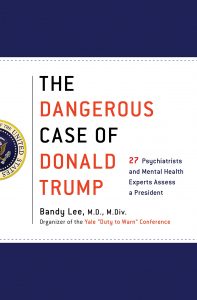
The Dangerous Case of Donald Trump: 27 Psychiatrists and Mental Health Experts Assess a President

By STEVEN FINDLAY

BY STEVEN FINDLAY

The resurgent debate about President Trump’s mental health prompts me to update a piece I wrote for THCB last June. That piece drew lively comments and debate.

It’s also the one-year mark of the Trump presidency.

As The New York Times editorial page recently asked, bluntly, on Jan. 11: “Is Mr. Trump Nuts?”

Since last summer, that question has gained more traction and spurred more earnest debate. The results from Trump’s medical and “cognitive” exam on Jan 12 are unlikely to quell concern.   (More about those results below.)

Nearly every major newspaper and magazine has run stories. Print media columnists and TV commentators dwell on it constantly.   It’s catnip for late night comedians. It’s been a trending topic on social media for months.   And, of course, it’s a topic of discussion and banter almost everywhere you go.

Lawmakers have finally joined in, too, after reluctance for the better part of 2017. Some even render an opinion publicly.

Articles have begun to pop up in medical journals, too—most recently Dr. Claire Pouncey’s piece in the New England Journal of Medicine (Dec. 27, 2017).

And then there’s the book, which sparked Dr. Pouncey’s piece as well other articles and reviews since it came out last fall.   I’m not talking about Fire and Fury: Inside the Trump White House by Michael Wolff—although that book is certainly relevant in this context.

Rather, I’m talking about The Dangerous Case of Donald Trump: 27 Psychiatrists and Mental Health Experts Assess a President, edited by Dr. Bandy X. Lee, a specialist in law and psychiatry at the Yale School of Medicine.

Continue reading…

NEJM Blasts “Crusade,” Omits that Its Former Editor Launched It

By MICHAEL MILLENSON

A blistering attack by the national editor of the New England Journal of Medicine against the “less is more” movement in medicine omitted that the publication’s former editor-in-chief played a foundational role in popularizing the idea of widespread medical waste.

The commentary in late December by Dr. Lisa Rosenbaum, “The Less-Is-More Crusade – Are We Overmedicalizing or Oversimplifying?” has attracted intense attention.  Rosenbaum berates a “missionary zeal” to reduce putative overtreatment that she says is putting dangerous pressure on physicians to abstain from recommending some helpful treatments. She also asserts that the research by Dartmouth investigators and others who claim 30 percent waste in U.S. health care, in which she once fervently believed, is actually based on suspect methodology.

What Rosenbaum fails to mention is that the policy consensus she seeks to puncture – that the sheer magnitude of wasted dollars in U.S. health care offers “the promise of a solution without trade-offs” – originated in the speeches, articles and editorials of the late Dr. Arnold Relman, the New England Journal’s editor from 1977 to 1991.Continue reading…

A Patient Experience-Based View of the TEFCA

By ADRIAN GROPPER

Let’s give the Office of the National Coordinator (ONC) credit for trying. In what’s arguably the first significant piece of policymaking, the newly Republican HHS issued a draft Trusted Exchange Framework and Common Agreement (TEFCA) that aims to implement the massively bipartisan 21st Century Cures act mandate to end information blocking. Are they succeeding?

Why should you care? After almost a decade and many tens of $billions spent on health information technology, neither physicians nor patients have access to a longitudinal health record, transparency of quality or cost, access to independent decision support, or even the ability to know what their out-of-pocket cost is going to be. After eight years of regulation, precious little benefit has trickled-down to patients and physicians. This post looks at the TEFCA proposal from the patient experience perspective.

The patient perspective matters because, under HIPAA, patients do not have choice about how our data is accessed or used. This has led to information blocking as hospitals and EHR vendors slow-walk the ability of patients to direct data to information services we choose. Patients lost the “right of consent” in 2002. This puts a regulation-shy administration in a quandary: How do they regulate to implement Cures, when current HIPAA and HITECH-era regulations give all of the power to provider institutions bent on locking-in patients as key to value-based compensation?

Continue reading…

The Kentucky Armageddon

By MARGALIT GUR-ARIE

The Commonwealth of Kentucky, best known for its weirdly colored grass, fine bourbon and equestrian pageantry, is about to be destroyed by the Trump administration. Many will suffer and perhaps die because Kentucky obtained a Medicaid waiver to impose additional and often insurmountable hardships on poor people receiving their free health care from the State. Since all I need to know, I learned on Twitter, allow me to share with you some illuminating insights from the Twitterati.

The evil Republican Governor of Kentucky, Matt Bevin, is salivating at the prospect off changing Medicaid as we know it, which obviously means that poor people and especially people of color will be suffering greatly under this plan. You really don’t need to know more, since this should be reason enough to mobilize the worried wealthy, who are tossing and turning in their featherbeds night after night, searching for ways to save the poor. For those who are neither worried nor wealthy enough to really care, here are the ominous provisions of the Kentucky racist, homophobic and xenophobic plan to change Medicaid (it is all these things because it was not only approved, but encouraged by the Trump administration, and we all know what that means).

Continue reading…

The Naming of Things

By JOE FLOWER

It’s happening across many parts of the federal government, in many sectors. Officials of the National Park Service have been reprimanded for tweeting about climate change. Scientists at the Centers for Disease Control (CDC) have been warned away from seven specific words in their budget documents, including “fetus,” “evidence-based,” and “transgender.”

It is happening in healthcare as well. In previously secret proceedings, revealed here for the first time, representatives of organizations and companies across healthcare are in negotiations with a cross-agency team at Health and Human Services to restructure the language we use around medicine and healthcare.

Continue reading…

A Surprisingly Logical Argument in Favor of Head Transplantation

Arthur Caplan PhD

By ARTHUR CAPLAN PHD & LISA KEARNS

Not since Rene Descartes gazed from his garret window in early 17th-century Paris and wondered whether those were men or hats and coats covering “automatic machines” he saw roaming the streets has the issue of personal identity and your cranium been of such import. Descartes feared a world that he alone occupied due to deception by the devil. Today we face a different mind-body challenge in the form of a devil we know: Italian neuroscientist Sergio Canavero. He recently announced that the first human head transplant is imminent.

For bioethicists, the moral critiques of this surgery practically write themselves: Are we merely our bodies? How can a person so ill as to wish to trade in his lifelong corporeal companion be considered competent to consent to such a drastic procedure? How can family members consent to donate a body that they could very well run into — and recognize — at the beach or gym? What if a left-handed person received a right-handed body? What if a lifelong Chicago Bears fan woke to find himself attached to the green-and-gold-tattooed torso of a former Packers fan? Would transplant recipients need to buy whole new wardrobes? Who will pay?

We were among those early to carry ethical torches and morally indignant pitchforks at this transplant ahead of its time. Caplan not long ago called Canavero’s work “crackpot science,” writing that “everything about Canavero’s activity is ethically wrong” while incisively reminding all that “[m]oving a head is not akin to moving a light bulb to a new socket.” Ever at the forefront of translational bioethics, Caplan was, as is his wont, quick to integrate electrical engineering with bioethics on the frontier of the emerging field he wittily dubbed, cephalogy.

More recently we decided to hole up in our own, 21st-century garrets: putty-colored, fluorescent-lit boxes seven stories above a lower midtown Manhattan block. It was here that we took the time over a lunch of offal things to explore the real risks and benefits of head transitioning, and it was here that we realized that we had been coming at the problem completely the wrong way. Remember good facts make for good ethics. What Canavero is planning isn’t really a head transplant, but a body transplant. “Heads up!” he cried, when he should have threatened, “Bodies down!”

Continue reading…

The Individual Mandate’s Dead. What Happens Next?

By STEVEN FINDLAY

The demise of the ACA individual mandate, along with Trump’s and Republicans’ efforts to repeal Obamacare in 2017, will trigger in election year 2018 a new phase of the long-running, bitter battle over the fate of ACA, the insurance marketplaces, and the direction of health reform in general.

Surprisingly, the Democrats appear to have the upper hand for the moment.   Republican efforts to repeal the ACA in 2017 were deeply unpopular—only about 20 percent of the U.S. population supported them. Independents and moderate Republicans, in Congress and among voters, were notably opposed. And in the Senate, moderates killed the various ACA repeal bills (albeit by narrow margins).

The Republican tax bill is also unpopular.

Recent special election results in Virginia and Alabama—put Republicans off-balance and on-notice as well. In particular, the Alabama result bends the vote math in the Senate against any repeat ACA repeal efforts in 2018, and very likely beyond.

But, perhaps most surprising, the resurgence of interest in “coverage for all,” universal coverage, and “health care as a right” that started with Bernie Sander’s campaign in 2016 has continued to gain traction, even among some conservatives.

Continue reading…