Categories

Author Archives

maithri

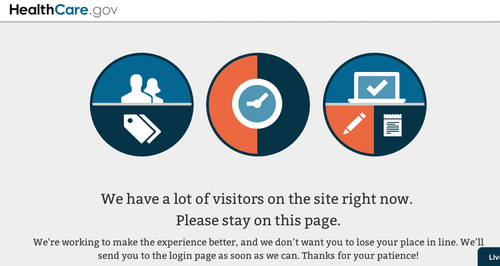
Descent Into Madness: An Account of One Man’s Visit to Healthcare.gov October 1st

image

As the owners of small businesses, my family has been curious to learn how much insurance would cost us once the Affordable Care Act kicks in – and what our choices of networks, providers and whatnot would be.

With the arrival of the October 1 open enrollment period, my first computer stop was healthcare.gov to begin comparison shopping among the four ACA plans vs. the COBRA plan that we have through the end of 2014.

Here’s how it went:

October 1, 2013

7:30 a.m. – I first encounter the Health Insurance Marketplace waiting room.

7:33 a.m. – The drop-down boxes on the security questions aren’t working.

Continue reading…

Who Knew That Blood, Sweat and Tears Could Start a Health Care Revolution?

The staid world of diagnostic testing is about to undergo a major disruption with huge advances in sensors and sensing technologies that live in or on our bodies, within our homes and offices, and even within our computers and networks.

Today we’re witnessing a massive shift in who will collect and control diagnostic and other health information. For the first time, as people and patients, we will have control over what we measure, when we measure it, and who has access to our personal data. This is made possible by a new generation of revolutionary biosensors that contain the power of clinical lab instruments in packages that are light, small, wireless and highly efficient.

This is a new world of sensors: they can be body-attached, monitor our immediate personal environment, or even work as pure software apps that extrapolate data from our health records. Using simple, non-invasive methods to take samples of tiny amounts of blood, traces of skin tissue, breath droplets or an image of the inner eye are just some of the new methods emerging. It is exciting to consider that several of these multifunctional sensors, working in concert with powerful mobile handhelds, offer us extraordinary data collection and diagnostic tool sets that will put us in touch with our health in ways never imagined before.

These advances in health sensing, available any time and anywhere, are game changing. A continuous stream of personalized health data will transform how doctors interact with their patients to address and solve health challenges. More importantly, it puts patients at the center of the care process. Personalized data means that specific therapies or drugs will be more effectively delivered and controlled, allowing doctors to fine-tune treatments and watch incremental physiological changes as they occur.

This technology will also disrupt the clinical diagnostics business by moving testing from specialized (and expensive) labs to pharmacies and then ultimately to our homes.

Continue reading…

My Worst Night as a Doctor

My worst night as a doctor was during my residency.  I was working the pediatric ICU and admitted a young teenager who had tried to kill herself.  Well, she didn’t really try to kill herself; she took a handful of Tylenol (acetaminophen) because some other girls had teased her.

On that night I watched as she went from a frightened girl who carried on a conversation, through agitation and into coma, and finally to death by morning.  We did everything we could to keep her alive, but without a liver there is no chance of survival.

Over ten years later, I was called to the emergency room for a girl who was nauseated and a little confused, with elevated liver tests.  I told the ER doctor to check an acetaminophen level and, sadly, it was elevated.  She too had taken a handful of acetaminophen at an earlier time.  She too was lucid and scared at the start of the evening.  The last I saw of her was on the next day before she was sent to a specialty hospital for a liver transplant.  I got the call later that next day with the bad news: she died.

The saddest thing about both of these kids is that they both thought they were safe.  The handful of pills was a gesture, not meant to harm themselves.  They were like most people; they didn’t know that this medication that is ubiquitous and reportedly safe can be so deadly.  But when they finally learned this, it was too late.  They are both dead.  Suicides?  Technically, but not in reality.

For these children the problem was that symptoms of toxicity may not show up until it is too late.  People often get nausea and vomiting with acute overdose, but if the treatment isn’t initiated within 8-10 hours, the risk of going to liver failure is high.  Once enough time passes, it is rare that the person can be cured without liver transplant.

According to a recent ProPublica investigation, acetaminophen overdose is the #1 cause of liver failure in the US. And  between years of 2001 and 2010, 1567 people in the U.S. were reported to have died by accidentally overdosing.

Continue reading…

Why Explaining the Affordable Care Act Turns Out To Be A Lot Harder Than We Thought It Would Be.

One of the chief aims of the Affordable Care Act (ACA) is the expansion of insurance coverage to individuals who at present either cannot afford it or choose not to purchase it. Unfortunately, many Americans lack the financial literacy needed to navigate the numerous and complex options thrust upon them by the ACA.

The ACA contains a number of mechanisms through which coverage will be expanded, including the individual mandate, the state insurance exchanges, and the expansion of Medicaid.

Yet, while many more Americans will be able to obtain health insurance under the law, the new policies present a complex new choice environment for consumers, one that contains new penalties, new subsidies, and a potentially vast number of plans to choose from.  Successfully navigating these choices requires consumers to be financially literate.

As recognized in research on related areas of financial decision-making – such as retirement planning, investing, and debt – consumers often lack the understanding, ability and confidence to make financial choices that are in their best interest.

To shed light on consumers’ ability to navigate the ACA, we recently examined the distribution of financial literacy by household income.  Our findings were recently posted on the Health Affairs Blog and in a working paper by RAND’s Bing Center for Health Economics.

Continue reading…

After the Navy Yard Shooting: A Call to Action On Mental Illness


The Navy Yard shooting in Washington, D.C. has once again confronted us with the issues of guns and mental illness, but what we really should address is the inadequacy of mental health care in the United States. Since 2009 there have been 21 mass shootings and the perpetrators in over half of these were suffering from or suspected to have a serious mental illness like schizophrenia, bipolar disorder and depression. (The other killers with no signs of mental illness were ideological zealots, disgruntled employees and disaffected loners.)

After each incident there is a great hue and cry, and calls for action but no substantive action is taken. Our reflexive approach has repeatedly failed to provide care in a timely fashion to individuals in need. As a country, we continue to ignore the growing public health need for greater access and a more proactive approach to mental health care. It is time that we say enough is enough and do something to prevent future tragedies.

When you strip away the hype and politics, the causal factors in these horrific incidents are clear and solvable. Yet we’ve lacked the social and political will to fashion and apply the solution.

The plain truth of the matter is that we do not provide adequate services to the 26% of the U.S. population with mental illness. The scope of and access to mental health services available to most people are limited and fragmented. Moreover, insurance coverage is all too often lacking and discriminatory. Consequently, we do not provide the level and quality of care of which physicians and health care providers are capable. It is the equivalent of knowing that a woman has breast cancer but not offering the indicated treatment options of surgery, radiation and chemotherapy. The result is that many people go untreated or inadequately treated.

Continue reading…

Will ACA Implementation Lead to a Spike in Demand for Care?

As the Affordable Care Act’s (ACA) exchanges open and Medicaid expansion takes effect, millions of uninsured Americans will gain new coverage. This raises a key question: how are we possibly going to meet the demands of all of these new individuals entering the system? The physician workforce is growing slowly, at best, at a time when an aging population is increasing demand for care.

Predictions include long lines for everyone, rising prices and premiums as physicians are able to command greater market power, and reduced quality of care. Some have recommended additional government funding to help train more medical residents as a response.

But while studies predict ACA implementation will prompt an increase in demand for medical services, there is evidence that the increase in demand will not be as great as the raw number of newly insured Americans might suggest.

The latest CBO forecast projects the reduction in the number of uninsured Americans under the ACA will be 11 million people next year and 24 million by 2016. That’s an increase in the percentage of Americans with insurance of roughly 5% in 2014 and 12% in 2016. If the uninsured used zero health care today, but upon becoming insured used the same amount as a typical insured person, then the increase in demand for care would be the same as the increase in coverage.

In reality, the uninsured use substantial amounts of health care – but only about half the care that the insured use today. One reason is because they are uninsured – paying full prices for care rather than a small copay discourages use. Another reason also explains why many (but not all) are uninsured in the first place: they are healthy and don’t anticipate needing or wanting medical care.

When the uninsured gain coverage, demand does increase, but not dramatically, studies show. Evidence from the Oregon Health Insurance experiment, in which a funding cap forced the state to grant Medicaid coverage to some applicants but not others using a lottery-type system, found that those who did gain coverage increased their use of both hospital and physician care by about one-third relative to controls.

Continue reading…

What Kind of Ancestor Will You Be?

Is excellent good enough?

As physicians, we are trained to diagnose and treat disease. We dedicate ourselves to searching for cures and perfecting procedures that will restore the health of our patients. Over the last 50 years, we’ve made some remarkable progress. We’ve reduced the death rate from heart disease by 32.5% with a better understanding of primary and secondary prevention and advances in treatment. We’ve made similar progress in cancer care with better treatment options through radiation, surgery, chemotherapy, and genomics. We’ve changed an HIV diagnosis from a hopeless death sentence with limited treatment options to a manageable, chronic condition.

These truly excellent accomplishments in medicine have been life-changing for millions of people. But is excellent good enough?

While we have made great strides in clinical care, the American dream is faltering. Americans are more obese, more medicated and more in debt than at any other time in the history of our nation. One-third of our nation’s total health-care spending, about $750 billion per year, is wasted on unnecessary treatments, redundant tests, and uncoordinated care [1]. Health Care Reform will have limited impact on this waste. While the rate of increase of health care spending has slowed in recent years, the United States still spends 2.5 times more than most developed nations on health care [2]. U.S. health care spending is on track to reach $4.8 trillion in 2021, almost 20% of our gross domestic product [3].

Continue reading…

How to Cut Medicare Spending: Attack Large Claims!!

Medicare reform thus far has been focused on $79 office visits, co-payments for home health care, hospital readmissions, Miami infusion clinics, the price paid for scooters, $45 resting EKG’s, the Plan B deductible, etc. These are important areas to pursue — but they are not where the real money is.

While we are debating the ‘doc fix’, the drug companies, device companies and hospitals are backing up the truck and cleaning out the store!

Consider the following paid claims paid by Medicare in Indiana in 2011:

  • 113 Heart Transplants: average payment was $773,877 a piece
  • 96 Bone Marrow Transplants: average payout was $509,637 apiece
  • 129 Liver Transplants: average payout was $367,000 apiece
  • 2,200 Tracheostomies: average payout was $376,103 apiece
  • 1,517 Open Heart Surgeries: average payout was $185,000 apiece

Altogether, the 12,000 largest claims in one state totalled $2.4 billion in Medicare spending. If the other states are consistent, then large claims like these ate up $120 billion of Medicare’s total spending of $545 billion. And when you factor in sepsis treatments, defribillator-implants, and similar claims that cost “only” $75,000 each and so did not make the above list…….. then almost two-thirds of Medicare spending — over $300 billion a year — is focused on just ten percent of beneficiaries.

Continue reading…

Disruptive Innovation and the Affordable Care Act

This post highlights the findings of a paper released today by the Clayton Christensen Institute, “Seize the ACA: The Innovator’s Guide to the Affordable Care Act.

Since its passage in 2010, the Patient Protection and Affordable Care Act (ACA) has been analyzed by experts from nearly every political, economic, and health policy angle possible. Yet in the noisy debate about whether the legislation is good or bad and whether to implement or repeal it, we think there’s something missing: a rigorous but practical discussion of the innovation opportunities created by the legislation and the barriers to innovation it imposes.

To facilitate that goal, we analyzed the ACA through the lens of the theory of disruptive innovation. First articulated by Harvard professor Clayton M. Christensen, disruptive innovation theory explains how innovations that decrease cost and increase accessibility transform entire industries.

As existing products increase in performance and begin to exceed customer needs (think of next year’s biggest Cadillac model), low-cost, lower-performance alternatives created by new entrants take root in the low end of the market (think of next year’s smallest Kia model).

These new products are initially inferior in comparison to established products, but they become better and better until they “disrupt” and eventually topple larger incumbent competitors.

So how does the ACA affect the pace of disruptive innovation in health care? What opportunities does it create for innovators? What barriers does it inadvertently erect? Here are a few thoughts from our recent paper.

Continue reading…

What Your Employer Is Secretly Thinking As Obamacare Goes Live

Employers face a multitude of challenges under the Affordable Care Act (ACA).  The ACA fundamentally changes the landscape for employer sponsored health insurance, forcing businesses to understand, navigate, and adapt to a quickly changing, highly complex, and still uncertain marketplace for health benefits.  To illustrate this, here are 10 pain points employers face in dealing with Obamacare:

1.  Explaining ACA to Employees, Dependents, and Retirees:
Effective internal communications is a strong indicator of a firm’s financial performance.  Indeed, internal communications is an essential ingredient for an engaged, productive workforce with low turnover.  This is all the more important under the dynamics and complexities of the ACA.

Every employer must be prepared to explain the ACA.  Like it or not, employees will look to their employer to explain the Affordable Care Act, even if the employer is not changing benefits.  Employees have friends and family who will need help understanding Obamacare.  The airwaves, mail boxes, and street corners will be packed with messaging from all angles and interests – some pro, some con, some partisan, some factually wrong, some even fraudulent, much of it confusing, and all of it mind numbingly complex.

This is an enormous new opportunity for employers to beef up their internal communications, demonstrate leadership, and support employees and their families.  This will also serve to boost a company’s external reputation since the help and information provided to employees and retirees will be shared by them with a much wider audience – their parents, children, spouses, siblings, friends, and neighbors.

However, when communicating and educating, given the dynamics and contentious nature of Obamacare, employers must also take into consideration the political leanings of most employees and other key stakeholders, such as the board of directors and state and local leaders.  This is not a factor in most employer benefit issues but the ACA is entirely different.

2.  Making Tough Decisions on Coverage and Benefits:
While making tough decisions on benefits is nothing new for employers, the ACA presents a new set of decision points.  Every business has their own starting point – what, if anything, they were already offering, who they were covering, and how much they were contributing financially to the cost of coverage.

For those employers that were not providing full-time workers with health coverage before, the ACA creates a new pay-or-play decision for those with more than 50 full-time workers.  For every employer, the ACA creates a strong financial incentive to either drop coverage, dial-down employer contributions, or move to defined contribution.

Continue reading…

assetto corsa mods