Categories

Author Archives

maithri

Medical Students: The Anti-Millionaires

A few months ago, CBS Moneywatch published an article entitled “$1 million mistake: Becoming a doctor.” Aside from the possibility that devoting one’s life to helping others might be considered a mistake, I was struck by the “$1 million” figure.

Was it actually that much? I mean, $1 million is a lot of money. When I was younger, millionaires seemed a rarefied breed. They drove expensive cars and had houses with names like “Le Troquet” or “Brandywine Vale.” The figure was supposedly calculated using the following factors:

  • The cost of school, inclusive of tuition, fees and insurance
  • The interest on the loans incurred to pay for the above items
  • The income lost by not working full-time for 10 years, assuming an average income of $50,000 per year

Before coming to medical school, I worked in the pharmaceutical industry. I even turned down a hefty promotion to start my education as soon as possible, rather than defer for a year or two.

Thus, my back-of-the-envelope calculations made it fairly obvious that, including benefits, bonuses, and potential promotions, my medical decision was not a $1 million mistake, but was more like a $1.3 million dollar disaster.

Of course, people tell me that I’ll be profitable and that I’m a good credit risk, but what I really am is one of a rarefied breed that drive economy cars and have houses with names like “Apt. #203.” What I really am is an anti-millionaire.

Continue reading…

Why Healthcare Should Be Worried About the Target Cyber Attacks

If you are a CEO or COO of a health care organization, and your IT people have been trying to get your attention, it’s time to have a serious sit-down with them.

If they haven’t been trying to get your attention, it’s time to have an more serious sit-down with them, complete with charts and graphs and arrows on fip charts.

Here’s why: Remember in November it was revealed that the Target retail chain’s computer systems were compromised? Some 70 million names, home addresses and phone numbers were stolen (pretty good raw material for identity theft) and 40 million credit card numbers.

It has turned out since then that some two dozen other companies, including Neiman-Marcus, the Michael’s arts-and-crafts chain and the White Lodging Services hotel management firm, have been hacked in similar ways, with the attackers software sitting in the companies’ servers, credit card machines and cash registers often for months before they were detected, sucking down every transaction, every bit of data moved about.

Hey wait, you say, I have every confidence in our computer security. Why we passed a security audit just recently.

Heh. So did Target — just before they discovered the break-in. They got a clean bill of health, and the auditors failed to find the malware installed on every server, every credit card terminal, every cash register.

Why? Because the attackers have gotten way more sophisticated, and they used new techniques and methods of entry. You can now buy ready-made hacking software designed to do this on the Internet for less than $1000.

Here’s the kicker: Target has security guards at the doors, it has those beeper tags on small high-value items so you can’t sneak them out without paying for them, it has burglar alarms — but the perps in the biggest heist in the company’s history entered through the thermostat.

Got that? The thermostat.

Continue reading…

Improving Clinical Document Exchange

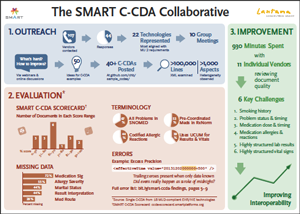
SMART C-CDA infographic -- click to enlarge2014 will see wide-scale production and exchange of Consolidated CDA documents among healthcare providers. Indeed, live production of C-CDAs is already underway for anyone using a Meaningful Use 2014 certified EHR.

C-CDA documents fuel several aspects of meaningful use, including transitions of care and patient-facing download and transmission.

This impending deluge of documents represents a huge potential for interoperability, but it also presents substantial technical challenges.

We forecast these challenges with unusual confidence because of what we learned during the SMART C-CDA Collaborative, an eight-month project conducted with 22 EHR and HIT vendors.

Our effort included analyzing vendor C-CDA documents, scoring them with a C-CDA scorecard tool we developed, and reviewing our results through customized one-on-one sessions with 11 of the vendors.

The problems we uncovered arose for a number of reasons, including:

  • material ambiguities in the C-CDA specification
  • accidental misinterpretations of the C-CDA specification
  • lack of authoritative “best practice” examples for C-CDA generation
  • Continue reading…

Ode to the Fat Man

Here is a sweeping generalization: When doctors write for the lay public they tend towards tiresome self-flagellation.

Samuel Shem’s House of God is an exception; a refreshing read.

Perhaps he wrote for physicians so he wrote with such open face honesty.

In today’s politically correct world, Shem would have been castigated as an ageist for his brilliant acronym, GOMER (Get out of My Emergency Room), for peri-ninety year olds with advanced dementia who are skirting that narrow zone between St. Peter’s Gate and fractured ribs post-CPR.

Time for a pronouncement for medical students: There are two things you must do before starting your internship. Pass your USMLEs and read House of God.

I have read Shem’s classic twice. I remember the Rules of House of God more reliably than I recall the names of the carpal bones.

My first read was a few days in to my internship in elderly care medicine. The hospital was a rickety establishment in Britain’s National Health Service, not quite the Best Medical School that Shem described. But I seemed to share the same clinical experiences as Roy Basch, Shem’s Gomer-phobic protagonist.

There was a deluge of Gomers on New Year’s Eve; the old practice of granny dumping. I had to justify admission by finding nitrates in their urine for suspected urinary tract infection (grandson attending New Year’s bash still does not have an ICD code), or the vaguest T wave changes on EKG (unstable angina is a useful bet in a 90 year old).

If medical taxonomy could not be clinically justified there was always “acopia.”

Shem was remarkably prescient.

Take rule 13:
“The delivery of good medical care is to do as much nothing as possible.”  This was before physicians were inserting stents through rock hard femoral arteries to give patients an aggregate of two extra hours of survival.

Basch’s elderly patients would do the best precisely because his caring was the least aggressive. He would occasionally forget to prepare them with laxatives for a barium enema, saving them from dehydration and its cascade.

If Shem realized in the seventies that nothing was more futile than an investigation leading to a futile treatment, God knows what he would have written today.

Continue reading…

The Pharmacies and Retailers Say They’re In. Is the Blue Button Initiative About to Change Everything?

The Obama administration announced significant adoption for the Blue Button in the private sector on Friday.

In a post at the White House Office of Science and Technology blog, Nick Sinai, U.S. deputy chief technology officer and Adam Dole, a Presidential Innovation Fellow at the U.S. Department of Health and Human Services, listed major pharmacies and retailers joining the Blue Button initiative, which enables people to download a personal health record in an open, machine-readable electronic format:

“These commitments from some of the Nation’s largest retail pharmacy chains and associations promise to provide a growing number of patients with easy and secure access to their own personal pharmacy prescription history and allow them to check their medication history for accuracy, access prescription lists from multiple doctors, and securely share this information with their healthcare providers,” they wrote.

“As companies move towards standard formats and the ability to securely transmit this information electronically, Americans will be able to use their pharmacy records with new innovative software applications and services that can improve medication adherence, reduce dosing errors, prevent adverse drug interactions, and save lives.”

While I referred to the Blue Button obliquely at ReadWrite almost two years ago and in many other stories, I can’t help but wish that I’d finished my feature for Radar a year ago and written up a full analytical report.

Extending access to a downloadable personal health record to millions of Americans has been an important, steady shift that has largely gone unappreciated, despite reporting like Ina Fried’s regarding veterans getting downloadable health information.

According to the Office of the National Coordinator for Health IT, “more than 5.4 million veterans have now downloaded their Blue Button data and more than 500 companies and organizations in the private-sector have pledged to support it.”

Continue reading…

PCMH Certification and Designing the Perfect Car

The Porsche Citroen 911Our clinic is now a Certified Patient-Centered Medical Home. The whole process leading up to this reminds me of one of my favorite subjects – buying cars. Specifically, buying cars based on technical specifications in color brochures. It takes real, on-the-road experience to know if a car is right for you.

When I moved to this country in 1981, I bought a 1980 Chevrolet Citation. Back in Sweden I had owned a Volvo wagon, but secretly admired the front-wheel-drive SAAB 900. Once in America, I figured I’d buy American. My wife’s relatives sent me car brochures to help me prepare for my choice of car.

The Citation sounded like America’s answer to the SAAB: a front-wheel-drive car with a powerful engine, quirky interior and a hatchback design. A car magazine at that time ran a comparison test between the Citation, the SAAB 900 and one of the German sports sedans, and the Citation almost won. I pretty much walked onto a used car lot and bought a silver Citation with red vinyl seats.

What does this have to do with PCMH certification?

Well, I bought a Citation based on a checklist of features that on paper made it look comparable to a SAAB. Once I owned it, I noticed the cracks between the door panels, the uneven paint and the awkward positioning of the controls, some of which felt like they could break if I wasn’t careful.

Not long afterward, I found myself hitting the front bumper on the pavement in sharp turns; I heard the rear shock absorbers snoring on dirt roads; I watched the dashboard dry out and crack in the temperate Maine summer weather, and I realized with the first frost that my car did’t have a rear defroster, and it never seemed to warm up in the winter.

Continue reading…

Is Obamacare Unraveling?

Rumors have been circulating in the marketplace all week that the administration was thinking of extending the individual health insurance policies that Obamacare was supposed to have cancelled for as much as three more years.

Those rumors have now come out into the open with Tom Murphy’s AP story on Friday.

That the administration might extend these polices shouldn’t come as a shock. My sense has always been that at least 80% of the pre-Obamacare policies would ultimately have to be canceled because of the administration’s stringent grandfathering rules that forced almost all of the old individual market into the new Obamacare risk pool.

But with the literal drop dead date for these old policies hitting by December 31, 2014, that would have meant those final cancellation letters would have had to go out about election day 2014. That would have meant that the administration was going to have to live through the cancelled policy nightmare all over again––but this time on election day.

The health insurance plans hate the idea of another three-year reprieve. They have been counting on the relatively healthy block of prior business pouring into the new Obamacare exchanges to help stabilize the rates as lots of previously uninsured and sicker people come flooding in.

With enrollment of the previously uninsured running so badly thus far, getting this relatively healthier block in the new risk pool is all the more important. The administration’s now doing this wouldn’t just be changing the rules; it would be changing the whole game.

Republicans, and a few vulnerable Democrats, had essentially called for this last fall when legislation was floated in both the House and Senate with the “If You Like Your Policy You Can Keep It,” proposals. At the time, the administration and Democratic leaders rightly said if this sort of thing would have been made permanent it would have a very negative impact on what people in the new pool would pay––and on their already high deductibles and narrow networks.

At the beginning of this post I asked, Is Obamacare unraveling?

First, as I have said before on this blog, the law’s reinsurance provisions will mean Obamacare can keep limping along for at least three years. And, even making this change won’t alter my opinion on this. It will just cost the government more reinsurance money to keep the carriers whole.

By asking if it is unraveling, what I really wonder about is the whole sense of fairness in the law and the expectation that everybody needs to get the Democrat’s definition of “minimum benefits” whether they want them or not.

Continue reading…

Don’t Be Fooled, Prospects for Long-Term SGR Fix Still Dim

In light of Thursday’s bicameral, bipartisan release of a Medicare physician payment policy to permanently replace the Sustainable Growth Rate (SGR) formula – an achievement to be celebrated in its own right – some are seeing momentum toward passage of such a deal before the current doc fix  expires on March 31.

But the scope of what the committees issued Thursday represents as much of a step back as a step forward, at least relative to their aspirations and timeline for accomplishing them.

Once the appointment of Senator Baucus to be Ambassador to China was announced, the committees agreed to make it “as far as they could” toward a comprehensive SGR replacement policy prior to his confirmation, including identifying offsets to pay for the $125-150 billion (over 10 years) bill. For those who missed it, Senator Baucus was confirmed on Thursday.

Only in the past week did the key committees acknowledge that achieving agreement on offsets by this deadline was unattainable, but finalization of the so-called “extenders,” a hodge podge of Medicare payment plus-ups and other polices perennially included with the doc fix, was still the goal.

(Recall that the Senate Finance Committee passed an SGR replacement bill with extenders in December, but their House counterparts have yet to do so.)

In negotiations on that extenders element, House Republican leads reportedly would not agree to include beneficiary-oriented policies, such as funding for outreach to Medicare enrollees regarding low-income subsidy programs and for Family-to-Family Health Information Centers.

While some Democrats involved in the talks may have been inclined to make this concession, others sharply objected, scuttling a deal on this front and demonstrating the difficulty of compromise on this relatively non-controversial topic.

Furthermore, and has always been the assumption, identifying offsets for the package continues to be an exponentially heavier lift than any other aspect of the process. On that front, the key camps have outlined their broad parameters for what they might accept.

House Republican leads desire and likely require meaningful cuts to ACA-related spending as well as a substantial balance of Medicare beneficiary-impacting cuts, such as those relating to premiums and coinsurance.

Continue reading…

Too Many American Physicians Or Too Few?

The goal of the Affordable Care Act, also known as “Obamacare,” is to make affordable, quality health care coverage available to more Americans. But how many physicians will America need to satisfy this new demand?

The debate over doctor supply rages on with very little conclusive evidence to prove one case or the other.

Those experts who see a shortage point to America’s aging population – and their growing medical needs – as evidence of a looming dearth in doctors. Many suggest this shortage already exists, particularly in rural and inner city areas. And still others note America maintains a lower ratio of physicians compared to its European counterparts.

This combination of factors led the American Association of Medical Colleges to project a physician shortage of more than 90,000 by 2020.

On the other side of the argument are health policy experts who believe the answer isn’t in ratcheting up the nation’s physician count. It’s in eliminating unnecessary care while improving overall productivity.

The solution, they say, exists in the shift away from fee-for-service solo practices to more group practices, away from manually kept medical records to electronic medical records (EMR), and away from avoidable office visits to increased virtual visits through mobile and video technologies. Meanwhile, they note physicians could further increase productivity by using both licensed and unlicensed staff, as well as encouraging patient self-care where appropriate.

The Doctor Divide: Global And Domestic Insights

Among the 34 member countries of the Organization for Economic Co-operation and Development (OECD), the U.S. ranks 30th in total medical graduates and 20th in practicing physicians per 1,000 people.

Despite these pedestrian totals, there is one area where the U.S. dominates. It ranks first in the proportion of specialists to generalists – and there’s not a close second.

These figures don’t resolve the debate on America’s need for physicians but they do reveal an important rift in the ratio of U.S. specialists to primary care practitioners.

Continue reading…

Uber for Health Care?? Not So Much.

Let’s get the disclaimer out of the way:

We love Uber.

As physicians with roots in the Bay Area, we use Uber all the time. The service is convenient, (usually) swift and consistently pleasant. With a few taps of a smartphone, we know where and when we’ll be picked up — and we can see the Uber driver coming to get us in real time.

When the vagaries of San Francisco public transit don’t accommodate our varying schedules, it’s Uber that’s the most reliable form of transportation. (It might be that we like having some immediate gratification.)

So when we caught wind of the news that Uber’s founding architect, Oscar Salazar, has taken on the challenge of applying the “Uber way” to health care delivery, there was quite a bit to immediately like. From our collective vantage point, Uber’s appeal is obvious. When you’re feeling sick, you want convenience and immediacy in your care — two things Uber has perfected.

And who wouldn’t be excited by the idea of keeping patients out of overcrowded emergency rooms and urgent care waiting rooms? The concept of returning those patients to their homes (where they can then be evaluated and receive basic care) seems so simple that it’s brilliant.

Continue reading…

assetto corsa mods